Schwa Sound Worksheets
About This Worksheet Collection
This collection of Schwa Sound Worksheets offers teachers a wide range of activities that make one of English's trickiest phonics concepts far more accessible. Through word hunts, riddles, story passages, and vowel identification tasks, students encounter the schwa in multiple contexts, allowing them to see how often and how subtly it appears in everyday reading. The varied formats support whole-group lessons, independent practice, literacy centers, and intervention settings, giving educators flexible tools for reinforcing this essential decoding skill.
Across the collection, learners strengthen their understanding of syllable stress, vowel reduction, and multisyllabic word reading. Students practice identifying, labeling, spelling, and applying schwa patterns in meaningful ways, helping them build fluency and vocabulary knowledge. These worksheets also promote careful analysis of word structure-an important stepping stone toward more confident, accurate reading and writing.
Detailed Descriptions Of These Worksheets
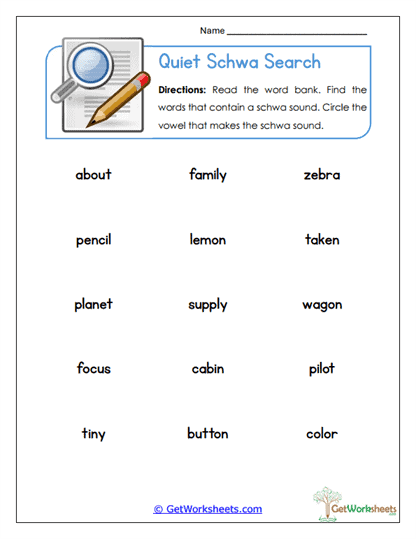
Quiet Schwa Search
Students examine a word bank to spot entries containing the schwa sound, prompting them to pay close attention to subtle vowel pronunciations. As they circle the vowel responsible for the reduced sound, they heighten their awareness of how stress shifts influence vowel quality. This carefully structured search strengthens decoding accuracy and builds comfort with multisyllabic words.
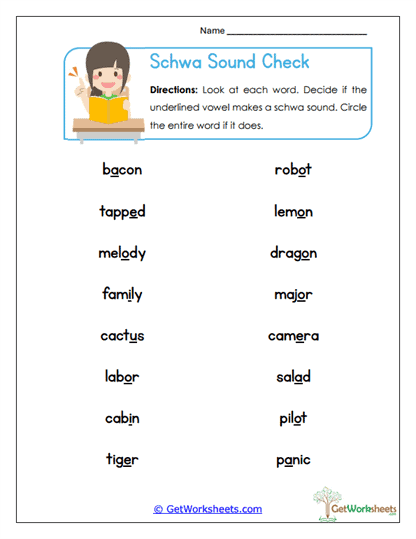
Sound Check
This worksheet invites learners to decide whether an underlined vowel represents a schwa, encouraging thoughtful comparison between stressed and unstressed syllables. Students circle the entire word when the vowel is pronounced as a schwa, reinforcing auditory discrimination and visual pattern recognition. By evaluating real words, they refine both phonics skills and vocabulary understanding. It also supports students as they encounter increasingly complex academic terms.
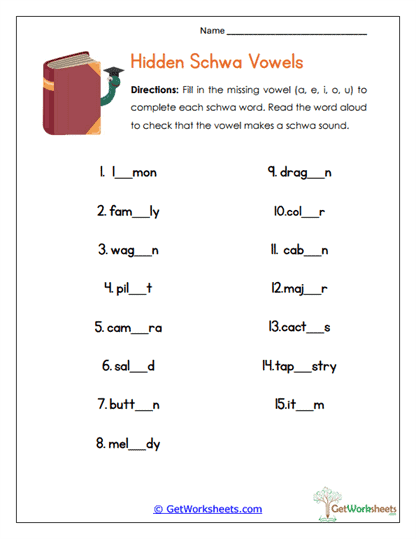
Hidden Vowels
Students supply the missing vowel in each word and then read the completed term aloud to verify the reduced sound. This exercise highlights how any vowel can take on a schwa quality depending on syllable stress. Learners also become more familiar with spelling patterns found in multisyllabic words. The activity builds both confidence and accuracy in reading and writing longer vocabulary items.
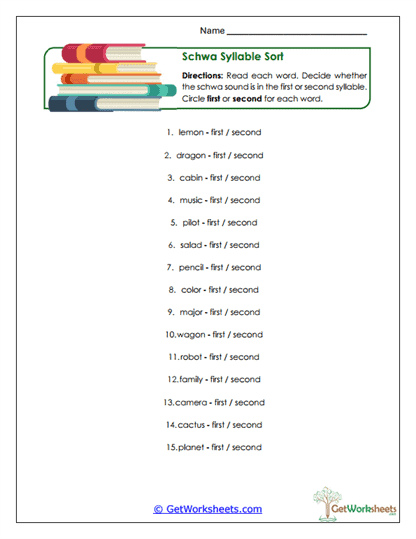
Syllable Sort
Learners identify whether the schwa appears in the first or second syllable of each word, prompting them to evaluate stress and rhythm. The work encourages students to think about pronunciation holistically rather than relying solely on spelling. As they sort, they strengthen their fluency and develop an intuitive sense of English syllable structure.
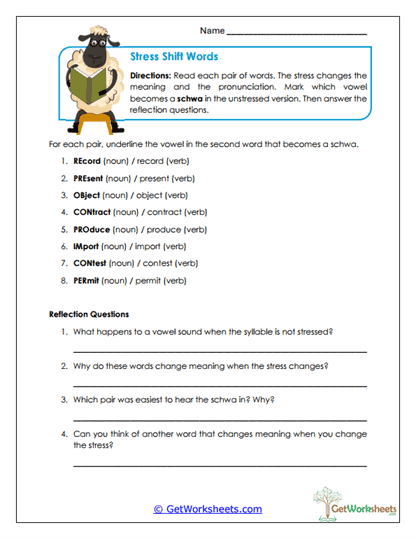
Stress Shift Words
Students compare pairs of words whose stress patterns change meaning and pronunciation, guiding them to notice how unstressed syllables often produce a schwa. This side-by-side analysis deepens students' awareness of word structure and semantic nuance. The reflective questions allow them to articulate what they observe and apply their understanding to new vocabulary. It provides a powerful bridge between phonics and morphology.
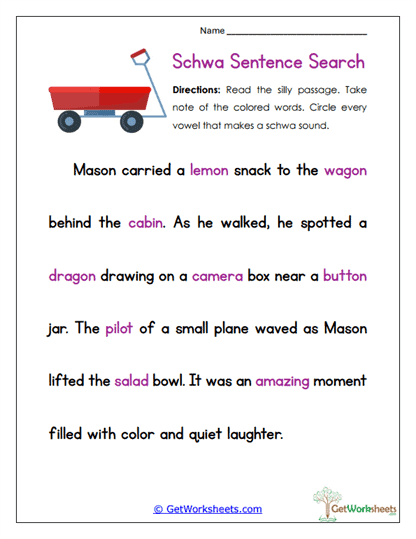
Sentence Search
In this activity, learners read a playful passage filled with schwa examples and circle all vowels that produce the reduced sound. Working within context helps students connect phonics skills to real reading experiences. The exercise enhances fluency while reinforcing instant recognition of unstressed syllables. Reading the passage aloud can further support accuracy and rhythm.
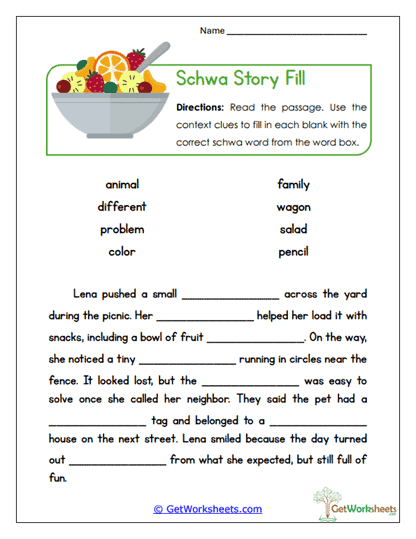
Story Fill
Students use context clues to choose the correct schwa words for the blanks in a short story, blending phonics with comprehension. This process reinforces vocabulary recall and encourages careful reading. Learners also see how schwa words function naturally within connected text, strengthening decoding skills. The engaging narrative structure supports student motivation.
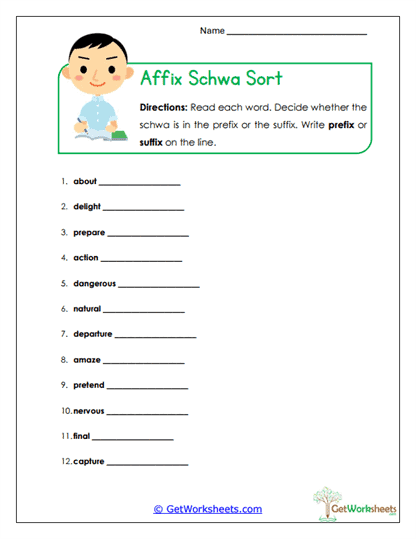
Affix Schwa Sort
Students determine whether the schwa appears in the prefix or suffix of each word, prompting deeper attention to morphological structure. This approach builds awareness of how affixes influence pronunciation and meaning. Learners gain greater comfort reading longer academic vocabulary. It also supports spelling accuracy by highlighting predictable patterns in word formation.
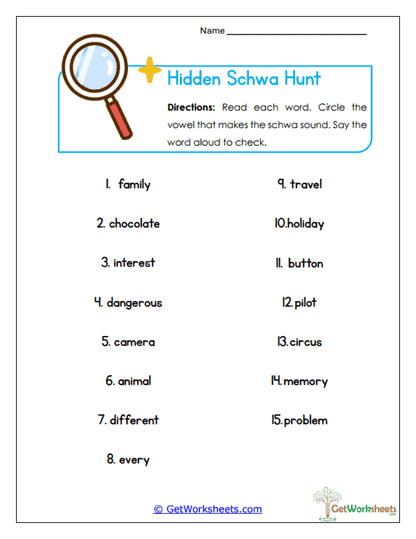
Hidden Hunt
Students examine each word closely and circle the vowel that represents the schwa, sharpening their visual scanning and auditory discrimination skills. They become more adept at recognizing reduced vowels in multisyllabic terms. This repeated practice reinforces automaticity and supports more fluent reading overall. It is a useful tool for developing confident word analysis habits.
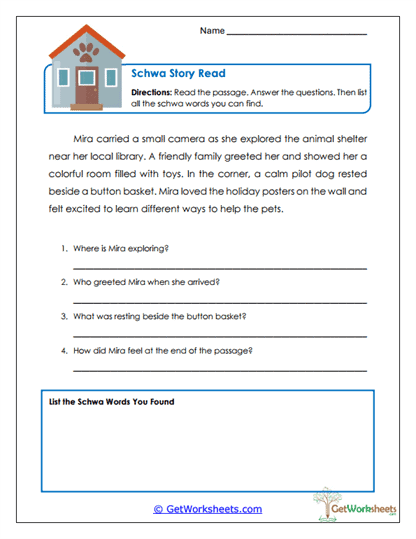
Story Read
Students read a passage, answer comprehension questions, and then list all schwa words they find, integrating decoding with higher-level thinking. This combination of tasks strengthens fluency and encourages close reading. Identifying schwa examples afterward allows students to reflect on how vowel reduction appears in authentic text. The multi-step structure builds comprehension, vocabulary, and phonics skills simultaneously.
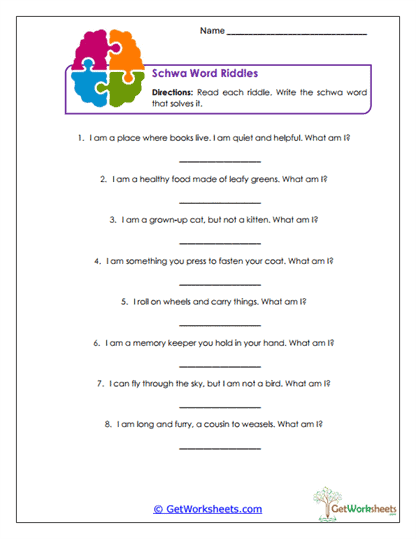
Word Riddles
Learners solve playful riddles whose answers are common schwa-containing words, adding an enjoyable twist to phonics practice. The clues prompt students to think about meaning, context, and sound all at once. This puzzle-like approach strengthens vocabulary recall and pronunciation awareness. Through engaging problem-solving, students deepen their understanding of reduced vowels.
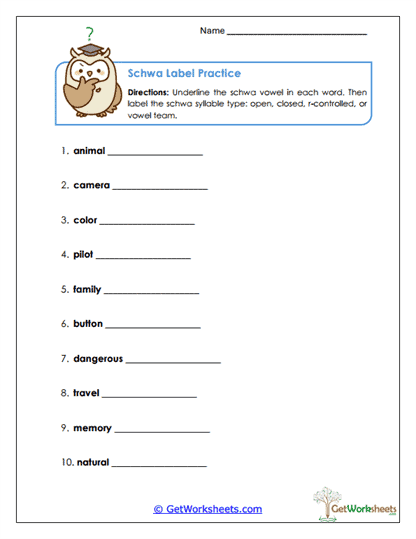
Label Practice
Students underline the vowel producing the schwa sound and then classify each word's syllable type, encouraging a thorough examination of structure and pronunciation. This dual step builds mastery of both phonics patterns and syllable identification. Learners also discover how the schwa appears across open, closed, r-controlled, and vowel team syllables. The activity supports more accurate decoding and spelling of multisyllabic words.

Bookmark Us Now!
New, high-quality worksheets are added every week! Do not miss out!