CVCe (Silent E) Patterns Worksheets
About This Worksheet Collection
This CVCe (Silent E) Patterns Worksheet Collection introduces early readers to the powerful role of the silent e in transforming short-vowel CVC words into long-vowel CVCe words. Through picture matching, riddles, cloze reading, rhyming, and word-building activities, learners experience how adding or recognizing a final e changes both pronunciation and meaning. These worksheets provide a developmentally appropriate bridge from simple short-vowel decoding to more advanced long-vowel phonics skills.
Across the collection, students practice identifying long-vowel patterns, distinguishing CVC from CVCe words, generating their own long-vowel vocabulary, and applying the silent e rule in context. They also strengthen comprehension, spelling accuracy, and morphological awareness as they encounter long-vowel words within stories and sentence-level tasks. Collectively, these activities build confident, flexible readers who can decode, analyze, and use CVCe words with growing fluency.
Detailed Descriptions Of These Worksheets
Making CVCe Words
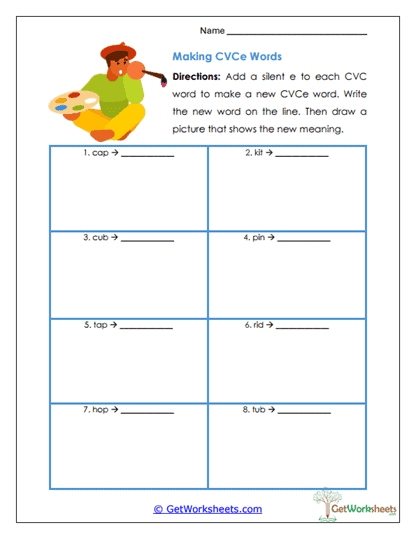
Students begin with a short-vowel CVC word and add a silent e to create a new long-vowel form. They write the updated word and illustrate its meaning, reinforcing comprehension and phonics simultaneously. This activity highlights how the silent e changes vowel sound and word meaning. It also strengthens encoding skills through meaningful word transformation.
Silent E Matchups
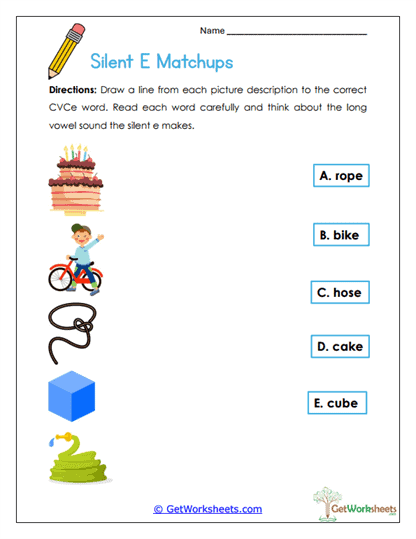
Learners match pictures to their corresponding CVCe words such as cake, rope, and cube. This supports recognition of long-vowel patterns and strengthens picture-word association. Students practice decoding by analyzing spelling structure and vowel cues. The matching format encourages accuracy and careful attention to details in both words and images.
Search Highlights
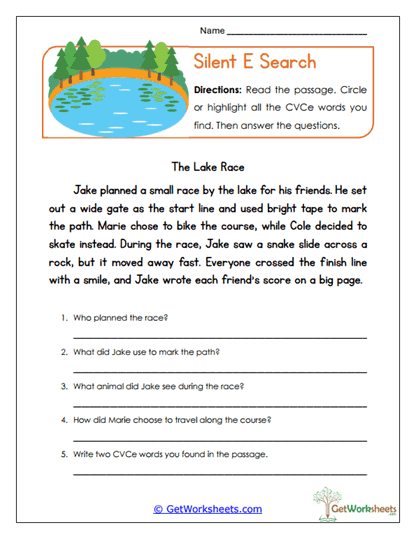
Students read a passage, circle all CVCe words, and answer comprehension questions about the text. This reinforces phonics skills within connected reading, helping students apply long-vowel decoding while understanding story details. Highlighting patterns strengthens visual recognition of the silent e structure. The integrated questions support vocabulary and comprehension development.
Choose the CVCe
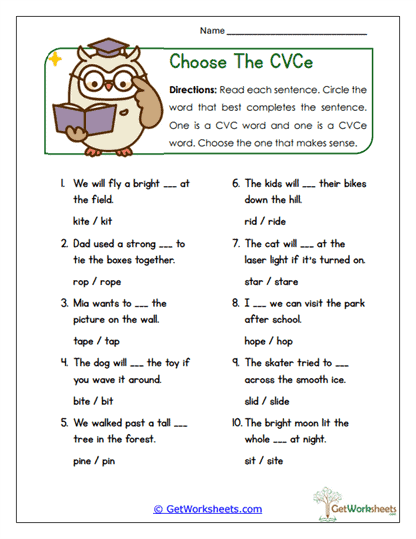
Students read sentences and decide whether a CVC or CVCe word best completes the meaning. This requires them to distinguish short- and long-vowel patterns while considering sentence context. The task strengthens decoding and vocabulary reasoning. It also encourages close reading as students evaluate which form fits grammatically and semantically.
Phonological Rhymes
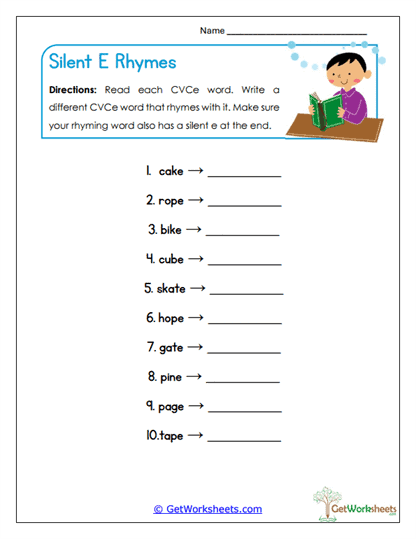
Learners write a rhyming partner for each given CVCe word, focusing on long-vowel endings. This activity builds phonological awareness by highlighting shared spelling patterns. Students expand vocabulary and practice generating words that follow consistent silent e structures. Rhyming also supports spelling intuition and pattern recognition.
Spot the Real CVCe
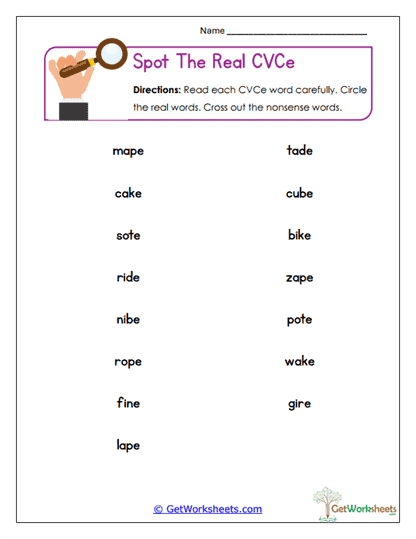
Students analyze a list of words and circle the real CVCe forms while crossing out the nonsense ones. This strengthens decoding accuracy and helps learners discriminate between valid and invalid long-vowel spellings. The task reinforces phonics understanding as students evaluate letter patterns. It also builds confidence with recognizing authentic vocabulary.
Fill-Ins
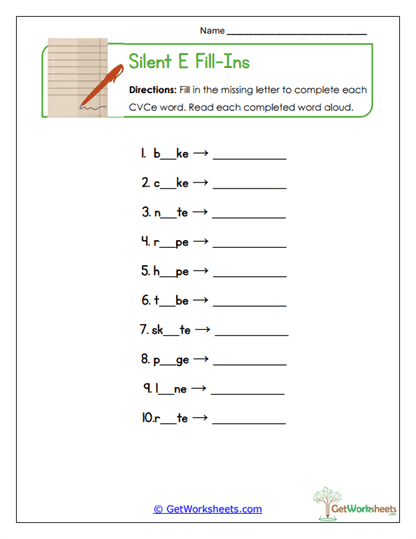
Students supply missing letters to complete CVCe words, then read them aloud for fluency practice. This reinforces long-vowel spelling conventions and strengthens encoding skills. Completing partial words supports vowel recognition and understanding of silent e structure. It also helps learners develop accuracy in forming meaningful vocabulary.
CVCe Riddles
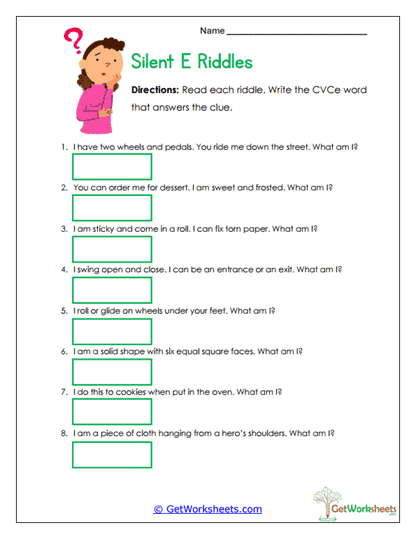
Learners solve riddles that each describe a CVCe word, such as bike or tape. This encourages inferential thinking while reinforcing phonics application. Students rely on meaning, structure, and long-vowel knowledge to answer correctly. The riddle format keeps the activity engaging and builds vocabulary flexibility.
Silent Answers
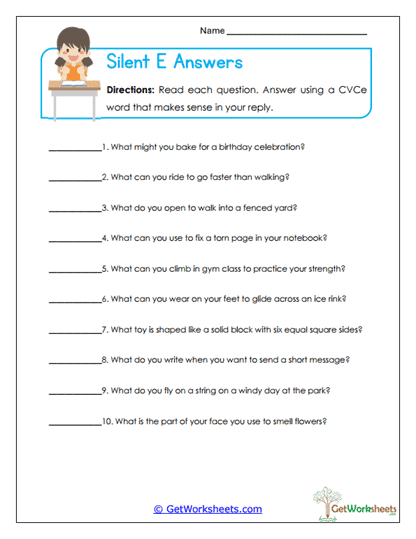
Students respond to questions using a CVCe word that fits each prompt. This promotes expressive vocabulary use and requires learners to think critically about which long-vowel word best completes the answer. Generating their own examples deepens understanding of CVCe patterns. The activity builds written expression and decoding confidence.
Adding Endings
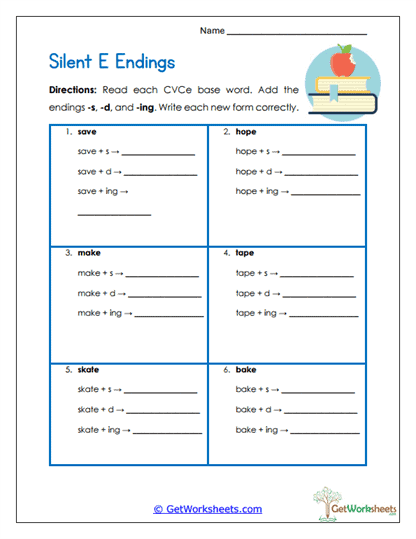
Learners attach -s, -d, and -ing to CVCe base words, observing how inflectional endings interact with the silent e. This strengthens spelling rules and morphological awareness. Students create forms like take → takes, took, taking or make → makes, made, making. The task supports grammatical understanding and accurate application of word endings.
CVCe Coloring Sort
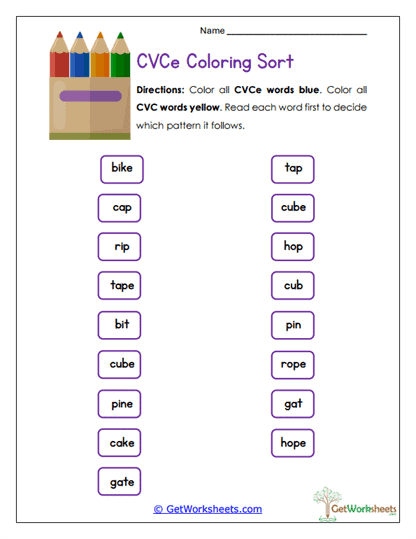
Students sort words by coloring CVCe patterns blue and CVC patterns yellow. This helps learners visually distinguish long- versus short-vowel structures. The color-coding approach reinforces spelling analysis and phonics discrimination. It also supports vocabulary categorization and pattern recognition.
Fill Up Cloze
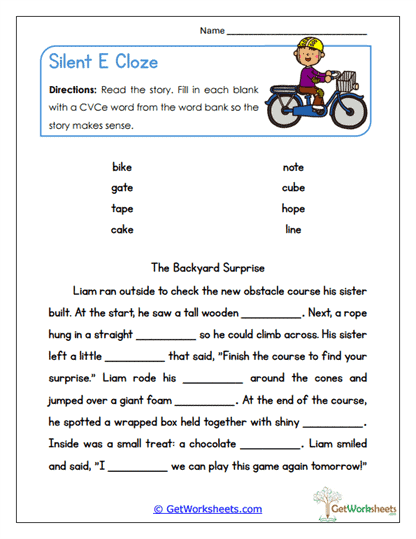
Students complete a story by choosing the correct CVCe word from a word bank. They rely on context clues and phonics knowledge to select words like gate, note, or cube. This activity integrates comprehension with long-vowel decoding practice. Completing the passage strengthens vocabulary, fluency, and meaningful word usage in connected text.

Bookmark Us Now!
New, high-quality worksheets are added every week! Do not miss out!