CVC Patterns Worksheets
About This Worksheet Collection
This collection of CVC Patterns Worksheets provides young readers with rich opportunities to practice decoding, blending, and identifying simple consonant-vowel-consonant words-an essential foundation for early literacy. Through picture matching, rhyming, riddle solving, word building, and short connected-text reading, students encounter CVC patterns in multiple, meaningful formats. The activities balance phonics skill-building with engaging tasks that help learners connect spoken sounds to printed words.
As students work through the worksheets, they develop stronger phonemic awareness, improve spelling accuracy, and build fluency with short vowel patterns. They practice blending onsets and rimes, distinguishing real words from nonsense, identifying vowel sounds, and using CVC words within sentences or stories. These experiences deepen decoding confidence and support learners as they transition from letter-sound understanding to independent reading.
Detailed Descriptions Of These Worksheets
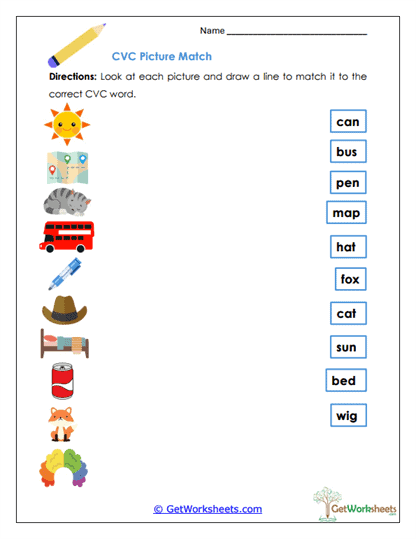
Picture Match
Students match each picture to its corresponding CVC word by drawing connecting lines. This reinforces early decoding skills as learners associate printed words with familiar images. The task encourages careful visual discrimination among similar word patterns. It also builds fluency by strengthening recognition of basic vocabulary.
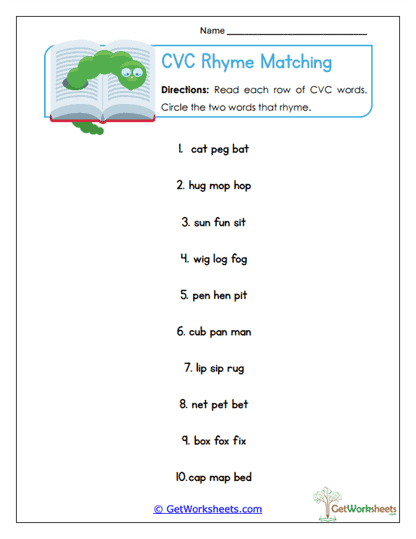
Rhyme Matching
Learners read sets of CVC words and circle the two that rhyme. This supports phonological awareness by drawing attention to shared ending sounds and vowel patterns. Students develop stronger short-vowel recognition as they compare words. The activity builds early reading fluency through repeated exposure to patterned vocabulary.
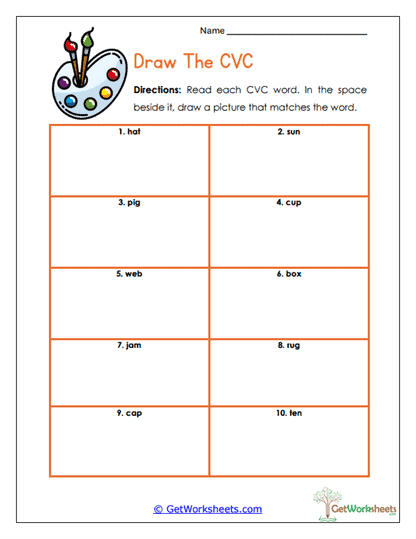
Draw the CVC
Students illustrate each CVC word in the blank space beside it. This deepens comprehension by requiring learners to interpret meaning and visually represent vocabulary. Drawing reinforces memory and strengthens word-picture association. Sounding out each word supports decoding practice.
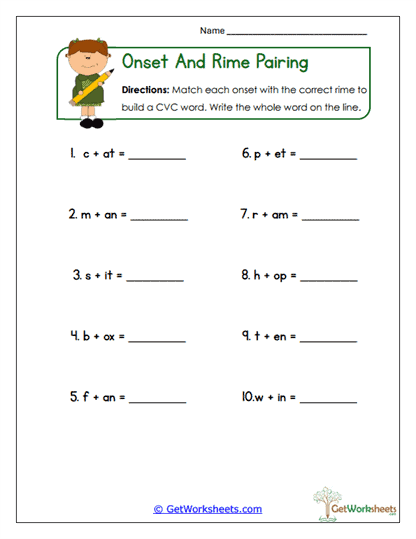
Onset and Rime Pairing
Learners blend given onsets and rimes to create complete CVC words, then write them on the line. This introduces students to the structure of word parts and strengthens blending ability. The predictable patterns support decoding accuracy. It also builds confidence with constructing simple words independently.
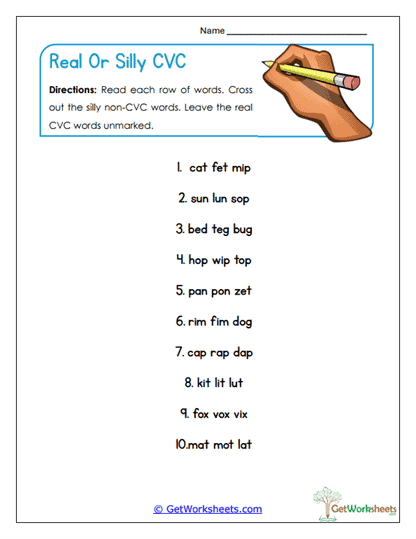
Real or Silly CVC
Students cross out nonsense words while leaving real CVC words unmarked. This encourages careful analysis of word structure and promotes accurate decoding. Distinguishing real vocabulary from invented forms boosts phonics understanding. The task supports fluent word recognition and critical evaluation.
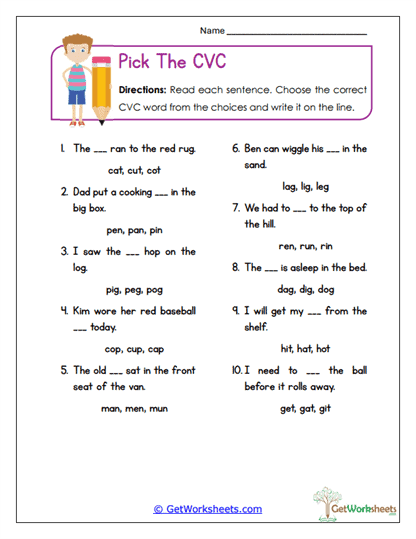
Pick the CVC
Learners read short sentences and select the correct CVC word from three options. This integrates phonics with comprehension as students choose words that make sense in context. It encourages attention to sentence meaning and grammatical fit. Writing the chosen word reinforces spelling and usage.
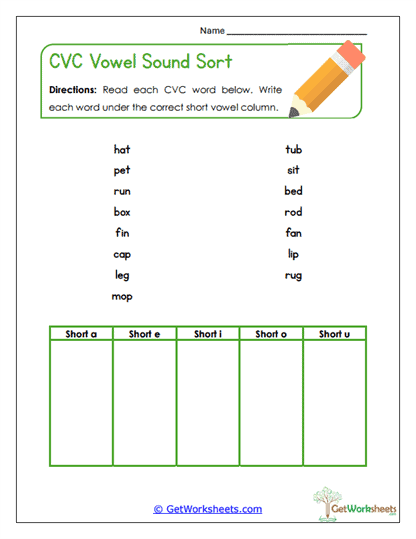
Vowel Sound Sort
Students sort CVC words into categories based on their short vowel sound. This strengthens vowel discrimination and supports mastery of core phonics concepts. Sorting improves decoding fluency and pattern recognition across word families. The structured layout helps learners visualize vowel patterns clearly.
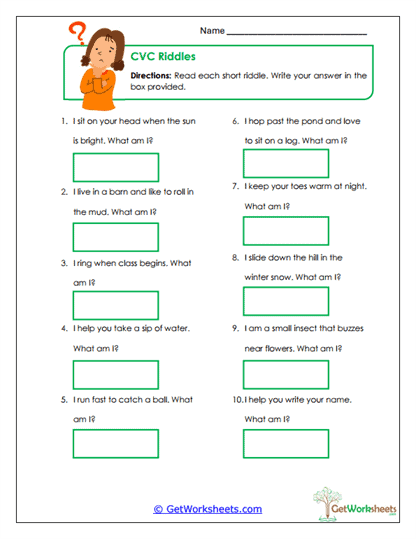
Riddles
Learners solve short riddles by identifying the correct CVC word for each clue. This encourages inferential thinking while reinforcing phonics skills. Students connect meaning, sound, and structure to generate answers. The riddle format boosts engagement and vocabulary understanding.
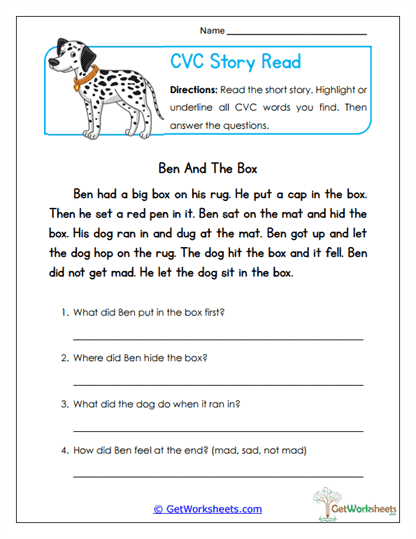
Story Read
Students read a short story featuring multiple CVC words, underline them, and answer comprehension questions. This blends phonics practice with reading comprehension and pattern recognition. Identifying CVC words in context strengthens decoding fluency. Follow-up questions build understanding of story events and details.
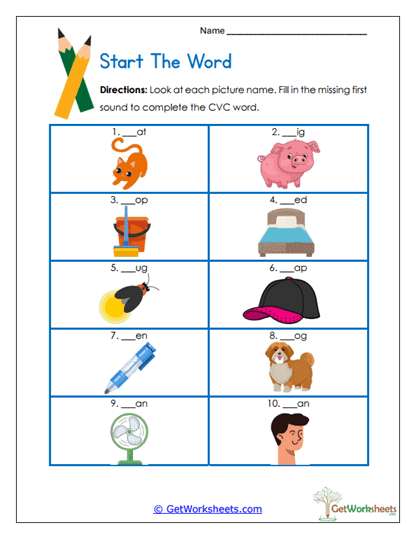
Start the Word
Learners look at each picture and supply the missing initial consonant to complete the CVC word. This builds phonemic awareness by focusing on beginning sounds. It reinforces picture-word connections and spelling accuracy. Students gain confidence constructing full words from partial prompts.
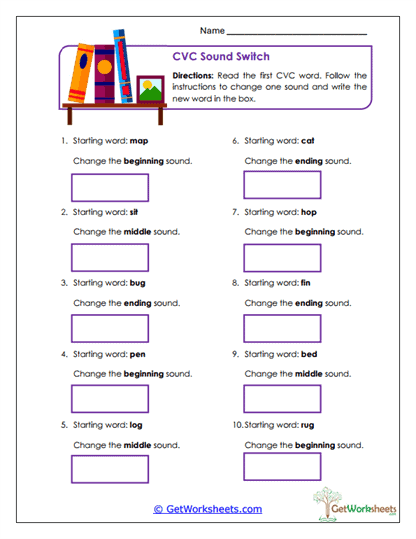
Sound Switch
Students modify given CVC words by changing the beginning, middle, or ending sound as directed. This develops strong phonemic manipulation skills and supports flexible decoding. Writing the new words reinforces encoding and sound-symbol understanding. The activity helps learners become confident word builders.
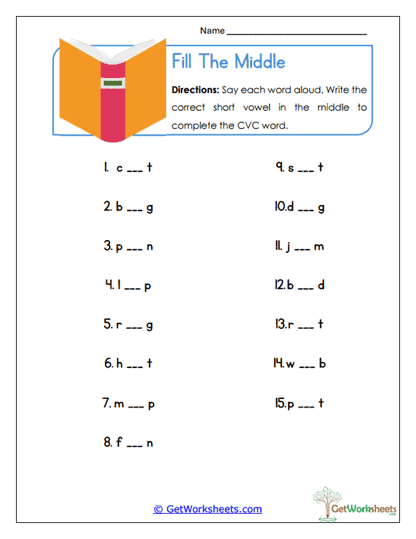
Fill the Middle
Students supply the missing short vowel to complete each CVC word. This focuses attention on vowel sounds, which are often challenging for early readers. Determining which vowel forms a real word strengthens decoding and spelling accuracy. The task builds fluency with simple word structures and enhances vocabulary recognition.

Bookmark Us Now!
New, high-quality worksheets are added every week! Do not miss out!