Integer Jumps
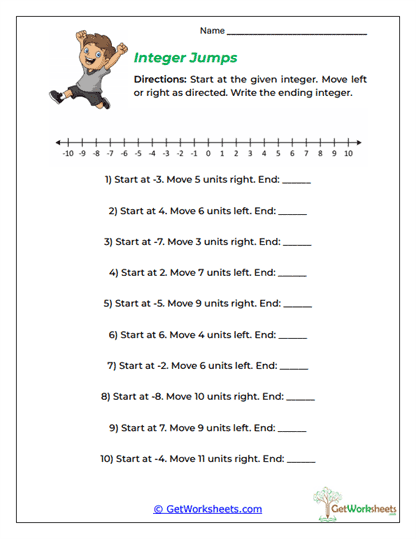
This worksheet helps students practice one of the most useful ways to understand integers: physically moving along a number line. Each problem gives students a starting integer and tells them to move a certain number of units either left or right. Students then write the integer where they land. Problems include directions such as starting at -3 and moving 5 units right, starting at 4 and moving 6 units left, or starting at -8 and moving 10 units right. Because many of the moves cross through zero, students get meaningful practice working between negative and positive values instead of staying on only one side of the number line.
For a parent who may not remember the formal integer rules, this worksheet is very easy to explain because it works like walking on a sidewalk. The starting integer tells the child where to stand. Moving right makes the number larger. Moving left makes the number smaller. So if a student starts at -3 and moves 5 spaces right, they count -2, -1, 0, 1, 2 and land on 2. No complicated rule has to be memorized first-the number line shows exactly what is happening.
Learning Goals
- Move Right to Greater Integers: Students understand that rightward movement increases a number.
- Move Left to Smaller Integers: Learners connect leftward movement with decreasing values.
- Cross Zero Correctly: Students practice moving from negative to positive numbers and from positive to negative numbers.
- Count Units Accurately: Learners distinguish between counting spaces moved and counting starting points.
- Build a Foundation for Integer Operations: Number-line movement prepares students to understand addition and subtraction with signed numbers.
Parent-Friendly Teaching Tips
Use the same routine on every problem:
- Find the starting number.
- Look at the direction.
- Move one space at a time.
- Count exactly the number of units requested.
- Write the number where you land.
For example:
Start at 4. Move 6 units left.
Count:
3, 2, 1, 0, -1, -2
The ending integer is -2.
Another example:
Start at -8. Move 10 units right.
The student passes through zero and lands on 2.
Why This Worksheet Helps
- Makes Integer Change Visible: Students see why a number increases or decreases.
- Reduces Sign Confusion: Rather than memorizing abstract rules, children can follow a direction they understand.
- Strengthens Zero Crossing: Moving across zero is a major source of difficulty for many students, and this page gives repeated practice.
- Supports Later Addition and Subtraction: Rightward movement naturally connects to adding positive values, while leftward movement connects to decreasing values.
- Builds Confidence: Students have a visual method they can fall back on when mental rules feel confusing.
Classroom & Home Use
- Excellent for Beginners: This worksheet works especially well before students are expected to solve integer operations mentally.
- Easy for Parents to Support: The directions require no specialized math vocabulary.
- Great for Hands-On Practice: Families or teachers can make a floor number line and have students physically walk the moves.
- Useful for Intervention: Students who struggle with signs often understand movement much more easily.
- Strong for Review: The page reinforces number-line location, order, direction, and distance all at once.
The real value of this worksheet is that it helps students understand integers as movement and position, not just numbers with plus and minus signs attached. Negative integers, positive integers, zero, direction, distance, and number-line order all work together. For parents, the best coaching language is simply: “Where do you start, which way do you move, and where do you land?” In classroom and homeschool settings, this activity gives students a strong visual foundation for the integer addition and subtraction rules they will use later.
Bookmark Us Now!
New, high-quality worksheets are added every week! Do not miss out!