Integer Elevator
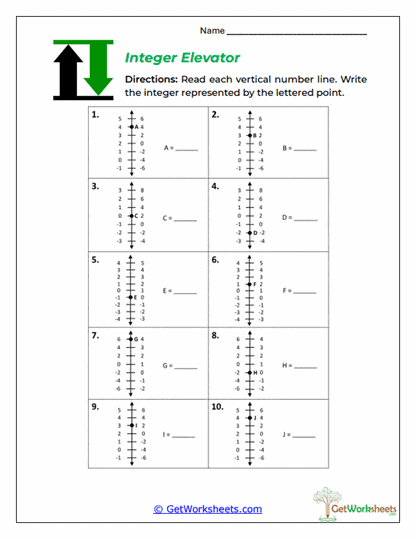
This worksheet gives students another way to work with integers by using vertical number lines. Each problem shows a vertical scale with a marked point labeled by a letter, and students must determine the integer represented by that location. Instead of moving left and right as they do on a regular horizontal number line, students read values by moving up and down. The activity strengthens integer location, vertical scale reading, positive and negative number sense, zero as a reference point, and preparation for coordinate graphing.
For a parent, the easiest comparison is an elevator in a building. Ground level can be thought of as zero. Floors above ground are positive, and levels below ground are negative. As the elevator goes up, the numbers get greater. As it goes down, the numbers get smaller. That is exactly how these vertical number lines work.
Key Learning Objectives
- Read Vertical Integer Scales: Students identify the value of each marked point.
- Understand Upward and Downward Order: Learners recognize that values increase as they move up and decrease as they move down.
- Use Zero as the Middle Reference: Students locate points relative to zero.
- Interpret Negative Positions: Learners correctly read values below zero.
- Prepare for the Coordinate Plane: The vertical y-axis follows the same increasing-upward pattern.
Parent-Friendly Explanation
A simple rule is:
“Up means greater; down means smaller.”
If a marked point is:
- 4 spaces above zero → the value is positive 4.
- 2 spaces below zero → the value is -2.
- exactly at zero → the value is 0.
If the child gets confused, imagine an elevator:
- Floor 3 is above ground.
- Level -2 is two floors below ground.
- Ground level is 0.
That gives the numbers a physical meaning.
Why This Worksheet Helps
- Builds Flexible Number-Line Understanding: Students learn that number lines do not always run horizontally.
- Supports Coordinate Geometry: The vertical axis on a graph works in the same direction.
- Connects to Real-Life Scales: Elevators, thermometers, and elevation charts often use vertical arrangements.
- Strengthens Negative Number Sense: Students see negative values physically below zero.
- Encourages Spatial Reasoning: Learners interpret position as well as number.
Classroom & Home Use
- Great Before Introducing the y-Axis: This worksheet creates a natural bridge to ordered pairs and coordinate planes.
- Easy for Parents to Explain: The elevator comparison is simple and memorable.
- Helpful for Visual Learners: Up-and-down positioning makes integer order easier to see.
- Good for Intervention: Students who understand horizontal lines but struggle with vertical ones get focused practice.
- Useful for Real-World Connections: The page can be connected to floors in a building or elevation above and below ground.
The real value of this worksheet is that it teaches students that integer order stays consistent even when the number line is turned upright. Positive integers, negative integers, zero, vertical position, and number-line order all work together. For parents, the best reminder is: “Going up makes the number bigger; going down makes it smaller.” In classroom and homeschool settings, this worksheet strengthens integer understanding while also preparing students for graphing on vertical axes.
Bookmark Us Now!
New, high-quality worksheets are added every week! Do not miss out!