Scale Search
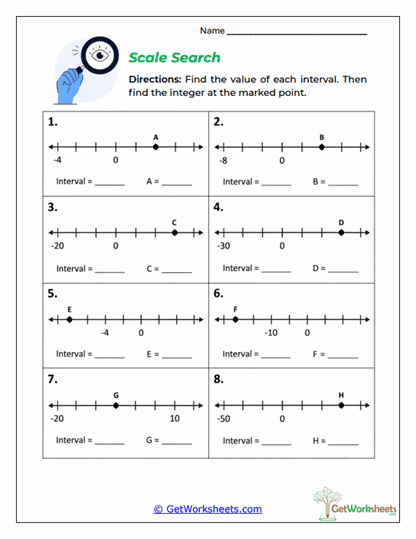
This worksheet teaches students an important number-line skill that is easy to overlook: figuring out what each tick mark is worth before trying to read the point. Each problem shows a number line with only some values labeled, and students must first determine the interval between marks and then use that interval to identify the integer represented by the marked point. Some lines count by small amounts, while others use much larger jumps, so students cannot assume that every tick mark means “one more.” The activity strengthens scale reading, skip counting, integer patterns, number-line interpretation, and careful mathematical observation.
For a parent who has not worked with scaled number lines in a long time, the most important thing to remember is that the little tick marks do not always count by ones. Before worrying about the marked point, look at two numbers that are already labeled and ask how many equal spaces lie between them. That tells you how much each step is worth. Once the child knows the interval, reading the point becomes much easier.
Learning Goals
- Determine the Interval: Students figure out how much the number changes from one tick mark to the next.
- Read Scaled Number Lines: Learners understand number lines that count by values larger than one.
- Find Marked Integers: Students use the discovered scale to identify each labeled point.
- Skip Count with Positive and Negative Values: Learners extend patterns across zero and through negative integers.
- Check for Equal Spacing: Students recognize that equal visual spaces represent equal numerical changes.
Parent-Friendly Teaching Tips
Have the child solve each problem in two separate steps.
First ask:
“What is each jump worth?”
Then ask:
“What number is the marked point sitting on?”
For example, suppose one labeled tick is -20 and another several equal spaces away is 0. If there are four equal jumps between them, each jump is worth 5:
-20, -15, -10, -5, 0.
If the marked point is two more ticks to the right, students continue:
5, 10.
So the point would represent 10.
The important part is to find the scale before naming the point.
Why This Worksheet Helps
- Stops Students from Assuming Every Tick Equals One: This is a common mistake when number lines become more advanced.
- Builds Graph-Reading Skills: Charts and coordinate axes frequently use intervals such as 2, 5, 10, or larger values.
- Strengthens Skip Counting: Students practice moving through integer patterns efficiently.
- Encourages Careful Observation: Learners have to inspect the labels rather than rush straight to the point.
- Prepares for Data and Algebra: Reading scales accurately becomes important in graphs, statistics, science, and coordinate geometry.
Classroom & Home Use
- Great for Guided Practice: Teachers or parents can model how to find the interval on the first problem.
- Helpful for Students Who Rush: The two-step structure encourages slower, more accurate reading.
- Useful for Graphing Preparation: Scaled axes appear throughout middle-school math.
- Good for Homework: Parents can easily check the interval before checking the marked value.
- Strong for Homeschooling: Families can draw extra number lines with different scales for continued practice.
The real value of this worksheet is that it teaches students not to take a number line at face value. They need to understand the scale before they can correctly interpret the point. Intervals, skip counting, negative integers, positive integers, zero, and number-line reading all work together. For parents, the best question is: “Before we read the point, what does each tick mark mean?” In classroom and homeschool settings, this worksheet develops the careful scale-reading habits students will need for graphs, coordinate planes, and more advanced math.
Bookmark Us Now!
New, high-quality worksheets are added every week! Do not miss out!