Upward Integers
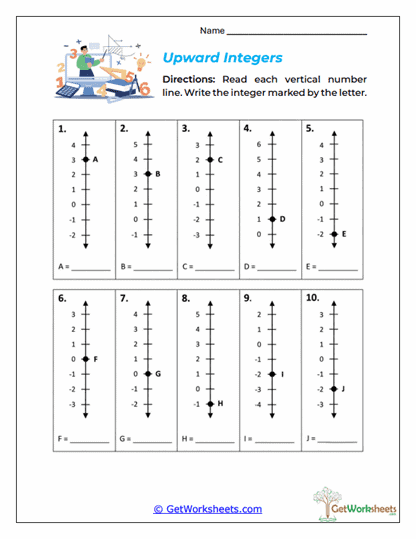
This worksheet helps students practice reading integers on vertical number lines, which is a useful change from the usual left-to-right format. Each mini number line has a marked point labeled with a letter, and students must determine the integer represented by that point. The values include positive numbers, negative numbers, and zero, so students learn that the same integer ideas still apply even when the number line is standing upright. The activity strengthens number-line reading, positive and negative integer recognition, zero as a reference point, vertical scale interpretation, and spatial number sense.
For a parent, the easiest way to explain a vertical number line is to think of it like an elevator. Numbers get larger as you move up and smaller as you move down. Zero is still the middle reference point. So if a point sits at 3, that means it is three units above zero. If a point sits at -2, it is two units below zero. The direction changes from left-and-right to up-and-down, but the math idea stays the same.
Learning Goals
- Read Vertical Number Lines: Students identify the integer shown by each marked point.
- Recognize Positive and Negative Positions: Learners understand that values above zero are positive and values below zero are negative.
- Use Zero as an Anchor: Students locate zero first, then count upward or downward.
- Build Flexible Number-Line Skills: Learners see that number lines can be horizontal or vertical.
- Strengthen Scale Reading: Students practice matching tick marks with integer values accurately.
Parent-Friendly Teaching Tips
A simple routine is:
- Find zero.
- See whether the point is above or below zero.
- Count the tick marks.
- Write the integer with the correct sign.
For example, if a point is three marks above zero, the value is 3. If it is two marks below zero, the value is -2.
You can also say:
“Up means greater. Down means smaller.”
That one idea helps students transfer what they already know from horizontal number lines.
Why This Worksheet Helps
- Builds Flexibility: Students learn that integer order does not depend on the page being horizontal.
- Supports Real-World Thinking: Thermometers, elevators, and elevation scales often work vertically.
- Prepares for Coordinate Graphing: The vertical axis on a coordinate plane follows the same increasing-upward pattern.
- Reinforces Sign Meaning: Students connect below-zero positions with negative values.
- Improves Visual Math Skills: Learners become more comfortable interpreting different kinds of scales.
Classroom & Home Use
- Great Before Coordinate Planes: This worksheet helps prepare students for reading the y-axis.
- Useful for Visual Learners: The elevator-style explanation is often easy to picture.
- Helpful for Parents: Adults can explain the page without needing formal math language.
- Good for Intervention: Students who rely too heavily on left-right number lines learn to generalize the idea.
- Strong for Review: The page revisits integer location in a slightly different format.
The real value of this worksheet is that it teaches students that number-line ideas stay the same even when the line changes direction. Positive integers, negative integers, zero, vertical movement, and scale reading all work together. For parents, the best reminder is: “Higher means greater, lower means smaller.” In classroom and homeschool settings, this activity builds the flexible number sense students need for thermometers, elevation, coordinate planes, and real-world graphs.
Bookmark Us Now!
New, high-quality worksheets are added every week! Do not miss out!