Number Line Neighbors
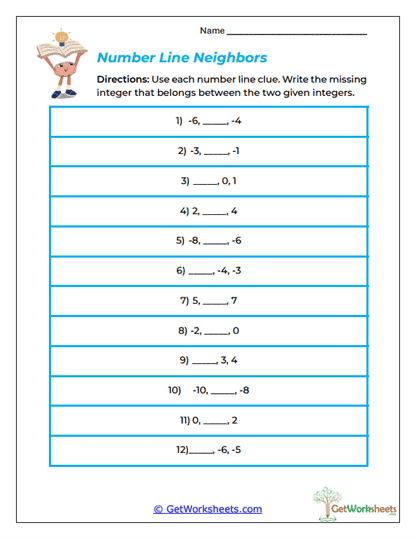
This worksheet helps students understand that integers follow a steady order on the number line, even when the numbers are negative. Each problem shows two known integers with a blank in between, and students must figure out which integer belongs in the missing spot. Examples include patterns such as -6, ___, -4 or 2, ___, 4. The skill may look simple, but it is very important because students need to understand the order of negative and positive numbers before they can compare integers, graph them, or work confidently with addition and subtraction.
For a parent who may not remember integer rules, the easiest way to explain this worksheet is to think of the numbers as neighbors standing in a row. If you see -6 and -4 with one blank between them, the missing neighbor is -5. The numbers still count in order: -6, -5, -4. The minus sign does not change the basic counting pattern; it only tells us that the numbers are on the left side of zero.
Learning Goals
- Recognize Consecutive Integers: Students identify the number that comes directly between two neighboring values.
- Count Through Negative Numbers: Learners practice sequences such as -8, -7, -6 without reversing the order.
- Cross Zero Correctly: Students work with patterns that may move from negative values through zero into positive values.
- Strengthen Number-Line Order: Learners reinforce the idea that numbers increase as they move right.
- Build Mental Integer Fluency: Students become faster at recognizing which number comes before or after another integer.
Parent-Friendly Teaching Tips
A very simple question is:
“What number comes right between these two?”
For example:
-8, ___, -6
Count forward:
-8, -7, -6
So the missing integer is -7.
Another example:
___, 0, 1
The number just before zero is -1.
If the child gets confused, draw a short number line and label a few nearby values. Sometimes seeing -3, -2, -1, 0, 1 makes the pattern click immediately.
Why This Worksheet Helps
- Builds a Strong Sense of Integer Order: Students stop seeing negative numbers as strange symbols and start seeing them as part of one continuous sequence.
- Supports Future Addition and Subtraction: Knowing what comes next or before helps with number-line movement.
- Prepares for Inequalities: Students who understand sequence and order are better able to compare values later.
- Helps Catch Reversal Errors: Some children mistakenly think -8 comes after -6 because 8 is larger than 6; this worksheet helps correct that.
- Keeps the Skill Manageable: Each problem is short, so students can focus on the number relationship instead of a lot of extra reading.
The real value of this worksheet is that it teaches students to feel comfortable moving through the integer system one number at a time. Negative integers, zero, positive integers, sequence, and number-line order all work together. For parents, the best reminder is: “Count the numbers just like you normally would, and keep the signs attached.” In classroom and homeschool settings, this is a strong confidence-building page for students who are still learning how negative numbers fit into ordinary counting order.
Bookmark Us Now!
New, high-quality worksheets are added every week! Do not miss out!