Positive Trail
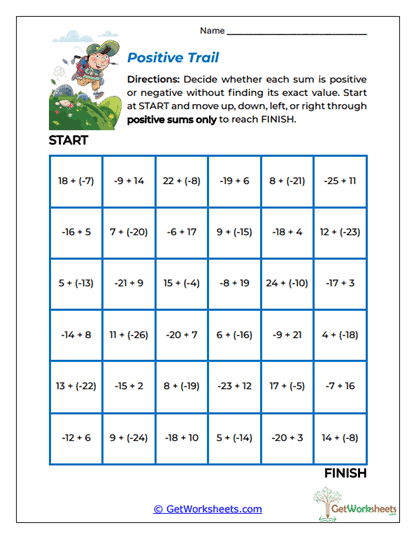
This worksheet asks students to travel from START to FINISH by moving only through addition problems whose answers are positive. The interesting twist is that students do not always need to find the exact sum before deciding whether a cell is usable. They can often compare the positive and negative addends and determine which has the greater absolute value. That makes the worksheet useful for developing both computation and number sense. Expressions such as 18 + (-7), -9 + 14, 22 + (-8), -19 + 6, and 8 + (-21) give students many chances to reason about whether the positive or negative side is stronger.
For a parent, this worksheet is a good place to explain that a positive answer happens when the positive amount outweighs the negative amount. If a child sees 18 + (-7), they can reason that 18 is larger than 7, so the final answer must stay positive. They may still calculate 11, but the important first thought is that the result will be above zero. On the other hand, -19 + 6 must be negative because the negative 19 has the greater absolute value.
Key Learning Objectives
- Identify Positive Sums: Students decide whether an addition expression results in a number greater than zero.
- Compare Magnitudes: Learners compare absolute values to determine which sign controls the answer.
- Use Mental Reasoning: Students can often determine the sign before calculating the exact total.
- Navigate Using Math Results: Correct sign reasoning determines the path through the maze.
- Strengthen Positive/Negative Number Sense: Learners become more comfortable predicting the sign of a result.
Parent-Friendly Explanation
A very useful question is:
“Which number has the greater absolute value?”
For example:
-9 + 14
14 is farther from zero than 9, and 14 is positive.
So the sum will be positive.
You can think of it as two teams pulling in opposite directions. The stronger side decides whether the final answer is positive or negative.
Why This Worksheet Helps
- Teaches More Than Basic Arithmetic: Students learn to predict the sign of an answer before finishing the calculation.
- Builds Mental Math: Many cells can be classified without doing every step on paper.
- Encourages Efficient Thinking: Learners begin recognizing integer patterns instead of treating every problem as brand new.
- Provides Built-In Feedback: If the trail stops, the student knows to recheck a nearby sum.
- Makes Sign Rules Memorable: The positive-only path reinforces what causes a positive result.
Classroom & Home Use
- Great for Skill Stations: Students can solve, mark, and follow the trail independently.
- Useful for Parents: Adults can help with the sign decision even if they do not calculate every exact sum.
- Strong for Pre-Algebra Practice: Predicting signs is useful later in expressions and equations.
- Good for Students Who Rush: The maze encourages them to slow down and verify each move.
- Works Well for Review: It reinforces integer addition in a fresh format.
The real value of this worksheet is that it teaches students to ask what kind of answer they expect before worrying about the exact number. Positive integers, negative integers, absolute value, addition, comparison, and sign prediction all work together as students follow the trail. For parents, the easiest coaching line is: “Which side is stronger?” In classroom and homeschool settings, this activity helps students develop stronger integer instincts, not just faster arithmetic.
Bookmark Us Now!
New, high-quality worksheets are added every week! Do not miss out!