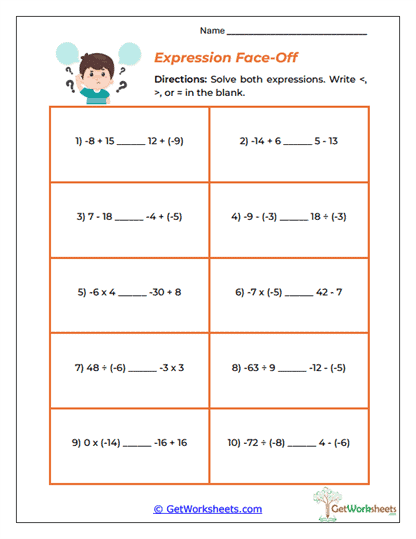
Expression Face-Off
This worksheet asks students to solve two different integer expressions and then compare the results using <, >, or =. That makes it more challenging than a regular computation page because students have to do the math correctly on both sides before they can even make the comparison. Problems mix addition, subtraction, multiplication, and division with positive and negative integers, so students are constantly switching rules and then deciding which final value is greater. This is especially useful for grades 6-7 students who already know the four integer operations and are ready to combine computation with comparison and number sense.
For a parent, the best way to help is to have the child treat each side like its own mini-problem. Solve the left expression first, solve the right expression second, and only then compare the answers. If the results are negative, remind them that the number closer to zero is greater. For example, -4 is greater than -10 even though 10 looks like the “bigger” number. Thinking of the answers on a number line can make that much easier to understand.
Learning Goals
- Solve Mixed Integer Expressions: Students use addition, subtraction, multiplication, and division rules accurately.
- Compare Final Results: Learners use <, >, or = after solving both expressions.
- Strengthen Integer Ordering: Students practice deciding which positive or negative result is greater.
- Use Number Sense to Check: Learners can estimate whether a comparison seems reasonable before finalizing it.
- Manage Multiple Steps: Students organize two separate calculations before making one final decision.
Parent-Friendly Teaching Tips
- Solve One Side at a Time: Do not try to compare expressions before evaluating them.
- Circle the Two Final Answers: This helps children focus on what is actually being compared.
- Use a Number Line for Negative Results: Farther right means greater.
- Remember Zero’s Position: Zero is greater than every negative number but less than every positive number.
- Check the Sign Rule First: A wrong sign can completely reverse the comparison.
Classroom & Home Use
- Great for Higher-Level Review: Students have to calculate and compare rather than simply solve.
- Builds Careful Work Habits: Two expressions on one line encourage students to organize their thinking.
- Useful for Small Groups: Students can explain why they selected a particular comparison symbol.
- Good for Test Preparation: Mixed expressions and comparisons often appear together on assessments.
- Helpful for Parents: Even if the arithmetic feels rusty, adults can help by checking whether the final comparison makes sense on a number line.
The value of this worksheet is that students have to connect integer operations with integer ordering. Addition, subtraction, multiplication, division, positive and negative results, comparison symbols, and number sense all work together in every problem. For parents, the most useful question is: “What did each side equal, and which of those two answers sits farther to the right on a number line?” That simple routine helps students avoid guessing based on how the original expressions look.
Bookmark Us Now!
New, high-quality worksheets are added every week! Do not miss out!