Apple Pair Test
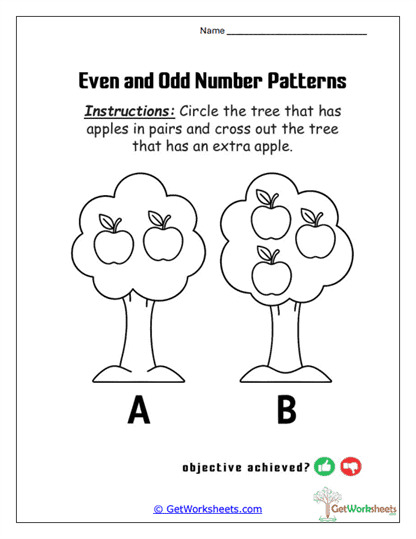
The Apple Pair Test Worksheet helps children understand even and odd numbers by looking at apples grouped on two different trees. Students compare the apple groups, decide which tree has apples that can be arranged in pairs, and identify which tree has an extra apple, using counting, pairing, quantity comparison, and even-odd reasoning. This is a strong fit for kindergarten and first grade because it shows the meaning of even and odd with real objects rather than asking children to rely only on number symbols. For parents, this is one of the easiest ways to explain the idea: if every apple can find a partner, the group is even; if one apple is left alone, the group is odd.
Targeted Skills
- Recognize Equal Pairing: Students identify the group where all apples can be matched into pairs.
- Find the Extra Item: Learners notice when one apple remains without a partner.
- Connect Groups to Number Properties: Students see the real meaning behind even and odd.
- Build Counting Confidence: Children count each tree carefully before deciding which rule applies.
Learning Benefits
- Makes the Concept Concrete: Apples give children something visible to group and compare.
- Supports Beginning Learners: The activity explains even and odd before expecting instant numeral recognition.
- Encourages Math Talk: Teachers and parents can ask students to describe how they know which tree is even or odd.
- Easy to Recreate at Home: Families can use fruit, toys, socks, or snacks to make pairs and check for leftovers.
Students strengthen even and odd understanding, pairing, counting, quantity comparison, grouping, and number sense while studying the apple trees. This matters because the strongest early math learning happens when children understand what a number property actually means, not just what numbers belong on a memorized list. In the classroom, teachers can model the apples as pairs before students make their choice. At home, parents can hand the child a small group of objects and ask them to partner everything up. If one is left over, the child has a clear picture of what “odd” means. With practice, learners build a much stronger and more dependable understanding of even and odd numbers.
Bookmark Us Now!
New, high-quality worksheets are added every week! Do not miss out!