Even-Odd Color Code
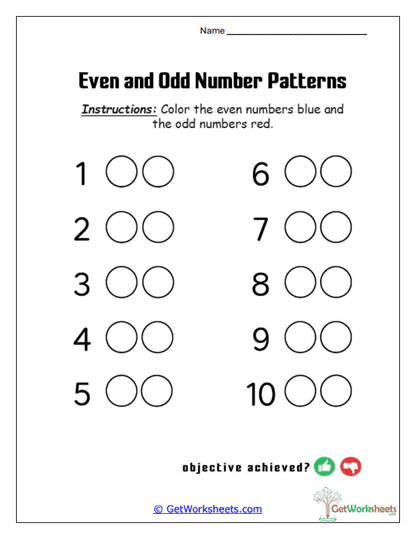
The Even-Odd Color Code Worksheet gives young learners a very clear first look at the difference between even numbers and odd numbers. Students work with the numbers 1 through 10, decide whether each number belongs in the even or odd group, and then use a simple color code, number recognition, classification, pattern spotting, and sorting routine to show their answers. This is a strong fit for kindergarten and early first grade because children are beginning to notice that whole numbers follow a repeating odd-even pattern as they count forward. For a parent who has not thought about this kind of math in years, the basic idea is simple: even numbers can be split into two equal groups with nothing left over, while odd numbers always leave one extra.
Learning Goals
- Identify Even Numbers: Students recognize 2, 4, 6, 8, and 10 as numbers that can be grouped into equal pairs.
- Identify Odd Numbers: Learners recognize 1, 3, 5, 7, and 9 as numbers that leave one unpaired item.
- Notice the Alternating Pattern: Students begin seeing that even and odd numbers take turns as they count.
- Connect Numbers to Categories: Children practice sorting numerals based on a mathematical rule instead of appearance.
Teaching Advantages
- Very Easy to Explain: Parents can simply say, “Even numbers make perfect pairs; odd numbers have one left over.”
- Uses Familiar Numbers: Keeping the range from 1 to 10 lets children focus on the new idea instead of difficult counting.
- Adds a Visual Memory Cue: Coloring even and odd numbers differently helps the two groups stand out.
- Ready for Quick Practice: The worksheet works well for classwork, centers, morning practice, intervention, or homeschool lessons.
Students strengthen even-number recognition, odd-number recognition, number patterns, classification, counting order, and early number sense as they complete the color code. This matters because understanding even and odd numbers helps children see that numbers are organized and follow predictable rules. In the classroom, teachers can pair this activity with counters or cubes and physically make pairs for each number. At home, parents can use socks, crackers, coins, or toys and ask whether everything can be matched into groups of two. That hands-on practice makes the difference between even and odd much easier to understand. With repetition, children begin recognizing the pattern quickly and gain confidence working with basic number properties.
Bookmark Us Now!
New, high-quality worksheets are added every week! Do not miss out!