Footprint Color Path
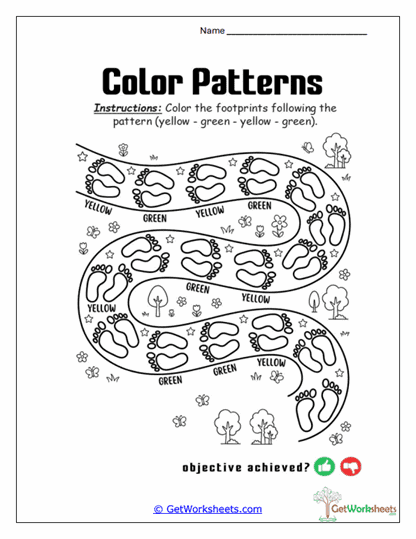
The Footprint Color Path Worksheet helps young learners practice a simple alternating color pattern by following a winding trail of footprints. Students look at the labeled examples, identify the yellow-green AB pattern, and then color the remaining footprints so the same alternating sequence, color order, repetition, and visual rule continues from beginning to end. This is a strong fit for preschool and kindergarten because AB patterns are one of the most important first steps in understanding how repeating sequences work. For parents, the idea is easy to explain: two colors take turns, so if one footprint is yellow, the next should be green, then yellow again, then green again.
Targeted Skills
- Recognize AB Patterns: Students identify a two-part sequence that alternates consistently.
- Continue Along a Path: Learners follow the sequence through a curved layout instead of a straight row.
- Use Color Labels as Clues: Students connect the written color names with the matching visual pattern.
- Maintain Consistent Alternation: Children practice keeping the yellow-green order correct across the entire trail.
Learning Benefits
- Strengthens Beginning Pattern Skills: The simple two-color structure is ideal for children still learning how repetition works.
- Adds a Spatial Challenge: The winding path encourages students to follow sequence order carefully from one footprint to the next.
- Supports Color Recognition: Learners repeatedly identify and apply yellow and green.
- Works Well at Home or School: The worksheet fits centers, independent practice, small groups, or homeschool instruction.
Students build stronger AB pattern recognition, alternating sequences, color identification, visual tracking, prediction, and attention to order as they follow the footprint path. This matters because children need to understand simple repetition before they can handle longer patterns like AAB, ABB, or ABC. In the classroom, teachers can have students say “yellow, green” with each footprint before coloring. At home, parents can create the same pattern with socks, blocks, or snacks and ask the child to continue it. That extra practice helps children see that pattern rules work in many different places. With repetition, students become more confident, more accurate, and more ready for harder sequencing tasks.
Bookmark Us Now!
New, high-quality worksheets are added every week! Do not miss out!