Heartbeat Color Cycle
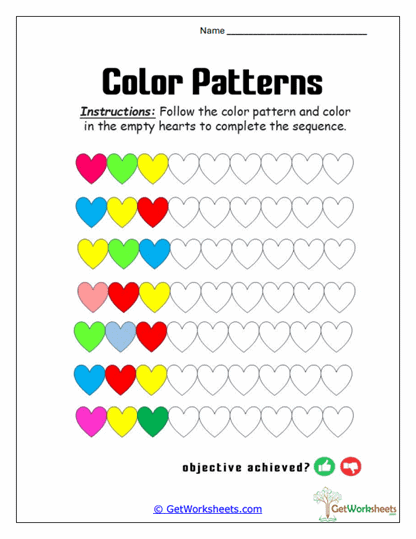
The Heartbeat Color Cycle Worksheet uses bright heart shapes to help children practice identifying and extending three-part color patterns. Students study the first three colored hearts, figure out the ABC pattern, and then continue the sequence using color recognition, visual memory, repetition, ordering, and prediction. This is a strong fit for preschool and kindergarten because the heart shape stays the same while the colors change, allowing children to focus on the actual pattern rule instead of juggling too many different features at once. For parents, an ABC pattern just means three different choices repeat in the same order, such as pink-yellow-green, pink-yellow-green, over and over.
Targeted Skills
- Understand ABC Patterns: Students recognize a repeating group containing three different color positions.
- Continue Color Cycles: Learners use the first three hearts to determine the correct colors for all remaining spaces.
- Remember Sequence Order: Children practice holding a three-part rule in mind while working from left to right.
- Use Evidence to Predict: Students learn that the next answer comes from the existing pattern rather than from personal color preference.
Learning Benefits
- Builds Early Math Thinking: Children practice finding and following a rule, an important foundation for later mathematics.
- Supports Working Memory: Remembering three colors in order gives young learners manageable memory practice.
- Encourages Independence: The repeated layout allows students to understand the directions quickly and complete later rows with less adult help.
- Useful Anywhere: The worksheet works well for classroom centers, independent practice, early finishers, homework, or homeschool learning.
Students reinforce ABC sequencing, color patterns, working memory, visual discrimination, prediction, and pattern fluency as they complete the heart rows. The purpose goes beyond knowing colors; children are learning that information can follow an organized and predictable rule. Teachers can ask students to identify where the pattern starts over, while parents can have children tap each heart and say the colors aloud. Similar practice can easily be created at home with socks, blocks, buttons, or pieces of fruit. Those everyday connections help children understand that patterns exist everywhere, not only on worksheets. With repeated practice, students become more observant, more confident, and better prepared for later work involving counting patterns, number relationships, and early algebraic thinking.
Bookmark Us Now!
New, high-quality worksheets are added every week! Do not miss out!