Where Does It Fall?
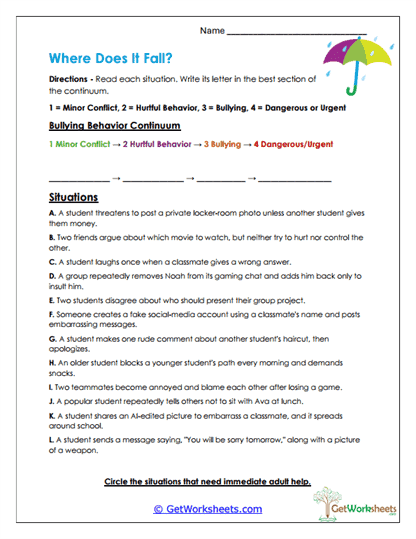
Students read twelve school situations and decide where each one belongs on a behavior continuum: minor conflict, hurtful behavior, bullying, or dangerous and urgent. They then place each situation’s letter in the correct section and circle the examples that require immediate adult help. This special education and social-emotional learning worksheet strengthens conflict recognition, bullying awareness, safety judgment, perspective-taking, decision-making, and help-seeking skills. It is especially useful for upper-elementary and middle school students who need direct practice understanding that not every disagreement is bullying, but threats, repeated targeting, humiliation, and weapons must always be taken seriously.
Learning Goals
- Tell Conflict From Bullying: Students learn that a one-time disagreement is different from repeated behavior meant to hurt, control, or embarrass someone.
- Recognize Repetition and Power: Learners notice when behavior happens again and again or involves someone using popularity, age, pressure, or social control.
- Identify Urgent Danger: Students recognize threats, blackmail, blocked movement, and weapon-related messages as situations that require immediate adult support.
- Choose an Appropriate Response: Children begin matching the seriousness of a situation with the level of help that is needed.
How This Helps
- Uses Clear Categories: The four-level continuum gives students a simple structure for sorting behavior that may otherwise feel confusing.
- Supports Concrete Thinkers: Specific situations are easier to understand than a vague lecture about bullying.
- Helps Families Talk Calmly: Parents can discuss why one situation is annoying, another is cruel, and another may be dangerous.
- Useful for Special Education: The page supports explicit instruction, repeated practice, social skills groups, and guided discussion.
- Encourages Adult Help: Students learn that asking for support is the right response when safety, threats, or repeated bullying are involved.
Many children are told to “ignore it” or “work it out,” even when they are facing behavior that is repeated, controlling, or unsafe. This worksheet gives students clearer language for explaining what is happening and helps them understand that different problems need different responses. Learners practice social awareness, conflict resolution, bullying identification, personal safety, emotional regulation, and help-seeking while thinking through realistic situations. Parents can reinforce the lesson by asking whether the behavior happened once or repeatedly, whether anyone is being pressured or threatened, and whether someone could be harmed. In classrooms, counseling groups, behavior-support programs, and homeschool settings, this activity can build confidence and help students know when to solve a small problem, set a boundary, save evidence, or immediately involve a trusted adult.
Bookmark Us Now!
New, high-quality worksheets are added every week! Do not miss out!