Number Line Disunions
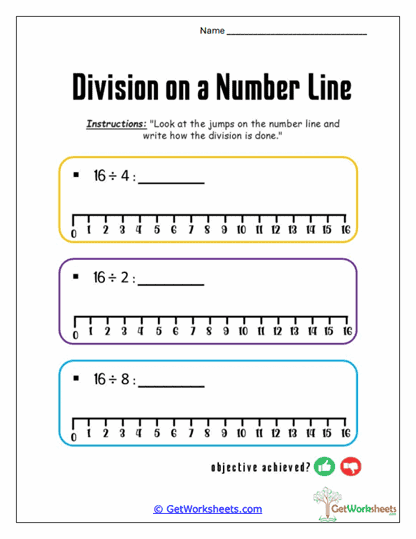
This worksheet is designed to help students in Grades 3 and 4 strengthen conceptual understanding of division by analyzing number lines that represent different division equations with the same dividend. Students study models such as 16 ÷ 2, 16 ÷ 4, and 16 ÷ 8, interpreting the number and size of jumps to determine the quotient. This visual comparison builds deep insight into how division works and how changing the divisor affects the result.
Skills Reinforced
- Modeling Division on a Number Line (Grades 3-4)
Interpret division as repeated jumps or equal sections along a number line. - Equal Group Reasoning
Understand division as splitting a total into equal-sized groups. - Operational Pattern Recognition
Recognize how larger divisors create fewer jumps and smaller quotients, and vice versa. - Conceptual Division Fluency
Build meaning and flexibility with division beyond memorized facts.
Instructional Benefits
- Teacher-Created Resource
Designed to support conceptual division instruction aligned with elementary standards. - Same Dividend, Different Divisors
Highlights relationships between divisors and quotients in a powerful visual way. - Visual Comparison Focus
Encourages reasoning, discussion, and mathematical justification. - Flexible Use
Ideal for guided lessons, math centers, small groups, intervention, or homeschool learning.
This printable worksheet helps students see division as a relationship between numbers rather than a single procedure. By comparing multiple number line models with the same total, learners develop a stronger understanding of how divisors influence quotient size and why division works the way it does. The activity bridges concrete visual models and abstract reasoning, preparing students for greater fluency with division algorithms and problem solving.
This worksheet is part of our Division on a Number Line Worksheets collection.
Bookmark Us Now!
New, high-quality worksheets are added every week! Do not miss out!