Who vs. Whom Worksheets
About This Worksheet Collection
Mastering the difference between who and whom can be challenging for many students, especially as sentence structures become more complex. This worksheet collection provides a wide range of engaging activities that help learners approach the concept from different perspectives, including sentence completion, editing exercises, mysteries, dialogues, essays, and advanced grammar challenges. The variety of formats keeps practice fresh while giving students repeated opportunities to apply the same essential grammar concept in meaningful contexts.
As students work through these worksheets, they develop a stronger understanding of subject and object pronouns, clause structure, sentence analysis, and formal English conventions. The activities encourage critical thinking, careful reading, and evidence-based grammar decisions rather than simple memorization. By practicing who and whom across a variety of situations, learners build confidence in their writing, strengthen editing skills, and develop language habits that support success in academic and professional communication.
Detailed Descriptions Of These Worksheets
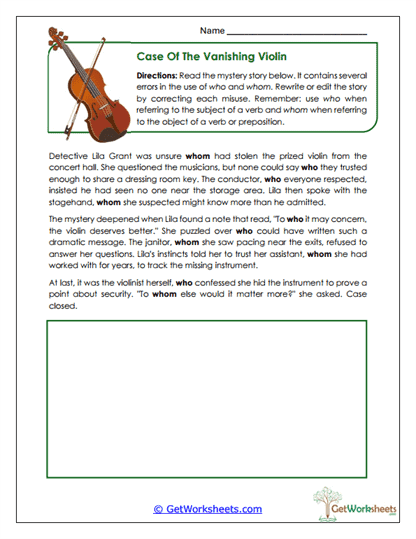
Case of the Vanishing Violin
Students investigate a missing violin case while correcting pronoun mistakes hidden throughout a mystery story. The narrative format encourages readers to stay engaged with the plot while carefully analyzing grammar. As they revise the passage, learners strengthen editing skills and improve their understanding of how who and whom function within complete sentences. The combination of storytelling and revision creates a memorable learning experience.
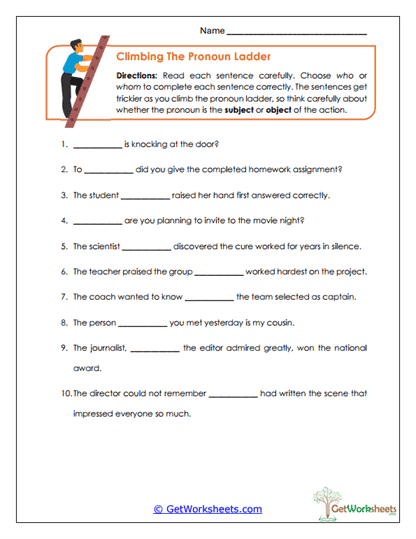
Climbing the Pronoun Ladder
This challenge-based activity guides students through a series of increasingly difficult who and whom questions. Each section builds upon earlier skills, allowing learners to gain confidence before tackling more advanced sentence structures. The progressive format rewards persistence and encourages thoughtful analysis. By the final stages, students are applying pronoun rules in complex grammatical situations.
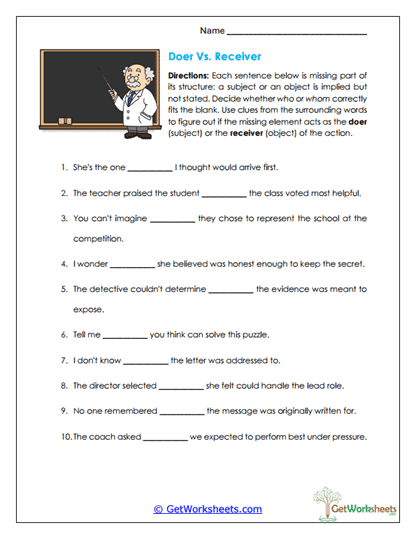
Doer vs. Receiver
Learners focus on one of the most effective strategies for distinguishing between who and whom: identifying whether the pronoun is performing or receiving an action. Through a variety of sentence examples, students practice applying this concept repeatedly until it becomes more natural. The worksheet simplifies a difficult topic without sacrificing rigor. It serves as an excellent foundation for future grammar learning.
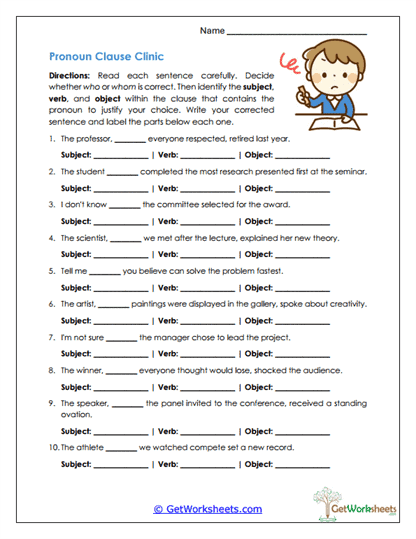
Pronoun Clause Clinic
Students take on the role of grammar specialists as they examine sentence evidence before selecting the correct pronoun. Rather than relying on shortcuts, learners identify subjects, verbs, and objects to justify every answer. This analytical approach promotes a deeper understanding of sentence construction. It also helps students develop skills that transfer to many other grammar concepts.
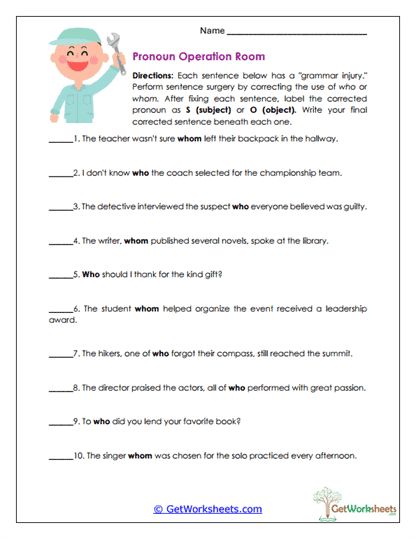
Pronoun Operation Room
In this creative editing activity, students act as grammar surgeons repairing sentences with incorrect pronoun usage. Each example requires careful diagnosis before a correction can be made. The engaging theme adds variety while reinforcing essential grammar concepts. Learners strengthen proofreading abilities and gain confidence in their revision skills.
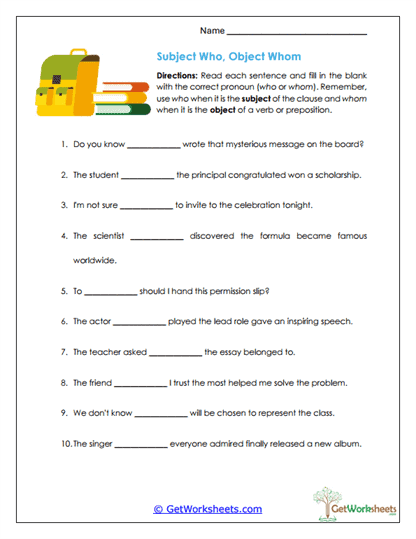
Subject or Object?
This fill-in-the-blank worksheet challenges students to supply who or whom without being given answer choices. Because learners must generate the correct response independently, they rely more heavily on grammatical reasoning. The activity strengthens understanding of clause relationships and sentence structure. It is particularly effective for building long-term mastery of the concept.
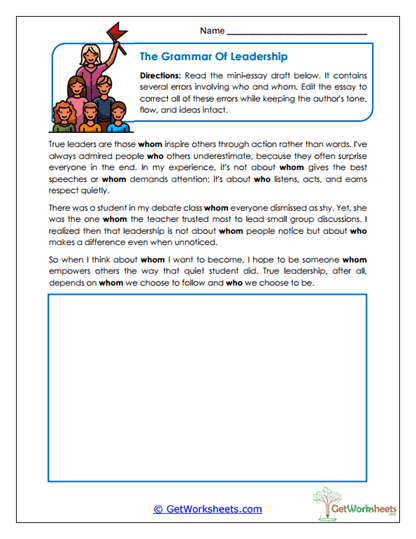
The Grammar of Leadership
Students revise an essay about leadership that contains multiple pronoun errors. Working within a connected piece of writing encourages learners to apply grammar knowledge beyond isolated sentences. The activity demonstrates how correct pronoun usage contributes to clear and effective communication. It also provides valuable practice with academic-style editing.
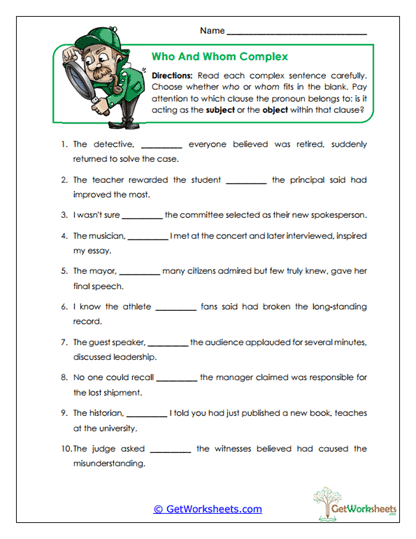
Who and Whom Complex
This advanced worksheet presents learners with sophisticated sentence structures that require careful clause analysis. Students must look beyond surface-level clues to determine how the pronoun functions within its own clause. The challenge helps develop precision and attention to detail. It is especially useful for enrichment, honors-level work, or advanced grammar instruction.
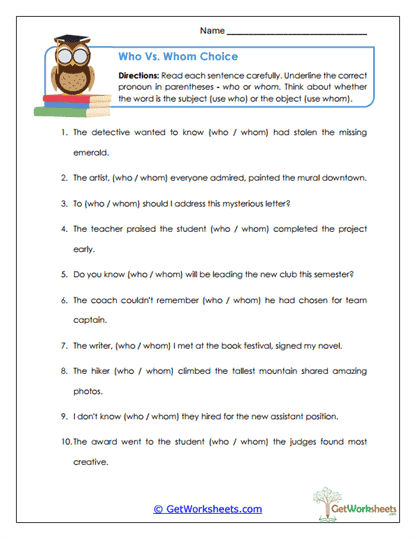
Who vs. Whom Choice
Students examine complete sentences and decide which pronoun belongs based on its grammatical role. The activity introduces the distinction between subjects and objects in a clear and structured way. Repeated practice helps learners recognize common patterns and avoid guessing. It serves as an excellent entry point into the study of who and whom.
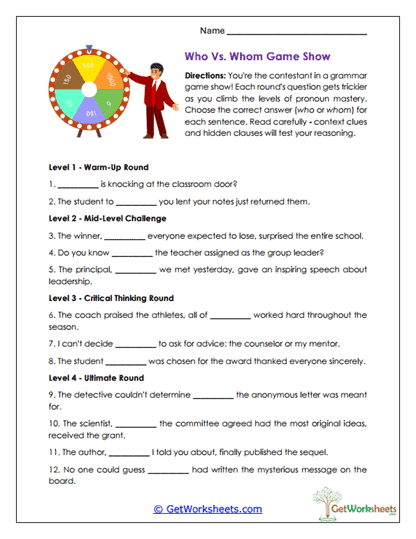
Who vs. Whom Game Show
Grammar practice becomes a competition as students advance through multiple rounds of pronoun challenges. Questions increase in difficulty as learners progress, creating a sense of achievement and momentum. The game-show format keeps students motivated while reinforcing important language concepts. By the end, learners have practiced a broad range of who and whom situations.
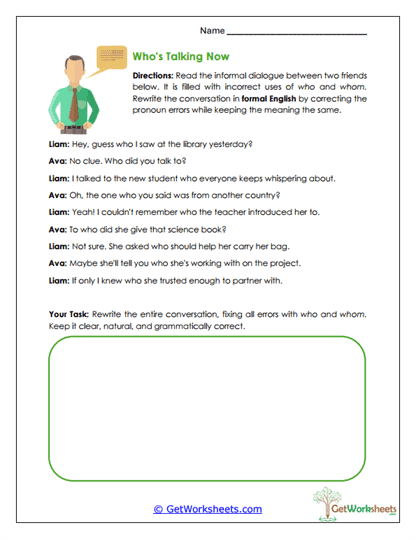
Who's Talking Now
Students edit a conversation between friends that contains several examples of incorrect pronoun usage. Because the mistakes appear in realistic dialogue, learners must carefully examine questions, responses, and conversational sentence patterns. The activity highlights the difference between everyday speech and formal grammar conventions. It also helps students improve editing skills within authentic communication contexts.
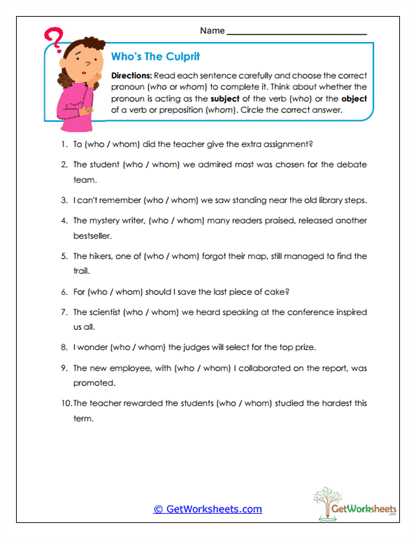
Who's the Culprit?
Learners solve a series of grammar cases by determining whether who or whom correctly completes each sentence. The detective-style format encourages students to gather evidence before making a decision. Through varied examples, students strengthen their ability to identify grammatical roles and analyze sentence structure. The engaging theme makes advanced grammar feel more approachable.
Who vs. Whom Choice
Students work through carefully selected sentences that require them to determine whether the pronoun serves as a subject or an object. The worksheet encourages thoughtful examination of sentence structure rather than relying on intuition alone. Through repeated analysis, learners become more comfortable applying formal grammar conventions. This foundational practice supports stronger writing and editing skills.
Bookmark Us Now!
New, high-quality worksheets are added every week! Do not miss out!