Gravity Worksheets
About This Worksheet Collection
The Gravity collection introduces students to one of the most fundamental forces in the universe through reading, reasoning, creativity, and exploration. Each worksheet helps learners build a deeper understanding of gravitational force-from how it keeps planets in orbit to how it shapes the motion of objects on Earth. The collection blends physics, literacy, and critical thinking to make abstract scientific ideas concrete and engaging.
Through matching, drawing, sequencing, and writing activities, students explore how gravity influences everything from tides and satellites to human experience in space. The materials are designed to encourage inquiry, accuracy, and conceptual reasoning. By connecting historical discoveries, real-world examples, and modern applications, these lessons build a strong foundation for understanding the invisible force that governs motion across the cosmos.
Detailed Descriptions Of These Worksheets
Definition Match
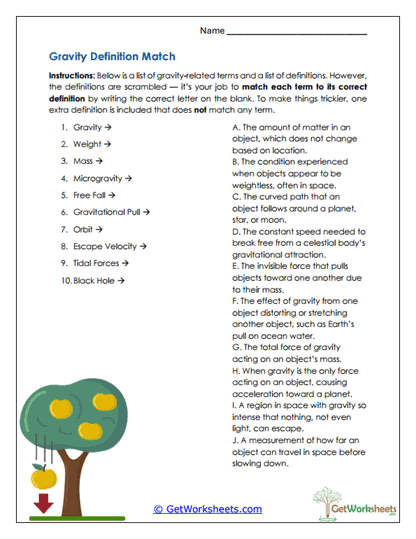
Students match gravity-related terms such as mass, weight, orbit, and gravitational pull with their definitions. One extra definition adds challenge, encouraging precise comprehension. The activity builds physics vocabulary and reinforces distinctions between related concepts. It strengthens reasoning about how gravitational forces act throughout the universe.
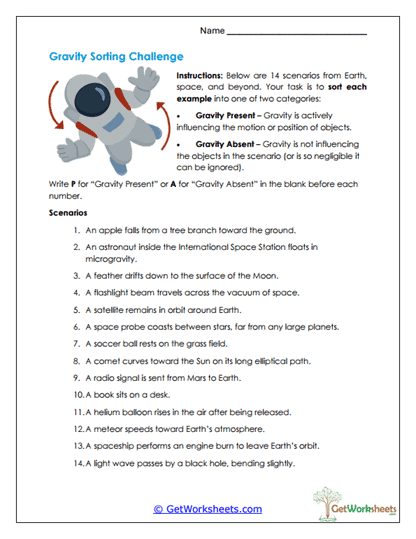
Sorting Challenge
Learners determine whether gravity is significantly present in fourteen described scenarios-from dropping a ball to orbiting a satellite. Each example requires analysis of gravitational influence in real or imagined settings. The sorting task enhances critical thinking and real-world application. It helps students visualize how gravity functions both on Earth and beyond.
Fill-in-the-Blanks
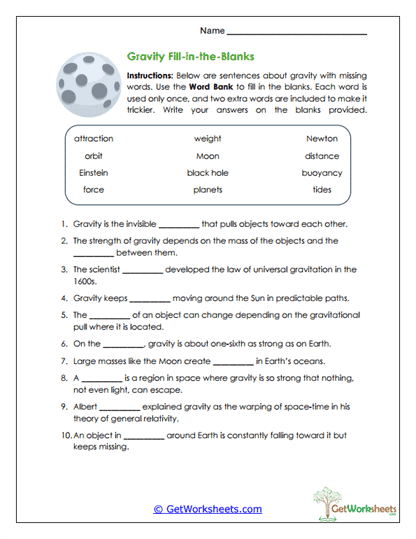
Students complete ten sentences using a scientific word bank that includes terms like force, Newton, and black hole. Each statement reviews a key principle of gravitational attraction and orbital motion. The task reinforces vocabulary and content comprehension through context. It bridges terminology with understanding of how gravity shapes motion and mass relationships.
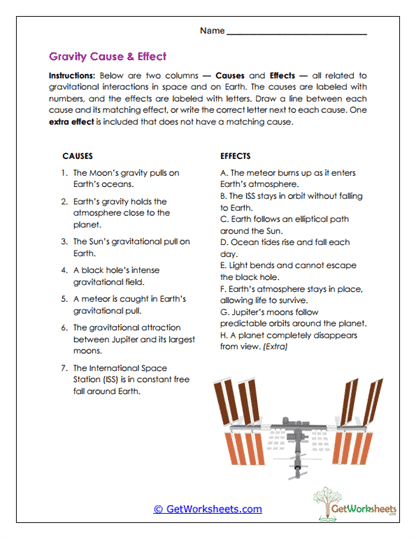
Cause and Effect
In this analytical exercise, students connect gravitational causes-such as the Moon's pull or a massive star's collapse-with their observable effects, including tides and light bending. An extra effect challenges students to reason critically. The activity strengthens comprehension of natural relationships and highlights gravity's role in shaping cosmic and terrestrial events.
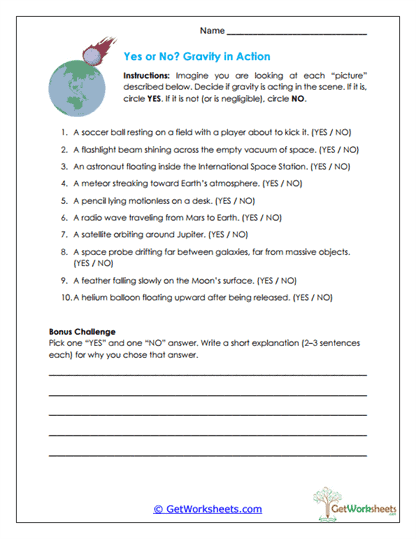
Yes or No? Gravity in Action
Learners examine real-world and space-based situations and decide whether gravity is acting in each. They respond "YES" or "NO" and justify their reasoning for one of each. The open-response component promotes scientific explanation and applied understanding. It encourages learners to see gravity's presence in both everyday and extraordinary circumstances.
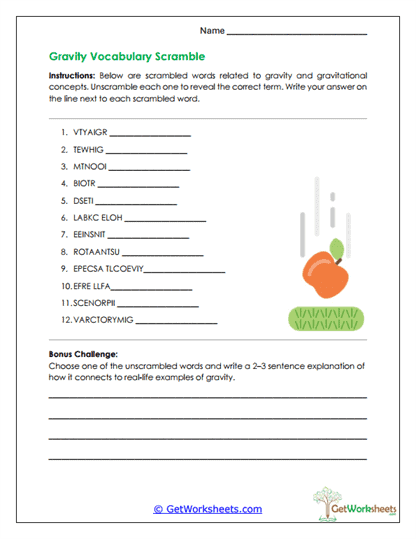
Vocabulary Scramble
Students unscramble twelve gravity-themed words and write a short explanation of one in real-world context. The combination of spelling, vocabulary, and application reinforces mastery of scientific language. Learners strengthen both linguistic precision and conceptual clarity by linking terms to examples like free fall or orbiting planets.
Scenario: What Would Happen?
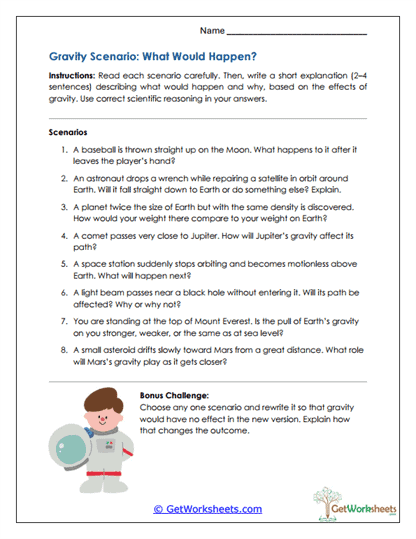
Students predict outcomes for imaginative gravitational scenarios, such as dropping objects in orbit or nearing a black hole. Each prompt requires explanation grounded in physics principles. A bonus challenge asks learners to imagine results in a world without gravity. The worksheet promotes creative problem-solving and understanding of theoretical science.
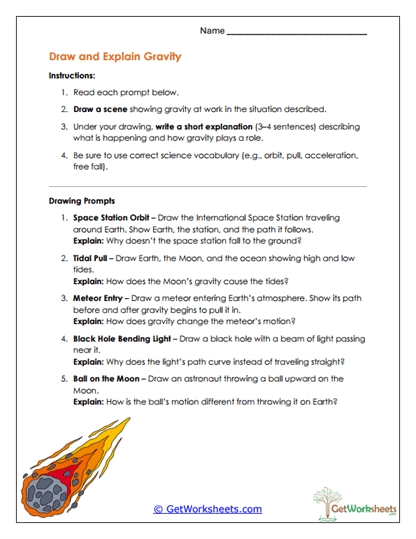
Draw and Explain
In this art-integrated task, students illustrate how gravity works in different contexts-on Earth, in orbit, or near celestial bodies. Accompanying written explanations connect visual thinking to scientific reasoning. The creative format strengthens understanding of gravitational influence through modeling and expression.
Timeline of Discoveries
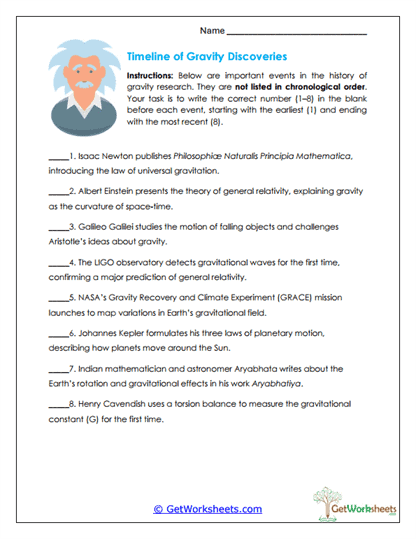
Learners organize eight major milestones-from Galileo's experiments to Einstein's general relativity-into chronological order. The visual sequencing builds historical literacy in science. Students trace the evolution of gravitational theory through observation, experimentation, and innovation. It emphasizes how scientific knowledge develops over time.
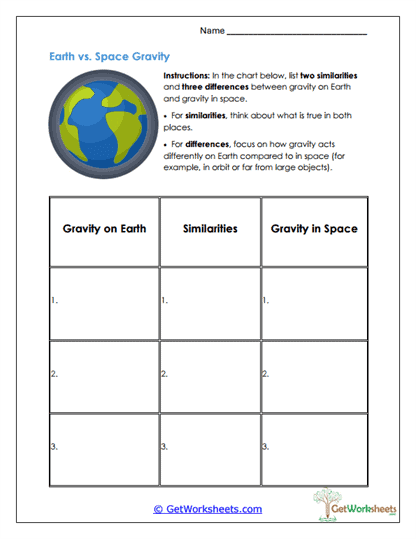
Earth vs. Space
Students compare gravity on Earth and in space using a three-column chart. They identify similarities, differences, and examples to clarify how gravitational strength and effects change by environment. This structured comparison deepens understanding of orbit, free fall, and weightlessness. It encourages analytical thinking about universal forces in varying contexts.
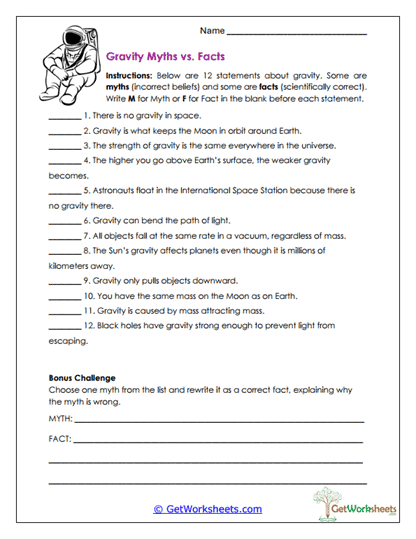
Myths vs. Facts
Learners assess twelve statements about gravity, marking each as a myth or fact. Examples range from simple misunderstandings to complex misconceptions. A bonus challenge asks students to rewrite one myth as a factual statement. This evidence-based exercise sharpens accuracy, critical reasoning, and science literacy by correcting popular myths.
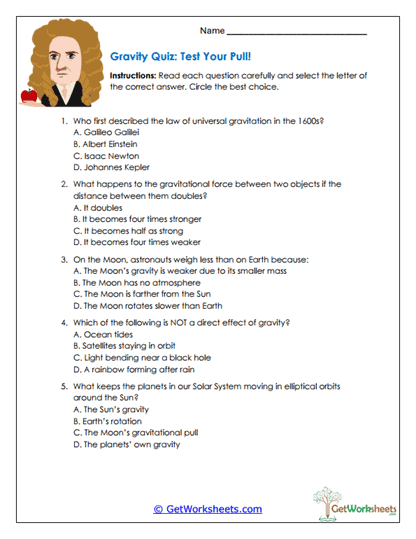
Quiz: Test Your Pull!
In this multiple-choice assessment, students answer questions covering Newton's law, orbital motion, and gravitational effects on celestial bodies. Each item reinforces conceptual and historical understanding of physics. The quiz encourages confidence in test-taking and application of learned concepts. It provides a quick, engaging review of gravitational science fundamentals.
Bookmark Us Now!
New, high-quality worksheets are added every week! Do not miss out!