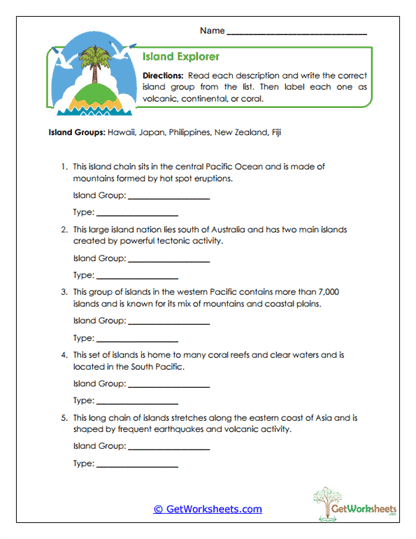
Island Explorer
This worksheet is designed for students in Grades 4, 5, and 6 to build understanding of Earth science and geography by classifying major Pacific island groups. Learners analyze descriptions of islands such as Hawaii, Japan, and Fiji and determine whether each is volcanic, coral, or continental, using clues related to tectonic activity, ecosystems, and physical features to support accurate classification.
Learning Goals
- Island Formation (Grades 4-6): Distinguish between volcanic, coral, and continental islands based on geologic characteristics.
- Earth Science Connections: Understand how tectonic plates, volcanic activity, and coral growth create different island types.
- Physical & Cultural Geography: Connect island formation to landscapes, ecosystems, and human settlement patterns.
- Analytical Thinking: Use descriptive clues to classify islands accurately and explain reasoning.
Instructional Benefits
- Teacher-Created Resource: Designed to align with upper elementary science, geography, and ELA standards.
- Classification-Based Learning: Encourages deeper thinking through sorting and categorizing rather than memorization.
- Integrated Content: Blends geology, physical geography, and real-world locations in the Pacific.
- Flexible Use: Ideal for science units, geography lessons, homework, centers, or formative assessment.
This printable worksheet helps students understand how Pacific islands form and why they differ from one another. By classifying island groups and analyzing formation clues, learners strengthen knowledge of geologic processes, physical features, and regional geography while building critical thinking skills. It’s a practical, no-prep resource that works well in both classroom instruction and homeschool learning, supporting meaningful exploration of Earth’s island systems.
Bookmark Us Now!
New, high-quality worksheets are added every week! Do not miss out!