Greek Island Origins
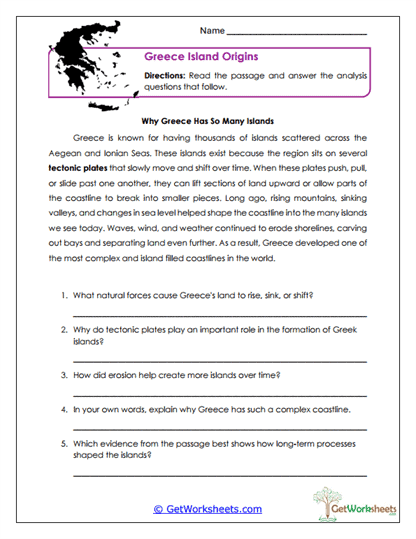
This worksheet supports students in Grades 5, 6, and 7 as they build scientific literacy, reading comprehension, and geographic reasoning by exploring why Greece has so many islands. Through an informational passage, students examine tectonic plates, erosion, sea-level changes, and long-term geological processes, then answer analysis questions using evidence, cause-and-effect reasoning, and complete sentences to explain how natural forces shape coastlines and landforms.
Learning Goals
- Earth Processes & Plate Tectonics (Grades 5-7) – Explain how tectonic movement and geological activity contribute to island formation
- Physical Geography Understanding – Describe how erosion, sea-level changes, and shifting landmasses shape coastlines
- Cause-and-Effect Reasoning – Analyze how multiple natural forces interact over time to create complex landforms
- Evidence-Based Responses – Use details from the text to support clear, accurate explanations
Instructional Benefits
- Teacher-Created Resource – Designed to align with upper elementary and middle school science, geography, and ELA standards
- Science-Literacy Integration – Combines earth science concepts with close reading and written analysis
- Flexible Classroom Use – Suitable for classwork, homework, assessment, discussion, or enrichment
- Low-Prep Format – Ready-to-print worksheet with structured questions and student-friendly layout
This Greek Island Origins worksheet helps students connect earth science to real-world geography while strengthening comprehension, reasoning, and written explanation skills. By analyzing how natural forces create islands and coastlines, learners develop a deeper understanding of physical geography and scientific processes. It’s a meaningful, no-prep resource for both classroom instruction and homeschool learning.
This worksheet is part of our Greece Worksheets collection.
Bookmark Us Now!
New, high-quality worksheets are added every week! Do not miss out!