Border Links
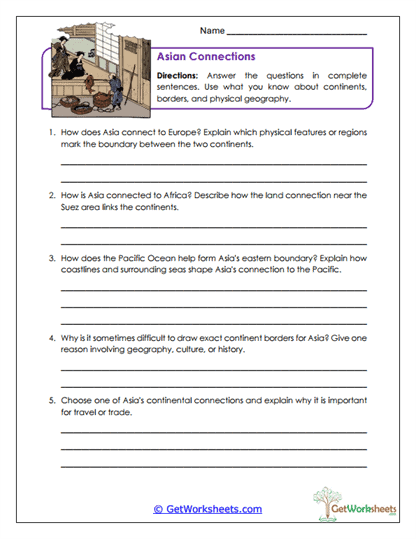
This worksheet is designed for students in Grades 6, 7, and 8 and focuses on helping them understand how Asia is physically and geographically connected to Europe, Africa, and the Pacific region. Through short-response questions and a reflective writing prompt, students analyze natural boundaries such as mountain ranges, land bridges, waterways, and coastlines while practicing geographic reasoning, explanatory writing, and real-world application of map knowledge.
Academic Focus
- Continental Geography (Grades 6-8) – Explain how Asia connects to Europe, Africa, and the Pacific through physical features
- Natural Boundaries & Landforms – Describe the role of mountains, waterways, and coastlines in shaping continents
- Geographic Reasoning – Analyze how physical geography influences movement, trade, and interaction
- Explanatory Writing – Respond in complete, well-supported sentences using geographic vocabulary
Instructional Support
- Teacher-Created Resource – Developed by educators with clear alignment to geography and ELA standards
- Explanation-Based Questions – Encourages reasoning and understanding rather than simple recall
- Real-World Connections – Links physical geography to trade routes, travel, and global interaction
- Flexible Use – Suitable for geography units, assessment, independent work, or homeschool learning
This Border Links worksheet helps students see how continents are connected through natural features and why those connections matter. By explaining boundaries, relationships, and geographic significance, learners strengthen spatial awareness, analytical thinking, and written communication. Ideal for classroom or homeschool use, this printable resource offers meaningful practice that deepens understanding of global geography and continental relationships.
Bookmark Us Now!
New, high-quality worksheets are added every week! Do not miss out!