Southern Ocean Worksheets
About This Worksheet Collection
This Southern Ocean worksheet collection introduces students to one of Earth's most powerful and least understood marine environments. Through a blend of informational texts, vocabulary-building activities, classification exercises, and comparative analysis, learners gain a comprehensive understanding of the region surrounding Antarctica. The worksheets highlight essential concepts such as ocean currents, wildlife adaptations, polar climate patterns, and the global significance of the Antarctic Circumpolar Current.
Across these activities, students build essential literacy and science skills, including reading informational passages, interpreting scientific processes, sequencing events, and analyzing environmental cause-and-effect relationships. The collection encourages critical thinking about polar ecosystems and climate systems while strengthening students' confidence with content-rich academic language. By exploring the Southern Ocean from multiple angles, learners develop a deeper appreciation of Earth's interconnected ocean systems.
Detailed Descriptions Of These Worksheets
An Overview
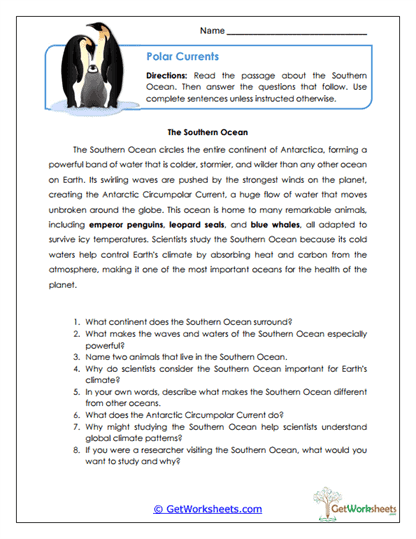
Students read an engaging passage that introduces the extreme climate, unique wildlife, and global importance of the Southern Ocean. The worksheet guides learners through key ideas about strong winds, powerful waves, and the Antarctic Circumpolar Current. After reading, students answer comprehension questions that reinforce factual recall and strengthen their ability to explain scientific concepts clearly. The activity supports informational reading and builds foundational ocean science knowledge.
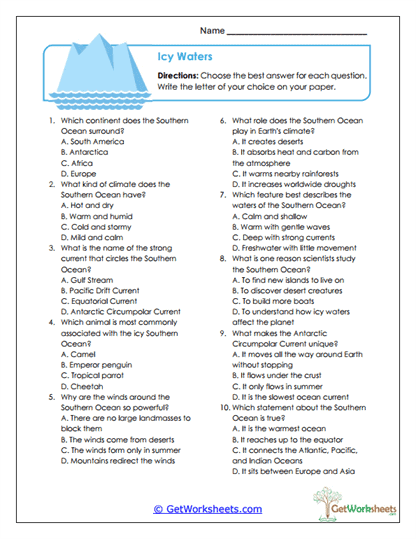
Southern Quiz
This multiple-choice quiz helps students review major features of the Southern Ocean, from its location around Antarctica to its role in climate regulation. Learners examine each question carefully and select the best answer, practicing standardized test-style reasoning. The activity supports accuracy, detail-oriented reading, and familiarity with core oceanography vocabulary. It also reinforces understanding of the Circumpolar Current and regional wildlife.
Paragraph Fill-In
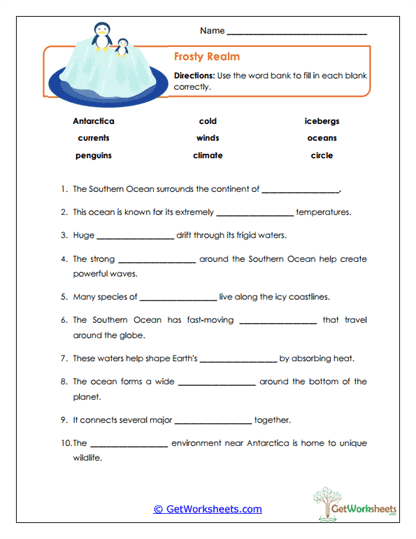
Students complete a descriptive paragraph using word-bank terms related to the Southern Ocean's climate, ice features, and fast-moving currents. As they select the correct words, learners strengthen their understanding of environmental concepts and Earth science terminology. The activity encourages careful reading and precise vocabulary use. It also builds confidence with context-based reasoning in informational text.
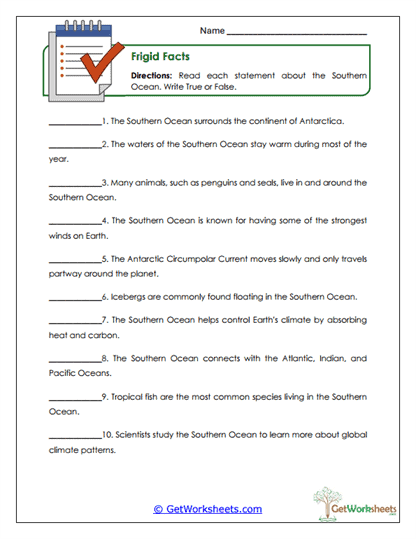
True or False
Students analyze ten statements about the Southern Ocean, determining which are accurate and correcting any that contain errors. The worksheet reviews topics such as extreme winds, icebergs, and climate influence while reinforcing scientific accuracy. By rewriting false statements, learners practice revising content for clarity and correctness. This task supports critical reading and strengthens fact-checking skills.
Features Facts
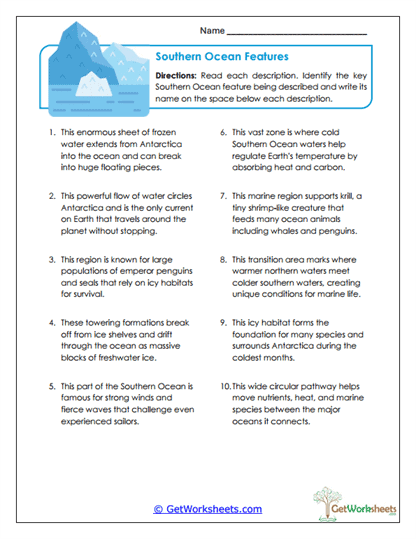
This matching worksheet introduces students to physical features of the Southern Ocean, such as sea ice, ice shelves, transition zones, and major currents. Learners match each description to the correct scientific term, improving their ability to identify and understand polar features. The activity enhances vocabulary knowledge and strengthens comprehension of ocean systems. It encourages careful reading and scientific recognition.
Ocean Vocabulary
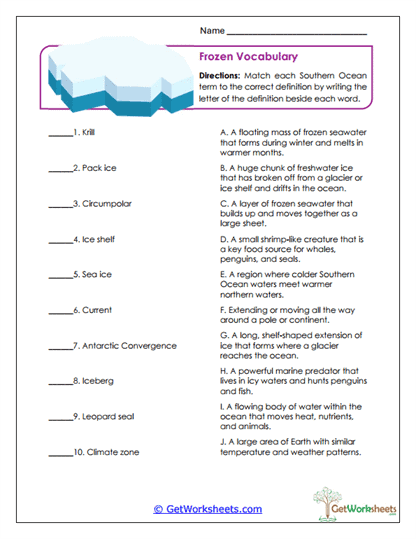
Students match Southern Ocean terms-including krill, pack ice, climate zone, and iceberg-to their correct definitions. The activity builds essential vocabulary used in oceanography, polar science, and climate studies. Learners develop stronger word-recognition skills while connecting terminology to real-world processes. It provides valuable practice with scientific language.
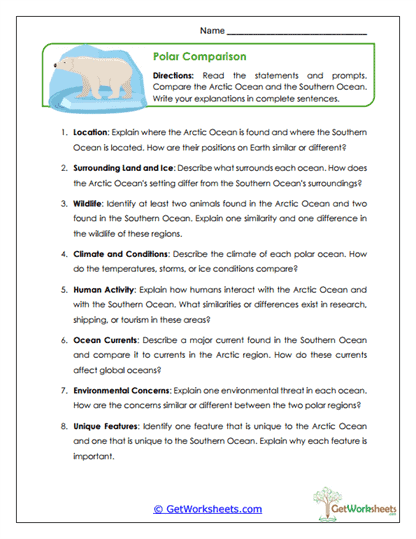
Polar Comparison
Students write detailed explanations comparing the Arctic Ocean and the Southern Ocean across multiple categories such as wildlife, climate, location, and human activity. This worksheet encourages deep thinking about how Earth's polar regions differ and what unique characteristics each holds. Learners practice writing in complete sentences and organizing comparative ideas clearly. It strengthens analytical reasoning and content knowledge.
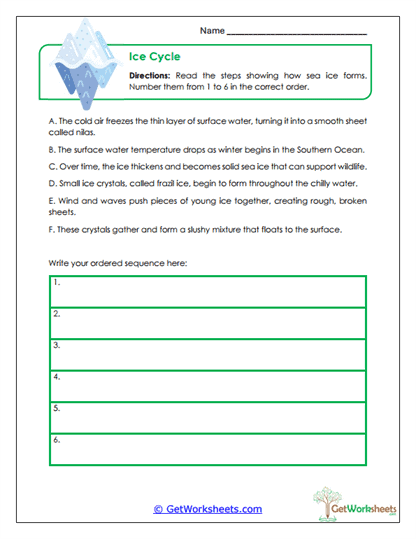
Sea Ice Sequence
This sequencing activity asks students to order six steps in the formation of sea ice, from early-stage frazil crystals to solid sheets. The worksheet supports understanding of physical processes and highlights the cause-and-effect relationships involved in ice formation. Learners build skills in ordering events and interpreting scientific descriptions. It is a strong reinforcement of polar environmental concepts.
Animal Classification Polar
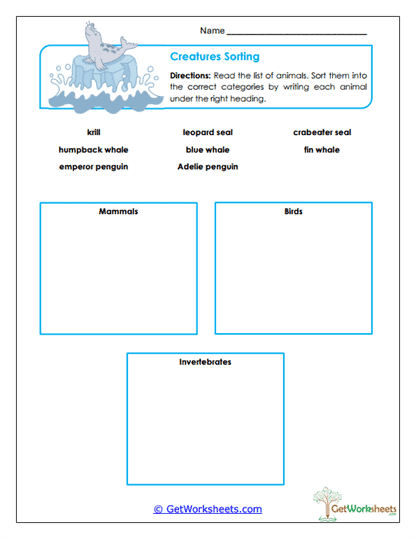
Students categorize Southern Ocean animals-such as whales, penguins, seals, and krill-into mammals, birds, or invertebrates. The activity reinforces biological classification and strengthens understanding of polar ecosystems. Learners practice grouping organisms by shared characteristics while deepening their familiarity with regional wildlife. It supports critical thinking and ecological knowledge.
Environmental Cause and Effect
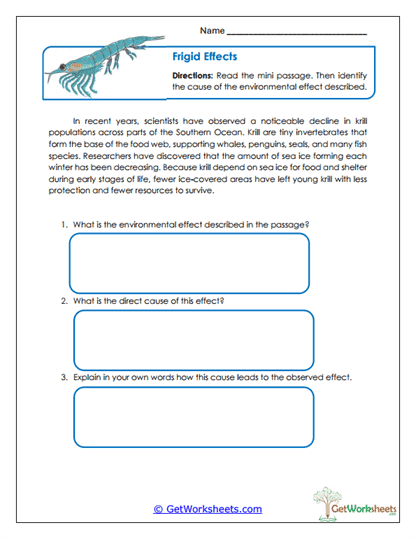
In this worksheet, students read a passage describing how reduced sea ice affects krill populations and related food webs. They identify the cause, the resulting effect, and explain the relationship in their own words. The task strengthens understanding of ecological processes and human-environment interactions. It also supports clear scientific explanation writing.
Circumpolar Current Fill-In
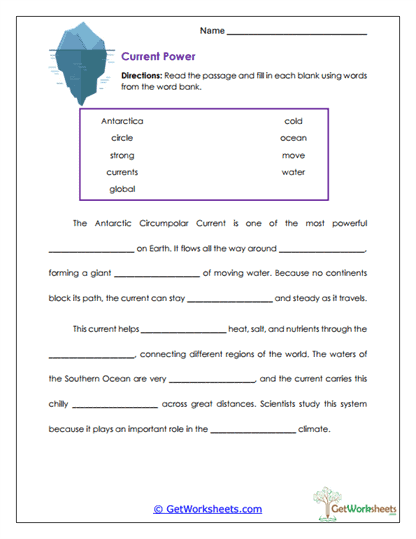
Students complete a passage explaining the Antarctic Circumpolar Current using words from a provided list. The activity highlights how the ACC circulates around Antarctica, moves heat and nutrients, and shapes global climate. Learners use context clues to select accurate scientific terms. This reinforces vocabulary knowledge and supports comprehension of ocean circulation.
Ocean Climate Comparison
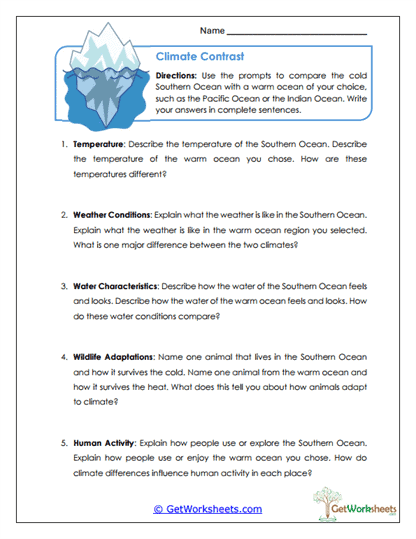
Students compare the Southern Ocean with a warm ocean of their choice by describing contrasts in temperature, wildlife, water conditions, and human activity. They write complete explanations using evidence from their knowledge of climate zones. The worksheet strengthens compare-and-contrast reasoning and encourages students to think about how climate shapes ecosystems. It supports clear, organized explanatory writing.
Bookmark Us Now!
New, high-quality worksheets are added every week! Do not miss out!