Sequencing Events Worksheets
About This Worksheet Collection
This sequencing events collection gives teachers and parents a well-rounded set of literacy activities that help learners understand how ideas, actions, and processes unfold in logical order. Across the worksheets, students work with narrative sequence, procedural steps, signal words, prediction, and text structure, making the set useful for reading instruction, writing support, and intervention practice. The activities are varied enough to keep practice engaging, yet focused enough to build a consistent understanding of chronology and organization. For classroom use, these pages fit naturally into comprehension lessons, literacy centers, and small-group support; for home use, they offer clear, skill-based practice that strengthens reading habits without requiring extensive preparation.
As students move through the collection, they develop stronger comprehension, retelling, summarizing, and narrative writing skills by learning to notice how events connect over time. They also build academic vocabulary through transition words and begin to distinguish between related structures such as sequence and cause-and-effect. For educators, this means stronger support for standards tied to story structure, informational text organization, and clear writing. For families, it means children gain practical tools for following directions, explaining ideas in order, and making better sense of what they read.
Detailed Descriptions Of These Worksheets
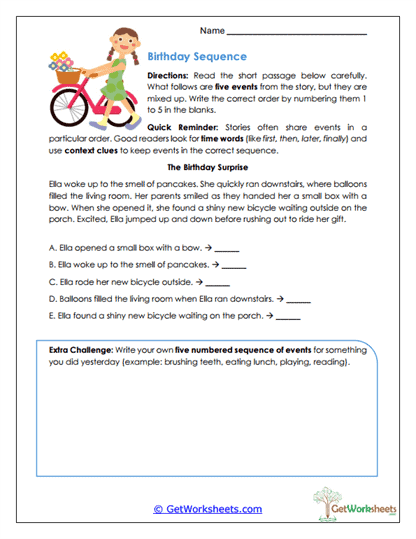
Birthday Sequence
A birthday-themed story gives learners an approachable way to practice putting events in their proper order using time clues and contextual details. Instead of relying on memory alone, students must pay attention to how one action leads into the next, which strengthens close reading and logical thinking. Teachers can use this worksheet to reinforce sequence signal words while also checking whether students truly understand the flow of a narrative. It is especially helpful for building the retelling skills that support later summary writing and story composition.
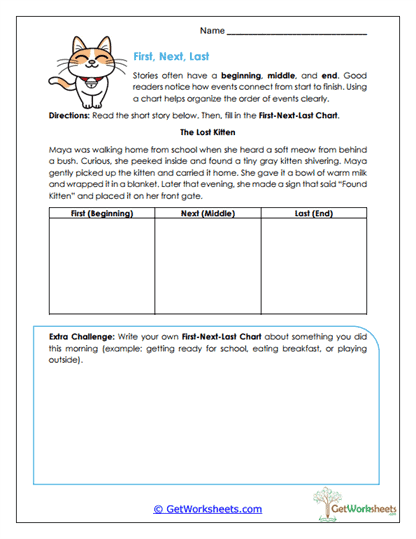
First, Next, Last
This worksheet strips story structure down to its most essential framework by helping learners sort events into beginning, middle, and end. That simple structure makes narrative organization easier to grasp for developing readers and gives teachers a clear entry point for comprehension instruction. Parents may also appreciate how the format helps children explain stories more clearly instead of jumping from one event to another. The activity quietly builds summarizing skills while making story shape feel concrete and manageable.
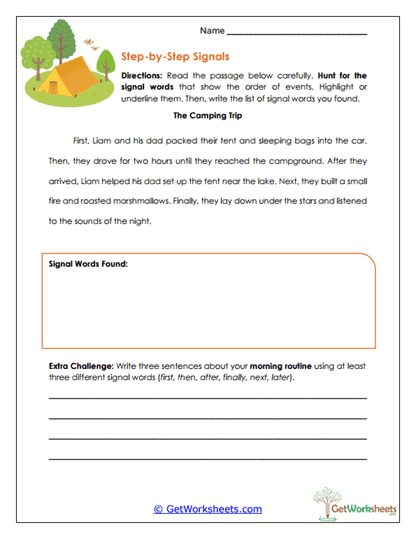
Step-by-Step Signals
Learners are asked to notice and work with sequence words such as first, next, then, and finally, turning transitional language into a visible reading strategy. This close attention to signal words helps students follow event order more confidently and gives them useful language for their own writing. In the classroom, it serves as a strong bridge between comprehension and composition because students begin to see how authors guide readers through a text. Over time, that awareness supports clearer writing, better retelling, and stronger organizational habits.
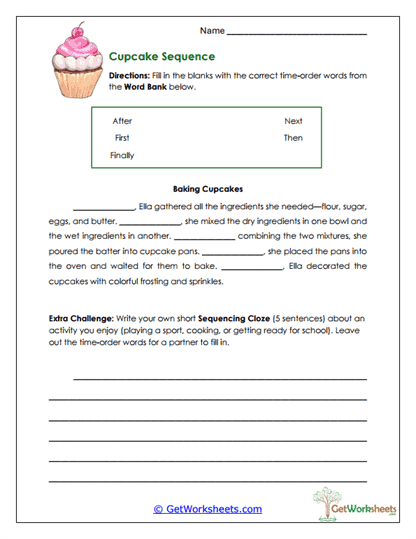
Cupcake Sequence
A familiar baking process makes this worksheet especially effective for teaching time-order words in a meaningful context. Students must choose transitions that make the directions logical and easy to follow, which reinforces both reading comprehension and process writing. Teachers can use it to connect literacy with real-world procedural text, while parents can point to how sequencing is used in everyday tasks. The result is a practical activity that strengthens clarity, structure, and purposeful word choice.
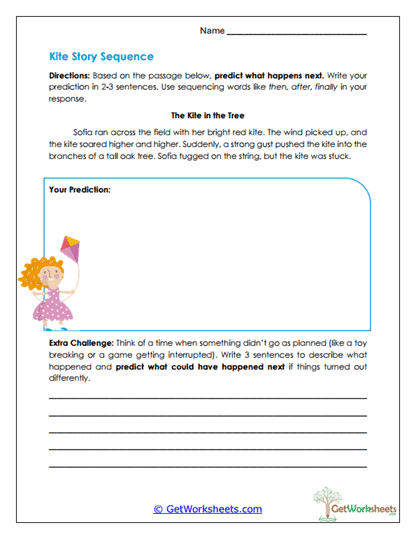
Kite Story Sequence
This worksheet goes a step further by blending sequencing with prediction, asking learners to use earlier events to determine what is most likely to happen next. That combination encourages active reading because students must think beyond the page while staying grounded in textual evidence. For teachers, it offers a useful way to build inference skills without losing focus on sequence. It also supports creative thinking by showing students that good predictions come from careful attention to story progression.
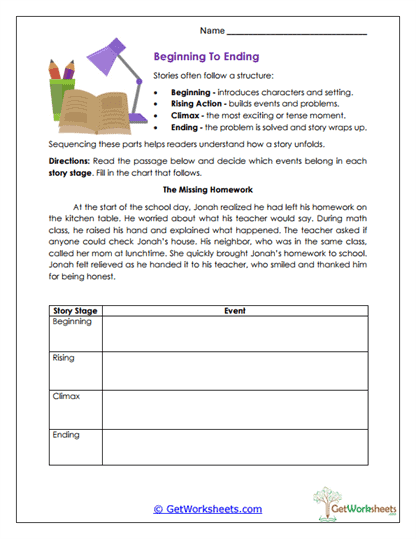
Beginning to Ending
Rather than focusing only on simple event order, this worksheet introduces learners to the deeper architecture of a story through beginning, rising action, climax, and resolution. Students begin to analyze not just what happened, but how the plot is constructed and why certain moments matter more than others. Educators will find it especially valuable for moving students into early literary analysis and plot discussion. It also gives young writers a stronger model for building tension and resolution in their own narratives.
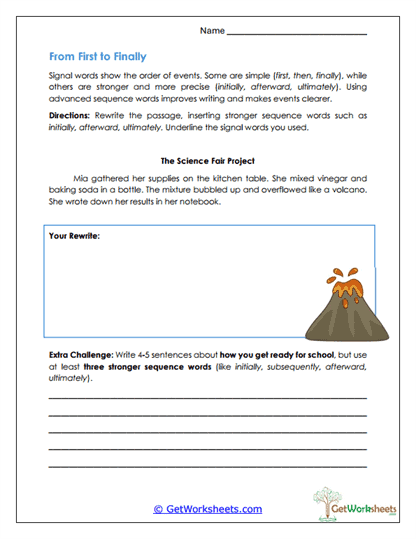
From First to Finally
This activity expands students' sequencing vocabulary by replacing basic transition words with more polished options such as initially, afterward, and ultimately. By revising an existing passage, learners practice applying stronger sequence language in context rather than memorizing isolated terms. Teachers can use it to support more mature writing and improved sentence fluency, especially as students move into longer responses. For parents, it offers visible growth from simple storytelling toward more academic, organized expression.
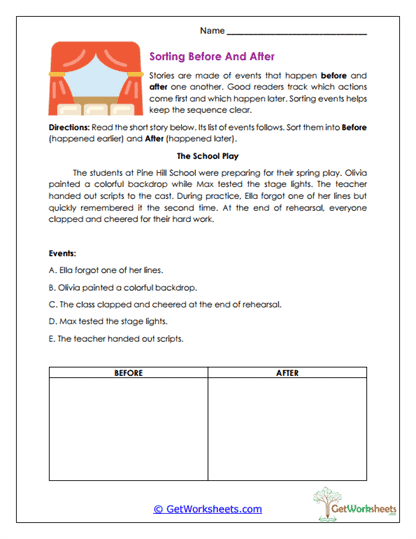
Sorting Before and After
Students strengthen their grasp of event timing by categorizing actions according to whether they happened before or after key moments in a story. That sorting process helps clarify relationships between events and gives learners practice with an important comprehension skill that goes beyond simple first-to-last ordering. In instruction, it works well as a bridge between basic sequencing and more advanced analysis of how events connect. It also supports more accurate retelling, which is a common area of difficulty for developing readers.
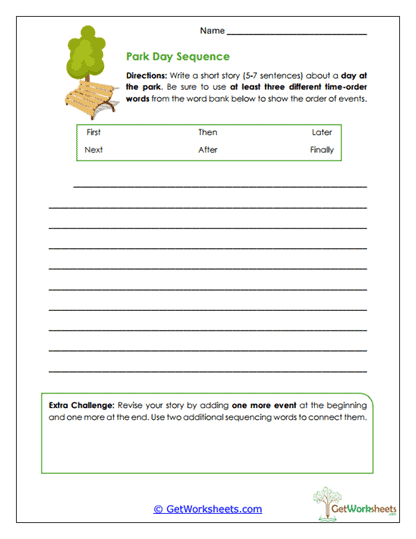
Park Day Sequence
This worksheet shifts sequencing from reading into writing by asking students to create their own short narrative using time-order language. Instead of identifying a sequence that is already provided, learners must generate one themselves, which strengthens ownership of structure and organization. Teachers can use it to connect comprehension skills directly to written expression, while parents can use it to encourage creative storytelling with clear beginnings and endings. The activity reinforces that good writing depends on logical flow as much as imagination.
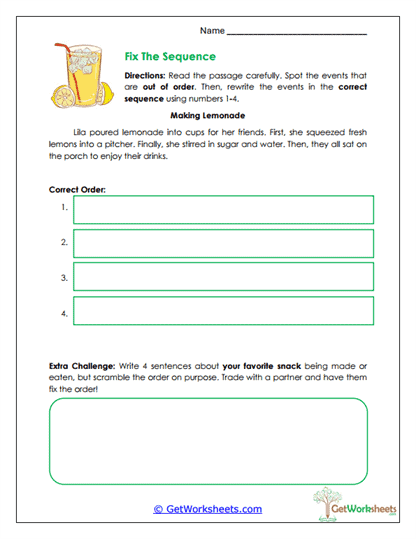
Fix the Sequence
Error correction gives this worksheet a slightly higher level of challenge, since learners must detect when events are arranged incorrectly and then repair the order. That process encourages rereading, self-monitoring, and attention to what makes a text logically coherent. Teachers may find it particularly useful for students who need practice noticing when something in a story does not make sense. The task builds stronger comprehension habits by teaching children to question, verify, and revise rather than reading passively.
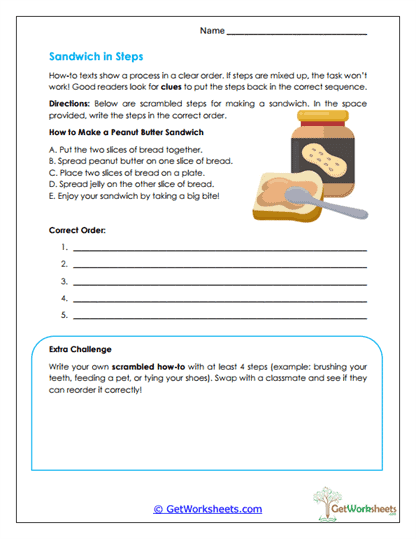
Sandwich in Steps
A real-life process provides the structure for this procedural sequencing activity, helping students organize the steps involved in making a sandwich. Because the task is practical and familiar, it makes sequencing feel immediately relevant beyond the reading block. Educators can use it to introduce procedural text features and reinforce how ordered steps support successful outcomes. Parents may appreciate that it strengthens both literacy and independence, since following directions is a skill children use every day.
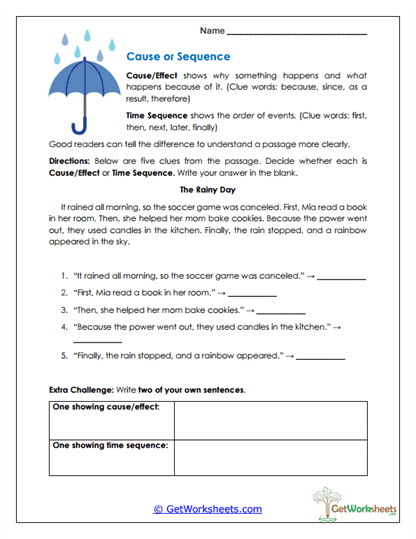
Cause or Sequence
This worksheet helps learners distinguish between two commonly confused text structures by deciding whether a sentence shows time order or cause-and-effect. That comparison sharpens analytical reading and gives students stronger tools for understanding how ideas are organized in both stories and informational texts. Teachers can use it to prevent the kind of structure confusion that often affects comprehension and writing clarity. The activity lays important groundwork for more advanced text analysis by helping students recognize whether a passage is explaining when something happened or why it happened.
Bookmark Us Now!
New, high-quality worksheets are added every week! Do not miss out!