Poland Worksheets
About This Worksheet Collection
This Poland worksheet collection provides educators with a rich blend of geographical, historical, cultural, and economic topics that illuminate one of Europe's most dynamic countries. Each activity approaches Poland from a different angle-its regions, borders, cities, industries, and traditions-offering teachers a well-rounded set of tools for social studies and literacy instruction. The materials balance informational reading passages with skill-building tasks, helping students gain both factual knowledge and confidence in interpreting nonfiction text.
Across the collection, students strengthen essential academic skills such as reading for detail, analyzing historical change, interpreting maps and borders, evaluating cultural features, and applying vocabulary in context. The worksheets promote evidence-based writing, critical thinking, and the ability to connect geography with human activity. Through these varied activities, learners develop a deeper understanding of Poland's role in Europe and the world.
Detailed Descriptions Of These Worksheets
Country Overview
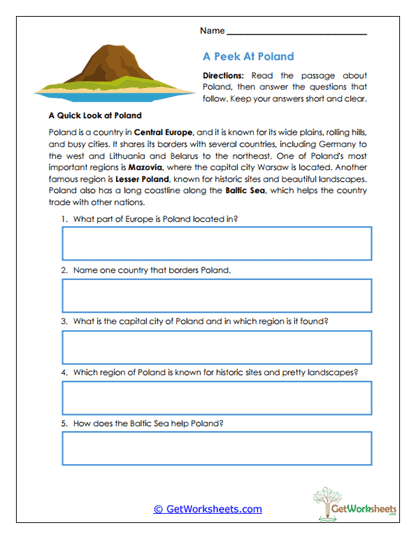
This worksheet introduces students to the geography and major regions of Poland through a clear, engaging passage. Learners explore border countries, key places such as Mazovia and Lesser Poland, and the importance of the Baltic Sea for trade. After reading, students answer questions that require complete-sentence responses and careful use of textual evidence. The activity supports comprehension of European geography and strengthens skills in locating and recalling factual details.
Historical Geography
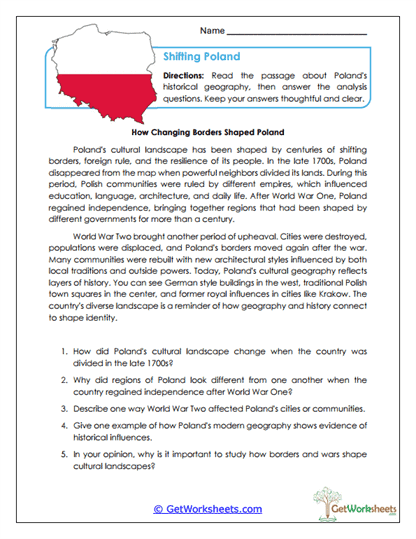
Students examine a reading passage explaining how Poland's borders and cultural influences have shifted over centuries. They analyze changes from the partitions of the late 1700s through major transformations following both World Wars. The worksheet guides learners in understanding how conflict, foreign rule, and rebuilding efforts shaped modern Poland. By responding to thoughtful prompts, students build skills in analytical reading and historical interpretation.
Cities Reading
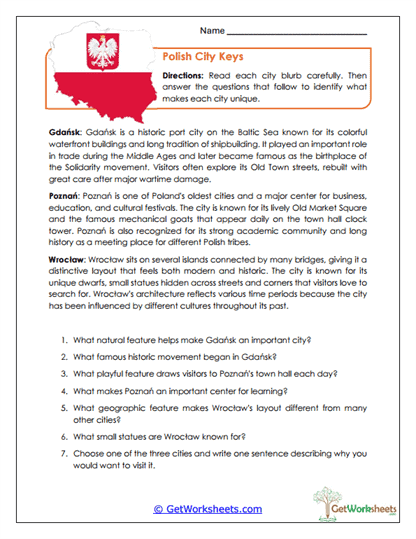
This worksheet highlights three Polish cities-Gdańsk, Poznań, and Wrocław-through descriptive mini-passages. Students identify distinguishing features such as architecture, markets, waterways, and cultural traditions. They compare the cities and explain which one they might enjoy visiting and why. The activity sharpens detail-oriented reading and strengthens geographic and cultural awareness.
Landmarks Quiz
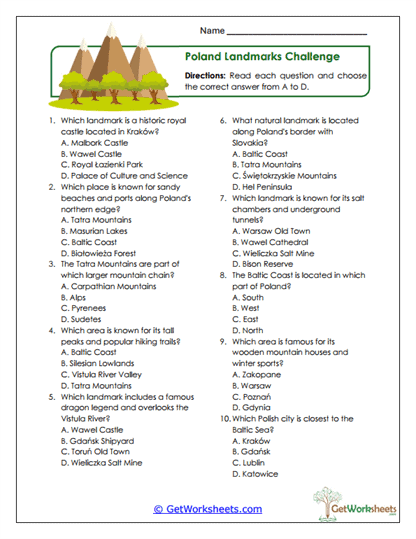
Students answer multiple-choice questions about important Polish landmarks, including natural wonders and historic sites. The format encourages close reading and careful reasoning as learners consider each option. Through the quiz, students become familiar with notable places such as Wawel Castle and the Tatra Mountains. It also reinforces test-taking skills and geographic knowledge.
Basics Fill-In
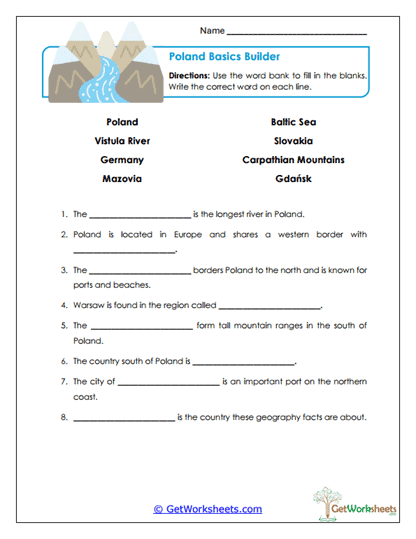
Using a word bank, students complete sentences about key elements of Poland's physical and political geography. The worksheet covers rivers, mountain ranges, ports, and regions, helping learners strengthen retention of foundational facts. Students use context to choose the correct terms and reinforce important vocabulary. This activity supports both comprehension and accuracy in geographic understanding.
Fact Check
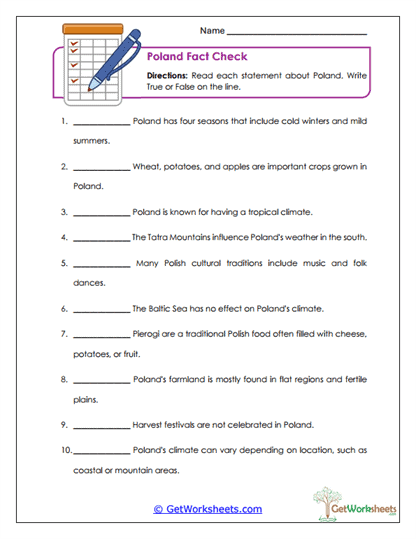
This worksheet asks students to determine whether statements about Poland's climate, traditions, and agriculture are true or false. When statements are incorrect, learners rewrite them to reflect accurate information. The activity promotes careful reading, correction skills, and deeper understanding of regional differences within Poland. It also supports content knowledge related to culture and environment.
Border Connections
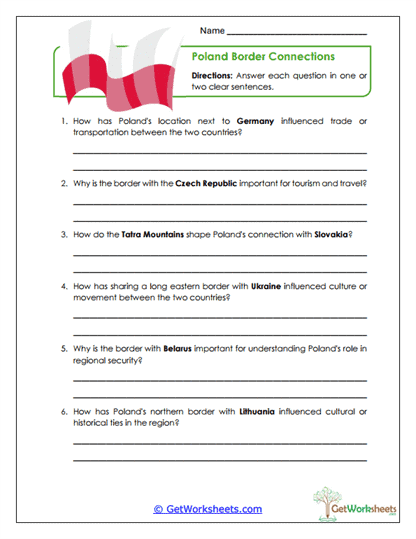
Students explore Poland's borders with neighboring countries and consider how these boundaries influence trade, tourism, and international relationships. They respond to short-answer questions requiring clear explanations and reasoned analysis. The worksheet encourages learners to think about geography as a force shaping cooperation and historical connections. It strengthens both political geography understanding and written communication.
Industry Insights
This worksheet introduces students to Poland's major industries, from agriculture and mining to shipbuilding and technology. Learners read about how physical geography supports economic activity and then answer evidence-based questions. They also examine how traditional sectors interact with modern innovation to shape national growth. The activity reinforces comprehension of economic geography and analytical writing.
Culture Match
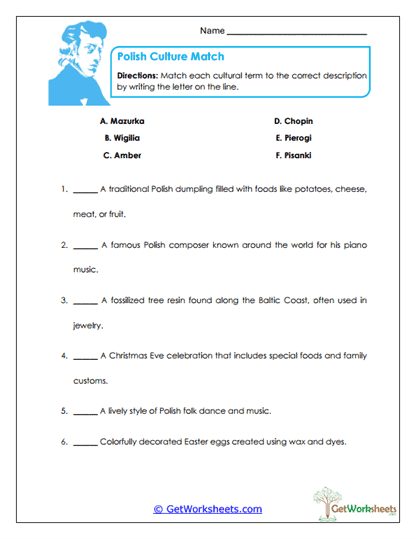
Students match cultural terms-such as pierogi, Chopin, and Wigilia-to their correct descriptions. The activity builds recognition of influential foods, holidays, music, and artistic traditions that define Polish identity. Learners strengthen vocabulary knowledge while practicing classification skills. It provides an engaging introduction to cultural studies and national heritage.
Climate Vocabulary
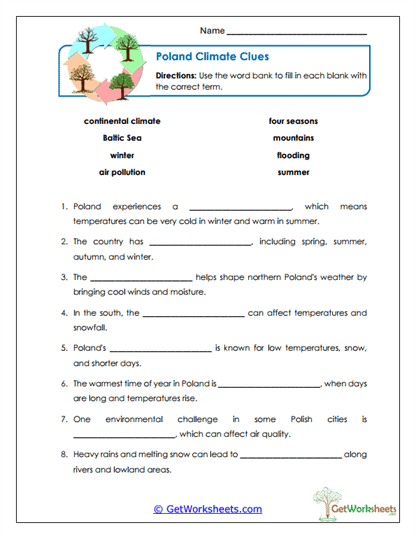
Using a word bank, students complete statements that explain Poland's climate patterns and environmental conditions. Concepts include seasonal changes, mountain influences, flooding, and Baltic Sea effects. The activity helps learners link weather patterns to geography and human life. It supports vocabulary development and strengthens understanding of physical geography.
Poland in the EU
This worksheet explains Poland's role within the European Union and how membership benefits the country politically and economically. Students learn about trade, investment, and cooperative projects before responding to evidence-based questions. The activity promotes comprehension of international relations and strengthens analytical writing. It deepens students' understanding of Poland's position in modern Europe.
Energy Geography
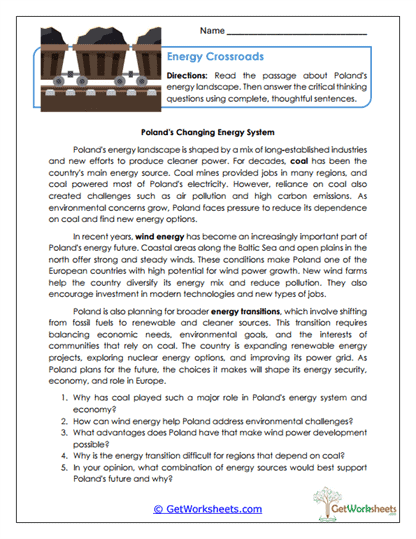
Students read about Poland's evolving energy system, including coal use, environmental concerns, and the rise of renewable sources. They answer critical-thinking questions that require them to evaluate challenges and weigh potential solutions. The activity ties together environmental science, economics, and geography in a meaningful way. It supports problem-solving skills and encourages thoughtful consideration of future development.
Bookmark Us Now!
New, high-quality worksheets are added every week! Do not miss out!