Pacific Ocean Worksheets
About This Worksheet Collection
This Pacific Ocean worksheet collection offers educators a rich blend of geography, earth science, ecology, and cultural studies. Each activity approaches the Pacific from a different angle-its physical features, island systems, climate patterns, wildlife, and human interactions-allowing teachers to present a full and engaging picture of the world's largest ocean. With passages, vocabulary work, classification tasks, map-based reasoning, and critical-thinking challenges, the collection supports flexible instruction across grade levels and curriculum goals.
Across these varied worksheets, students build a wide foundation of skills while deepening content knowledge. Learners practice reading informational text, interpreting scientific ideas, analyzing cause-and-effect relationships, and strengthening their understanding of cultures and environments shaped by the Pacific. The activities promote evidence-based reasoning, observational accuracy, and conceptual vocabulary, helping students grow as thoughtful readers, problem-solvers, and global thinkers.
Detailed Descriptions Of These Worksheets
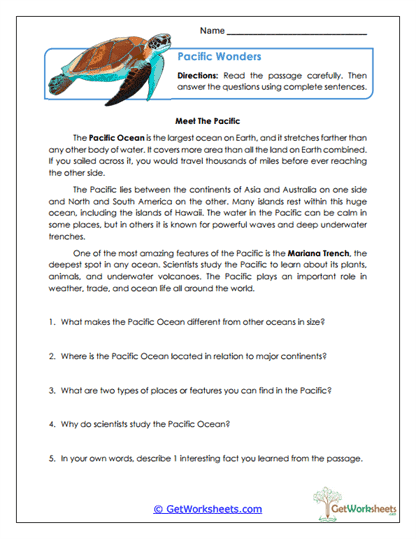
Pacific Wonders
This reading passage introduces students to the vast Pacific Ocean and the many natural wonders found within it. Learners examine everything from deep trenches to wide island chains as they explore how geography influences global systems. The worksheet guides students toward identifying main ideas, drawing connections across concepts, and applying evidence from the text. It also encourages thoughtful analysis of how the ocean impacts weather, ecosystems, and daily life.
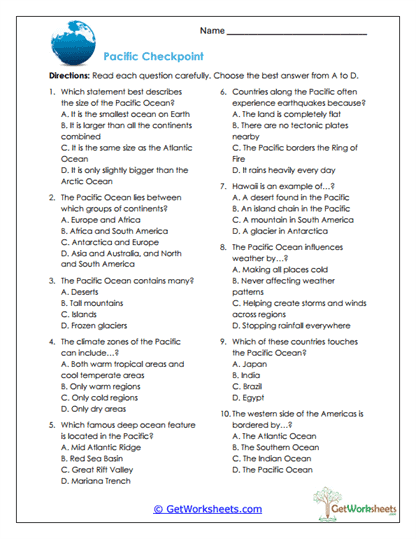
Ocean Quizzer
This multiple-choice activity challenges students to apply their understanding of Pacific Ocean features, including earthquakes, weather influences, and major continental boundaries. Each question invites careful comparison of similar facts, prompting learners to think logically before selecting an answer. Students not only reinforce key geography concepts but also gain confidence in test-taking strategies. The format supports close reading and precise reasoning.
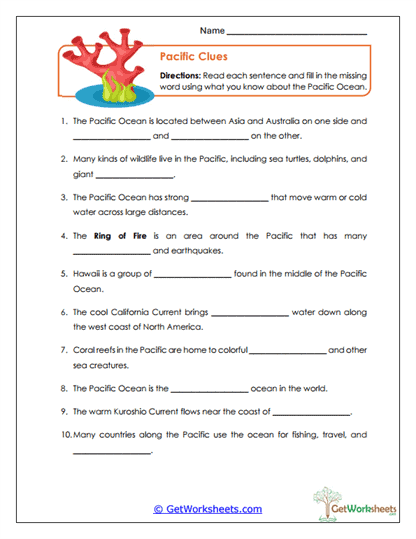
Clue Waves
Students complete fill-in-the-blank statements that highlight important facts about Pacific wildlife, currents, coral systems, and island features. The clues help learners use context to determine missing vocabulary and reinforce scientific terminology. As they work, students deepen their grasp of how the Pacific's physical processes shape living environments. The activity builds accuracy, attention to detail, and conceptual understanding.
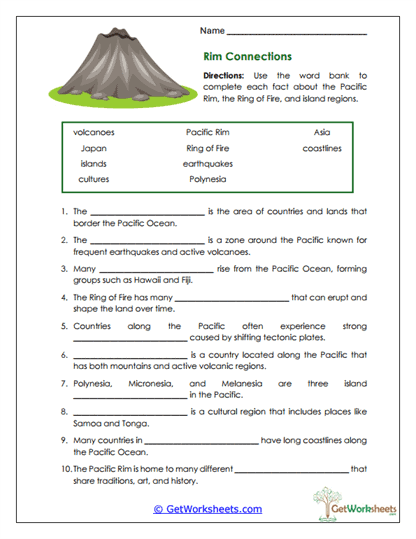
Rim Connections
This worksheet introduces students to major Pacific Rim regions and the powerful tectonic forces that influence them. Using a word bank, learners describe earthquakes, volcanoes, coastal nations, and culturally connected island groups. The activity blends earth science with cultural geography as students explore how natural processes affect human communities. By making these connections, students strengthen cause-and-effect reasoning and expand their academic vocabulary.
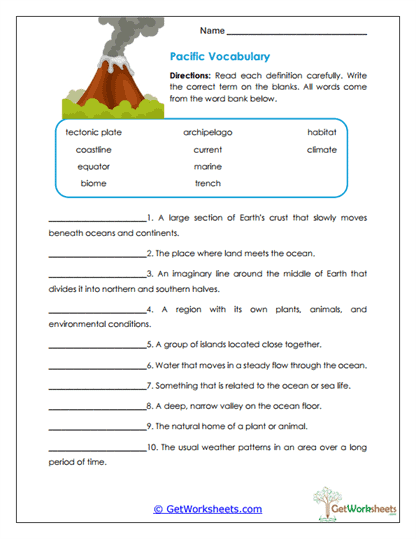
Word Waves
In this vocabulary-focused worksheet, students match scientific and geographic terms to their correct definitions. The activity highlights words such as biome, trench, coastline, and archipelago to strengthen disciplinary language. Students learn to interpret specialized vocabulary accurately and apply it in context. This exercise supports fluency in academic reading and prepares learners for more advanced scientific texts.
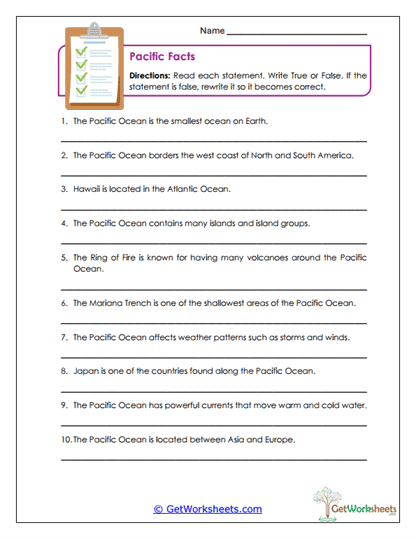
True Tides
Students evaluate statements about Pacific Ocean characteristics and determine whether each one is factually correct. When a statement is false, learners rewrite it to reflect accurate information, strengthening both comprehension and precision. This task encourages students to analyze geography content carefully and correct misconceptions. It also reinforces long-term retention of essential ocean facts.
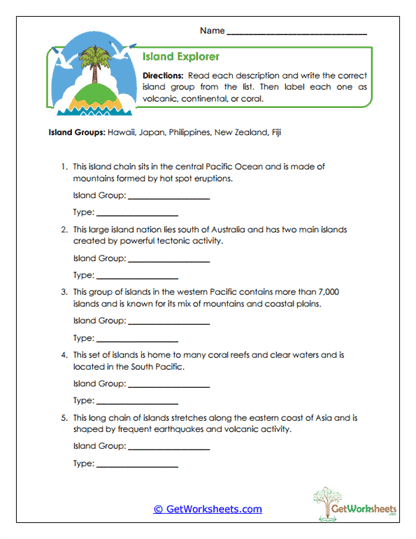
Island Explorer
Learners identify different types of Pacific islands-volcanic, coral, and continental-using descriptive clues about their formation and environment. Students compare physical features, geological origins, and regional examples to complete the classification. The activity encourages analytical thinking as students interpret details and match them to the correct island type. It provides an engaging blend of earth science and cultural geography.
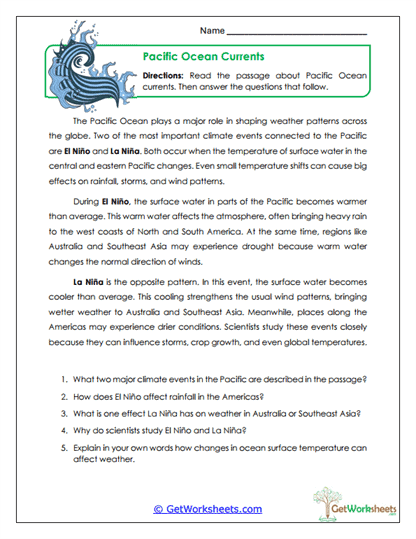
Ocean Currents
This reading passage explains the climate events known as El Niño and La Niña and how they influence global patterns of weather. Students explore how changes in Pacific water temperatures can affect storms, rainfall, agriculture, and climate systems around the world. The worksheet promotes an understanding of complex scientific relationships and encourages students to analyze evidence within informational text. It also strengthens comprehension of climate vocabulary.
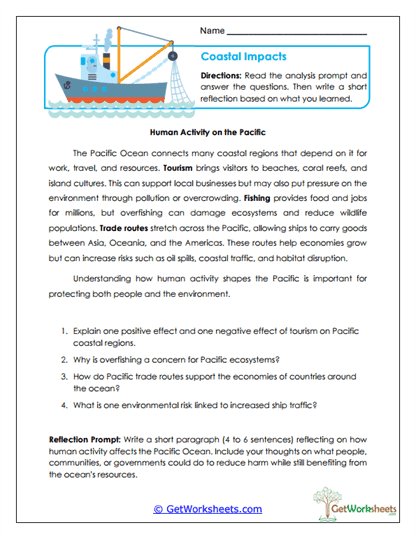
Coastal Impacts
Students read about human activities along Pacific coastlines and how these actions shape both environments and local communities. The passage introduces topics such as tourism, overfishing, pollution, and trade, prompting learners to consider their benefits and drawbacks. A written reflection invites students to propose strategies for protecting coastal ecosystems. This task blends environmental science with critical thinking and explanatory writing.
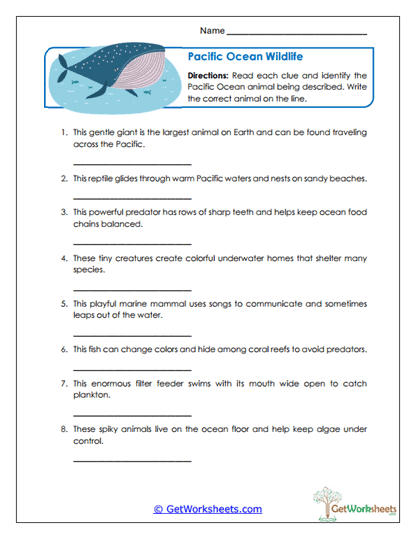
Ocean Creatures
Students match descriptive clues to Pacific animals such as whales, sea turtles, sharks, coral polyps, and sea urchins. The worksheet encourages learners to use inference and observation to connect behaviors and adaptations to the correct species. As students work through the clues, they build understanding of ecosystem roles and marine biodiversity. The activity reinforces life science vocabulary and supports deeper ecological reasoning.
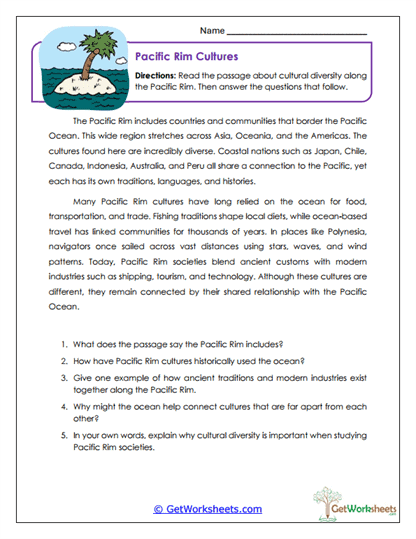
Pacific Rim Cultures
This worksheet introduces learners to the diverse cultures surrounding the Pacific Rim and how geography influences traditions and daily life. Through the passage and accompanying questions, students explore the connections between environment, navigation, fishing practices, and modern industries. They compare cultural practices and consider why cultural diversity is essential to studying the region. The activity supports comprehension, cultural awareness, and evidence-based responses.
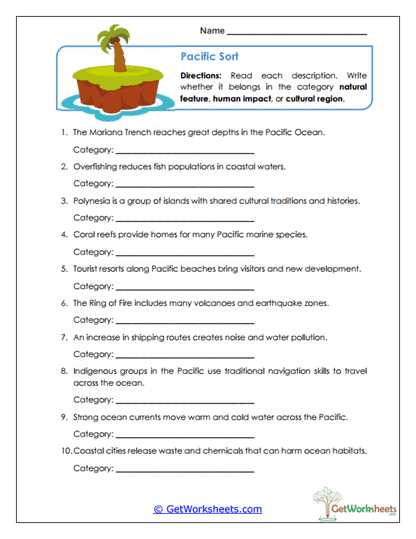
Pacific Sort
Students categorize a series of descriptions into natural features, human impacts, or cultural regions related to the Pacific. The sorting task requires learners to analyze each statement closely and identify its central idea. By distinguishing between physical geography, human activity, and cultural traditions, students develop stronger classification and reasoning skills. This worksheet deepens understanding of how natural systems, people, and cultures interact across the Pacific region.
Bookmark Us Now!
New, high-quality worksheets are added every week! Do not miss out!