Explicit vs. Implied Details Worksheets





About This Worksheet Collection
The Explicit vs. Implied Details collection helps students become careful, analytical readers who understand not only what the text says but also what it suggests. Each worksheet guides learners through the process of identifying explicit information, facts and statements clearly presented, and contrasting it with implied meaning that must be inferred from tone, context, and character behavior. By practicing this distinction, students gain the ability to think critically, draw logical conclusions, and support interpretations with textual evidence.
Throughout the collection, learners strengthen comprehension, inference, and reasoning across narrative and informational texts. These activities also build empathy and awareness of subtext, helping readers recognize emotion, motivation, and author intent. Through sorting, labeling, short-answer responses, and written justification, students refine their ability to “read between the lines” and support their conclusions with clear, text-based proof.
Detailed Descriptions Of These Worksheets
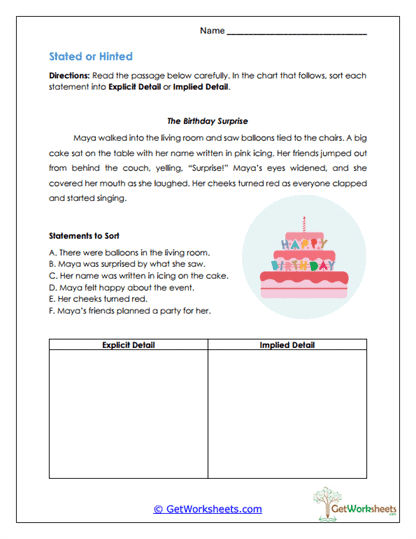
Stated or Hinted
Students read about a surprise birthday party and sort statements into explicit or implied categories. The task teaches them to separate clearly stated details from ideas that require inference. It strengthens reading comprehension, interpretation, and evidence-based reasoning.
Stated Meets Suggested
Learners analyze a short passage about a lost umbrella and draw lines matching explicit clues to implied ideas. This activity connects observation with interpretation, helping students recognize how authors hint at meaning through subtle context.
Homework Hints
Students complete a chart dividing explicit facts from implied conclusions in a passage about a nervous student. This structured task develops inferential reasoning and close reading skills by teaching how tone and action reveal hidden meaning.
True or Implied
Using a soccer game narrative, learners determine whether each statement is directly stated or inferred. The familiar theme keeps engagement high while promoting evidence-based judgment and contextual analysis.
The Empty Chair
Students read a classroom story and infer emotions and motivations not directly expressed. This activity deepens empathy and subtext awareness, teaching readers to connect actions and dialogue with underlying meaning.
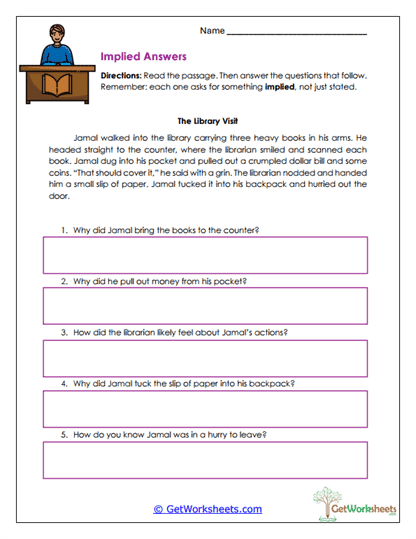
Implied Answers
Learners interpret a story about a library visit by analyzing implied feelings and motivations. Through guided questions, they identify context clues and reasoning that reveal indirect meaning. It’s ideal for building critical comprehension skills.
Missed Bus Inference
Students read a passage about a missed school bus and infer emotional and situational meaning beyond what’s written. The activity strengthens awareness of tone and body language cues, enhancing narrative interpretation.
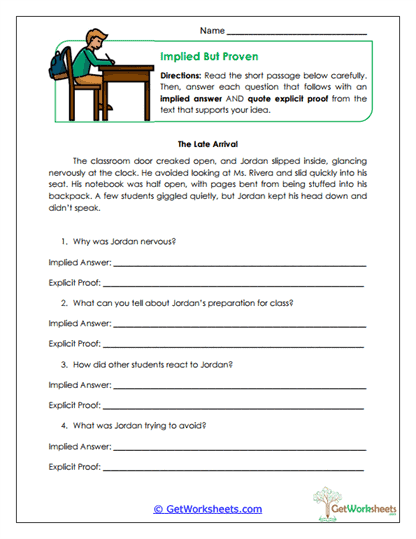
Implied But Proven
Learners answer inferential questions about a late student while citing explicit textual proof. This two-step structure teaches how to justify inferences with evidence, reinforcing critical thinking and academic reading rigor.
Implied Personalities
Students read about a girl rescuing a kitten and infer her personality traits from her actions. The exercise develops understanding of indirect characterization and emotional intelligence through close reading.
Lunchbox Clues
Learners label each sentence in a passage about a forgotten lunch as explicit or implied. They examine dialogue and emotion to uncover unstated meaning, building inference, comprehension, and empathy.
Stormy Word Hunt
Students read a descriptive passage about a thunderstorm and infer meanings of bolded vocabulary using explicit context clues. This worksheet blends inference with vocabulary development, enhancing word comprehension through reasoning.
Implied Conclusion
Learners read an unfinished story about a talent show and infer how it likely ends, citing textual clues to justify their conclusion. This creative-analytical task builds prediction, evidence-based writing, and logical interpretation skills.
Bookmark Us Now!
New, high-quality worksheets are added every week! Do not miss out!