Character Voice Practice Worksheets
-
Anger to Ache
-
Authentic Echoes
-
Café Conversations
-
-
Character Shift Reading
-
Crowns and Chords
-
Dice of Emotions
-
Expressive Dialogue Quest
-
Guess That Character
-
Jokes and Justifications
-
Letters That Linger
-
Mic Check Moments
-
Monologue Mastery
-
Read in Role
-
Storyteller vs. Character
-
The Batter Banter
-
The Silent Confession
-
The Sound of Defiance
-
The Voice Next Door
-
Tone Switch
-
Tone Takes Over
-
Voice Match Quest
-
Voice Pace Challenge
-
Voice Swap Reading
-
Whisper to Stage
About This Worksheet Collection
This character voice practice collection gives teachers and parents a versatile set of literacy activities that move beyond basic comprehension and into interpretation, performance, and close reading. The worksheets invite learners to listen for nuance in dialogue, notice how tone shapes meaning, and explore how speech patterns reveal personality, background, and motivation. Because the activities include analysis, oral reading, perspective work, and role-based performance, the set works well for classroom discussion, small-group instruction, literacy centers, drama integration, and homeschool enrichment. It offers a practical way to make character study more active, memorable, and intellectually engaging.
As learners work through the collection, they strengthen literary analysis, inference, expressive reading, oral communication, and written response skills. The exercises also support social-emotional understanding by asking students to consider attitude, emotion, sincerity, authority, and perspective within a text. For educators, these pages provide strong support for standards-aligned work in tone, point of view, dialogue, and textual evidence. For families, they offer meaningful practice that helps readers become more attentive, articulate, and confident when discussing how characters sound and why that matters.
Detailed Descriptions Of These Worksheets
The Sound of Defiance
Built around a dialogue-rich passage, this worksheet asks learners to examine how conviction, resistance, and attitude come through in a character's speech. Attention to diction, tone, and perspective helps readers see how beliefs are embedded in the way a speaker responds. Teachers can use it to support text-based discussion about characterization and rhetorical stance. It is especially useful for helping students cite dialogue as evidence during literary analysis.
Anger to Ache
Emotional progression takes center stage as learners trace how a speaker's tone shifts across a scene. Rather than treating dialogue as static, the activity encourages readers to notice subtle changes in phrasing, mood, and intensity. This makes it a strong option for teachers who want students to analyze character development through language choices. Parents can also use it to build stronger inferencing habits during independent reading practice.
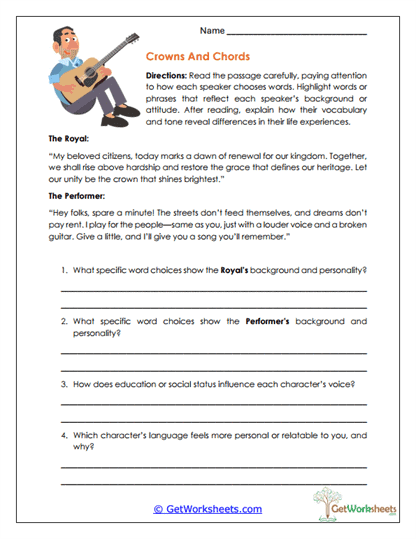
Crowns and Chords
Contrasting voices in paired passages give learners a clear opportunity to compare tone, register, and personal history as reflected in speech. The worksheet highlights how formal and informal language can signal identity, experience, and worldview. For educators, it provides a thoughtful entry point into discussions of characterization and social context. Its comparative format also strengthens analytical writing and class conversation.
Café Conversations
Speech patterns, regional phrasing, and conversational rhythm become the focus in this dialogue analysis task. Learners look closely at how location and cultural background can shape voice without needing direct explanation from the author. This gives teachers a useful tool for discussing language variation in a respectful, text-centered way. It also helps students become more attentive readers of dialogue in fiction.
Letters That Linger
Repetition is treated as more than a stylistic feature here; it becomes a clue to emotional pressure, longing, or unresolved conflict. By studying repeated words and phrases in a letter, learners gain insight into how voice can carry vulnerability and internal tension. Teachers may find it especially effective for modeling how authors create emphasis and emotional resonance. The worksheet supports deeper written responses grounded in textual evidence.
Tone Takes Over
Group dialogue provides the setting for students to determine which speaker carries the most influence in a conversation. Close attention to authority, interruption, confidence, and response patterns helps reveal who controls the exchange. This makes the worksheet valuable for classroom work on power dynamics, leadership, and verbal persuasion in literature. It also encourages more sophisticated thinking about how dialogue shapes relationships.
The Voice Next Door
Perspective shifts drive this activity as learners recast a passage from another character's point of view. In doing so, they must rethink tone, emotional emphasis, and word choice so the rewritten version feels true to the new speaker. Teachers can use it to connect reading comprehension with narrative writing in a meaningful way. The exercise also helps students develop empathy by considering how different characters interpret the same event.
Jokes and Justifications
Humor becomes a lens for literary analysis in this worksheet, where learners examine how a speaker uses wit, deflection, or exaggeration to influence others. The activity invites close study of persuasive language, self-protection, and personality revealed through dialogue. For educators, it offers a nuanced way to discuss tone without reducing it to simple emotion labels. It also helps students recognize that funny language can still carry serious intent.
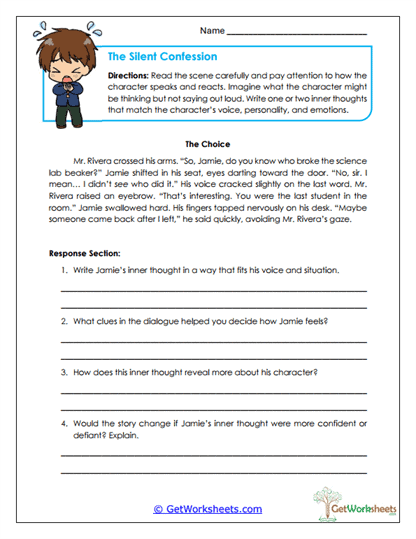
The Silent Confession
Inference work is at the heart of this task as learners imagine what a character may be thinking beneath spoken words. Using clues from behavior, dialogue, and emotional cues, students construct internal responses that remain faithful to the scene. Teachers can use it to strengthen both character analysis and evidence-based creative writing. The format is especially effective for helping readers notice subtext.
The Batter Banter
Distinctive lines of dialogue are used as clues in this voice-identification activity, prompting learners to match speech to the character who most likely said it. The task sharpens attention to attitude, phrasing, and perspective while reinforcing the idea that well-written dialogue sounds individual. In the classroom, it works well as a discussion starter for how authors differentiate speakers. At home, it offers engaging practice in close reading and reasoning.
Authentic Echoes
This worksheet asks learners to evaluate whether a character's voice feels believable, natural, and emotionally honest. Rather than simply naming tone, students must consider why certain phrases sound sincere and others less convincing. Teachers will appreciate its value for moving students toward higher-level analysis of credibility and realism in writing. It also supports stronger revision habits for young writers learning to craft authentic voice.
Mic Check Moments
Performance interpretation shapes this activity as learners imagine how dialogue might actually sound when spoken aloud. By focusing on pacing, intensity, hesitation, and confidence, students connect textual details to vocal delivery. This makes the worksheet a strong fit for drama-integrated literacy instruction or expressive reading practice. It also helps teachers assess whether students truly understand the emotional texture of a scene.
Read in Role
Expressive oral reading becomes purposeful in this worksheet, which encourages learners to embody characters through changes in tone, speed, and inflection. The activity goes beyond fluency drills by asking readers to make performance choices that reflect personality and perspective. Teachers can use it to build confidence in oral presentation while reinforcing comprehension. Parents may also appreciate it as an engaging alternative to routine read-aloud practice.
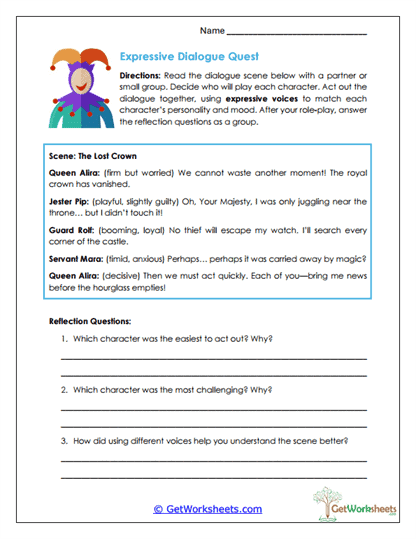
Expressive Dialogue Quest
Role-play and close reading work together here as learners act out a conversation using voices that suit each character's mood and manner. The task reinforces the connection between word choice and delivery, helping students hear how characterization lives inside dialogue. It is particularly useful for collaborative literacy settings where discussion and performance support one another. The worksheet also promotes stronger speaking skills through purposeful interpretation.
Character Shift Reading
Switching between speakers in a single passage helps learners practice vocal flexibility while keeping track of characterization. The worksheet emphasizes pace, emotion, and tonal contrast so each voice remains distinct and meaningful. Teachers can use it to strengthen dialogue comprehension and oral fluency at the same time. Its performance-based structure also keeps students actively engaged with the text.
Tone Switch
This activity explores how the same lines can take on different meanings when read with anger, joy, surprise, or another emotional stance. Learners come to see that interpretation is shaped not only by words on the page but also by delivery and emphasis. That makes the worksheet especially helpful for discussions about subtext and audience perception. It gives parents and teachers a simple way to make tone instruction far more concrete.
Storyteller vs. Character
Narration and dialogue are placed side by side so learners can distinguish the storyteller's voice from the voices of the characters inside the story. The comparison helps readers notice differences in purpose, neutrality, emotional charge, and style. Teachers can use this worksheet to support lessons on point of view, text structure, and authorial choices. It builds a stronger foundation for literary analysis across genres.
Whisper to Stage
Volume becomes an interpretive tool in this performance-based worksheet, where learners reread a passage using quieter and stronger delivery choices. The activity highlights how projection, restraint, and emphasis can shift the listener's understanding of tone. For teachers, it offers a practical way to blend speaking standards with reading fluency work. Students also gain valuable awareness of how vocal control supports communication.
Voice Match Quest
Learners match lines of dialogue to different vocal styles, using textual clues to decide what kind of delivery best fits each line. The focus on tone, phrasing, and implied personality turns a simple matching task into a meaningful comprehension exercise. Teachers may find it especially helpful for students who benefit from concrete entry points into dialogue analysis. It also adds a playful element to voice study without losing academic value.
Monologue Mastery
A single character speech provides the foundation for close work on motivation, emphasis, and emotional delivery. Students consider how pacing and tone can reveal intention, urgency, or vulnerability within a monologue. This makes the worksheet useful for both reading fluency and deeper character interpretation. It also gives teachers a ready-made bridge between literacy instruction and performance practice.
Voice Swap Reading
Role-switching invites learners to reread a dialogue scene from multiple positions, deepening their awareness of how voice and perspective interact. By comparing narrator language with character speech, students begin to notice differences in function, tone, and emotional focus. Teachers can use repeated readings to build fluency while also encouraging richer discussion of point of view. The activity is especially effective for collaborative partner work.
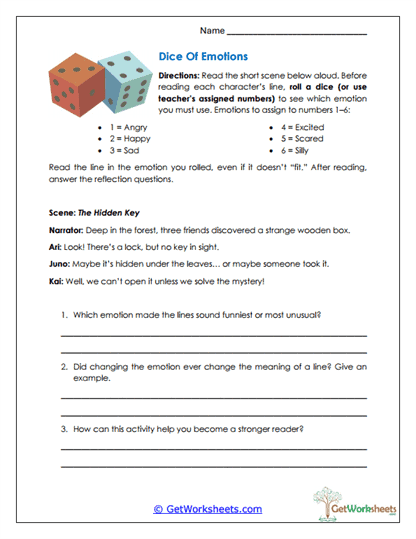
Dice of Emotions
Chance adds energy to this worksheet as learners assign unexpected emotions to lines and then reflect on how the altered tone changes interpretation. The random element makes students more flexible readers because they must adjust delivery and meaning on the spot. For teachers, it is a lively option for demonstrating that tone is not fixed by punctuation alone. It also encourages thoughtful listening as students compare alternate readings of the same text.
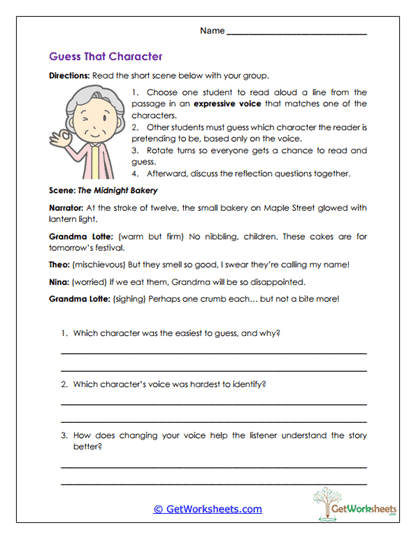
Guess That Character
Expressive reading and character recognition come together in this interactive activity, where listeners identify a speaker based on vocal choices and dialogue cues. The task strengthens attention to personality, mood, and stylistic traits that make voices distinct. Teachers can use it to support speaking and listening standards while keeping the class engaged. It also gives parents a fun, discussion-rich literacy activity for small-group or family practice.
Voice Pace Challenge
Reading rate becomes the focus as learners experiment with slower and faster delivery while maintaining clarity and expression. The worksheet helps students recognize that pacing is not merely about speed; it shapes mood, emphasis, and understanding. Educators will find it useful for fluency instruction that also addresses interpretation. The reflection component encourages students to become more intentional and self-aware readers.
Bookmark Us Now!
New, high-quality worksheets are added every week! Do not miss out!