Atlantic Ocean Worksheets
-
Atlantic Challenges Response
-
Atlantic Crossings Reading
-
Atlantic Explorer Cloze
-
-
Atlantic Facts Fill-In
-
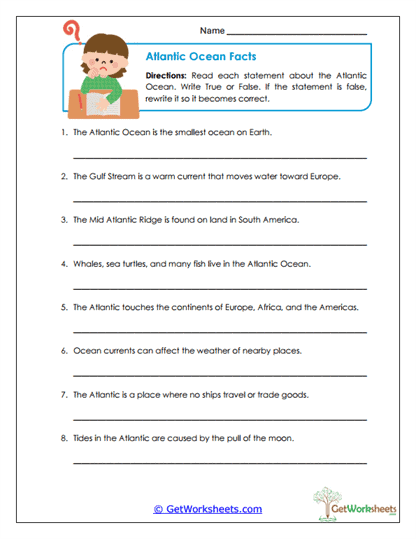
Atlantic Facts True-False
-
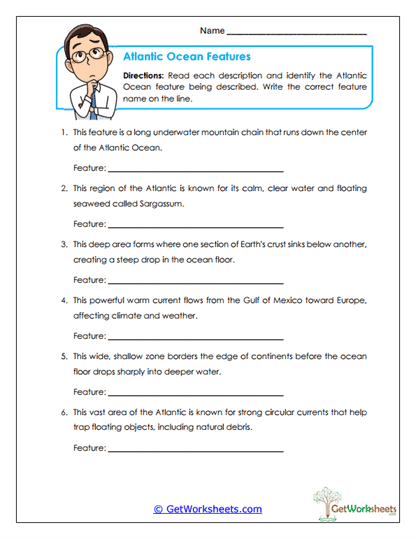
Atlantic Features Identification
-
Atlantic Importance Writing
-
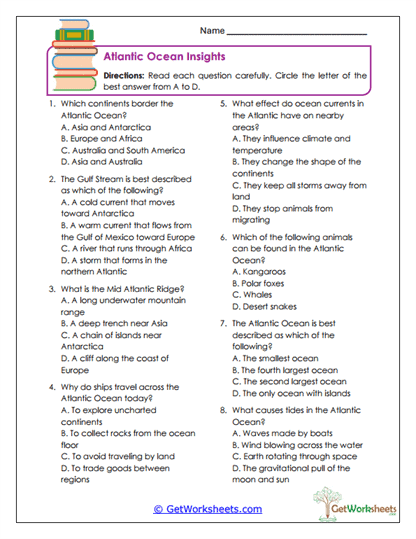
Atlantic Insights MCQ
-
Atlantic Significance Response
-
Atlantic Trade Paths
-
Atlantic Wonders Reading
-
Ocean Connections Matching
About This Worksheet Collection
This Atlantic Ocean worksheet collection introduces students to the geography, science, history, and global significance of the world's second-largest ocean. Through a rich mix of reading passages, cloze activities, vocabulary tasks, matching exercises, and written responses, learners explore the Atlantic's physical features, wildlife, climate influence, and role in global trade. The worksheets balance factual learning with interpretive and analytical thinking, helping students understand the Atlantic through multiple disciplinary lenses.
As students complete these activities, they build essential academic skills such as interpreting informational text, analyzing scientific processes, evaluating facts, and crafting evidence-based responses. They deepen their understanding of ocean currents, underwater landforms, marine ecosystems, and historical exploration. The collection promotes scientific literacy, geographic reasoning, and clear written communication-skills that prepare students for more complex work in Earth science, social studies, and environmental studies.
Detailed Descriptions Of These Worksheets
Atlantic Wonders Reading
Students read an informational passage highlighting the Atlantic's physical features, bordering continents, underwater landforms, and marine life. They answer open-ended questions that require them to identify key ideas, infer meaning, and explain scientific concepts in complete sentences. This worksheet strengthens comprehension of Earth science topics while promoting careful reading of nonfiction text. It also encourages students to synthesize information about currents, ridges, and modern ocean uses.
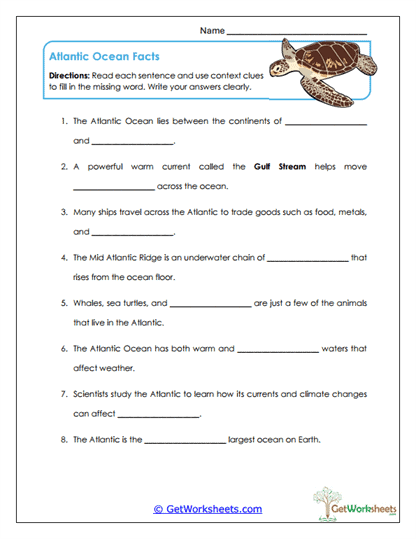
Atlantic Facts Fill-In
Learners fill in missing terms by using context clues in sentences about the Atlantic Ocean. The statements address climate effects, trade routes, animal life, and major currents. Students strengthen vocabulary recognition and contextual reasoning as they decide which word completes each idea. This activity reinforces comprehension of environmental and geographic concepts.
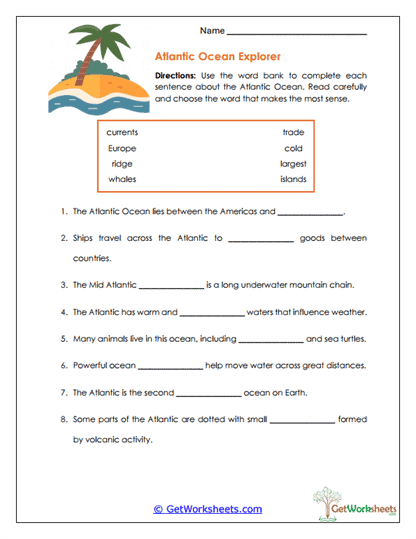
Atlantic Explorer Cloze
Using a word bank, students select accurate terms to complete sentences about Atlantic currents, ridge systems, continents, and marine animals. The cloze format encourages readers to analyze sentence meaning before choosing a word. It supports accurate vocabulary application and improves content understanding related to Earth's oceans. The task also develops confidence interpreting scientific language.
Ocean Connections Matching
Students match ocean-related terms-such as Gulf Stream, Continental Shelf, and Mid-Atlantic Ridge-to their definitions. This builds understanding of key marine and coastal features. Learners sharpen recognition of geographic and scientific vocabulary while practicing concept association. The matching format strengthens retention and supports both science and social studies learning.
Atlantic Facts True-False
Learners evaluate statements about Atlantic currents, marine life, geography, and physical processes. When a statement is false, students rewrite it correctly, reinforcing fact-checking and editing skills. This task promotes critical reading and strengthens accurate understanding of ocean science. It also provides valuable practice in writing clear informational corrections.
Atlantic Insights MCQ
This multiple-choice worksheet assesses knowledge of the Atlantic's surrounding continents, major currents, geological structures, and marine species. Students evaluate four choices for each question, strengthening logical reasoning and comprehension of scientific and geographic topics. The activity builds test-taking confidence and reinforces key ocean concepts.
Atlantic Importance Writing
Students write a paragraph explaining why the Atlantic Ocean is important for trade, ecosystems, or cultural exchange. They support their ideas with facts and examples, practicing explanatory writing and evidence-based reasoning. This activity deepens understanding of the Atlantic's global role while building communication skills. It encourages students to synthesize knowledge from previous lessons.
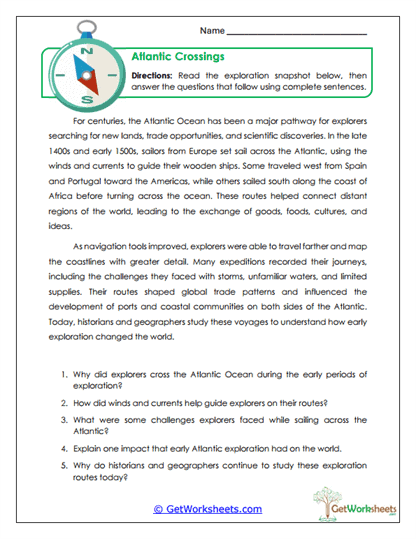
Atlantic Crossings Reading
Learners read a passage about early Atlantic exploration, navigation challenges, and cultural interactions. Afterward, they respond to open-ended questions requiring careful interpretation of historical and geographic details. The worksheet develops informational reading skills and helps students articulate complex ideas in their own words. It integrates history, geography, and ocean science.
Atlantic Features Identification
Students read detailed descriptions of oceanic features-including the Sargasso Sea, warm currents, and the continental slope-and identify each one. This strengthens vocabulary related to Earth's ocean systems. Learners practice matching descriptive clues to scientific terms, improving attention to detail. The activity supports content retention and concept recognition.
Atlantic Significance Response
This extended-response prompt asks students to explain the Atlantic Ocean's environmental and economic importance, including climate moderation, biodiversity, fishing, shipping routes, and coastal communities. Students write a structured explanation supported by examples. The worksheet builds high-level writing skills and connects geographic knowledge to real-world issues. It emphasizes clear reasoning and evidence use.
Atlantic Trade Paths
Students read two passages comparing early Atlantic trade routes with modern shipping networks. They answer open-ended questions that analyze historical change, economic systems, and technological improvements. This activity deepens understanding of human movement and global trade. It also strengthens textual analysis and evidence-based writing.
Atlantic Challenges Response
Learners choose a major Atlantic-related issue-such as sea-level rise, warming waters, or international ocean protection-and write a detailed explanation of its causes, effects, and potential solutions. This worksheet promotes advanced critical thinking, scientific reasoning, and structured writing. Students practice connecting environmental changes to global cooperation and long-term impacts.
Bookmark Us Now!
New, high-quality worksheets are added every week! Do not miss out!