Asia Worksheets


About This Worksheet Collection
This Asia worksheet collection introduces students to the world's largest and most diverse continent through geography, climate, culture, history, and reading comprehension activities. Learners explore everything from towering mountain ranges and ancient civilizations to bustling modern cities and major regional landmarks. The worksheets combine informational text, matching tasks, timeline reasoning, vocabulary practice, and narrative reading to give students a well-rounded understanding of Asia's complexity.
By engaging with maps, clues, passages, and short written responses, students build key academic skills across multiple subject areas. They practice interpreting geographic terminology, analyzing climate systems, recognizing cultural features, and sequencing historical events. These activities also strengthen inferential reasoning, evidence-based writing, and contextual vocabulary knowledge. Together, the worksheets support world geography literacy while encouraging curiosity about Asia's environments and cultures.
Detailed Descriptions Of These Worksheets
Asian Scope
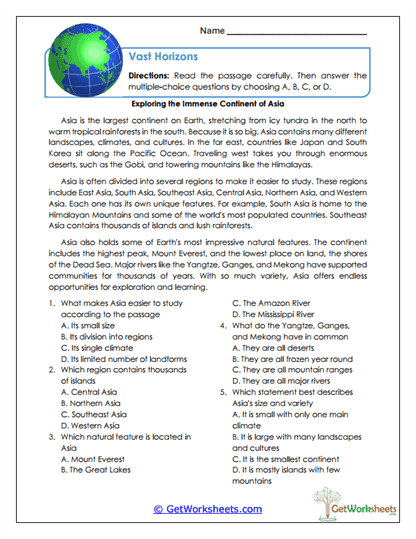
Students read an informational passage introducing Asia's scale, diverse climates, and major natural features such as the Himalayas and Yangtze River. The accompanying multiple-choice questions guide learners to distinguish central ideas from supporting details and interpret technical geographic vocabulary. This activity strengthens nonfiction comprehension through close reading of dense text. It also reinforces test-taking skills by requiring analysis of similar answer choices.
Regional Map
Learners match each Asian region-such as East Asia, South Asia, and Central Asia-to clues describing climate, culture, or dominant physical features. The worksheet emphasizes how monsoons, deserts, tropical forests, and economic patterns vary across the continent. Students sharpen classification skills by organizing regions based on detailed hints. This matching task helps them form a clearer mental map of Asia's diversity.
Feature Fill
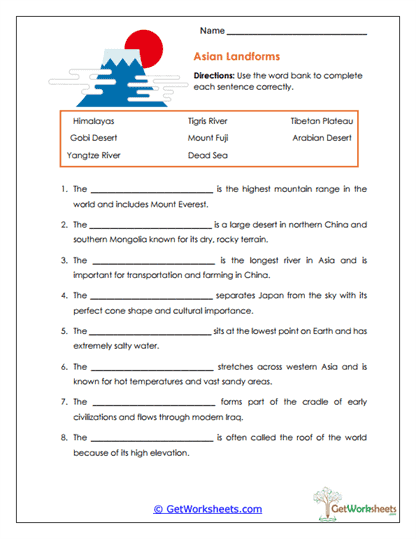
Using a word bank, students identify famous landforms like the Himalayas, Gobi Desert, and Yangtze River by completing sentence clues. This activity builds understanding of Asia's major deserts, river systems, and mountain ranges. Students practice using context clues to select the correct geographic term. It also strengthens vocabulary related to physical geography and environmental diversity.
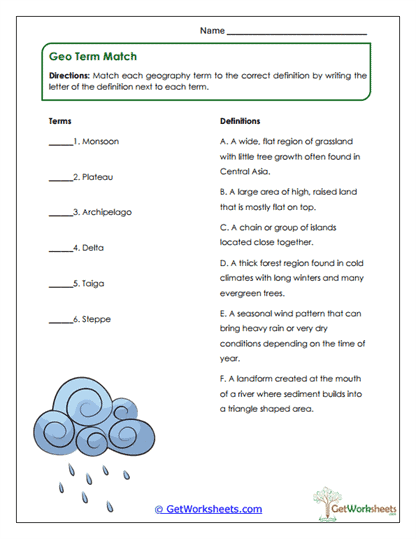
Term Links
Students match geography terms-including monsoon, plateau, archipelago, taiga, and delta-to accurate definitions. Each definition highlights landforms or climate systems prominent throughout Asia. Matching reinforces recognition of foundational geographic terminology. The task strengthens concept precision and supports long-term retention through meaningful term-to-definition connections.
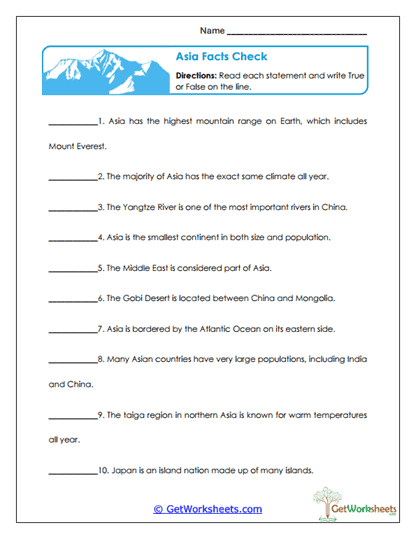
Truth Test
Learners decide whether statements about Asia's climate, population, landforms, and regional locations are true or false. Some statements reflect common misconceptions, encouraging careful evaluation. This activity builds critical thinking and accuracy in interpreting geographic facts. It also reinforces content from earlier readings, maps, and region studies.
Climate Sense
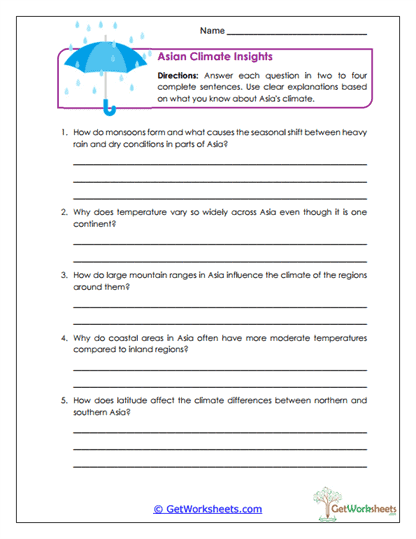
Students answer short-response questions about Asian climate systems, including monsoon patterns, mountain influences, and coastal temperature effects. They must explain cause-and-effect relationships using academic vocabulary. The worksheet encourages thoughtful writing and a deeper understanding of how geography shapes climate. It also connects climate concepts directly to human settlement and agriculture.
Country Quest
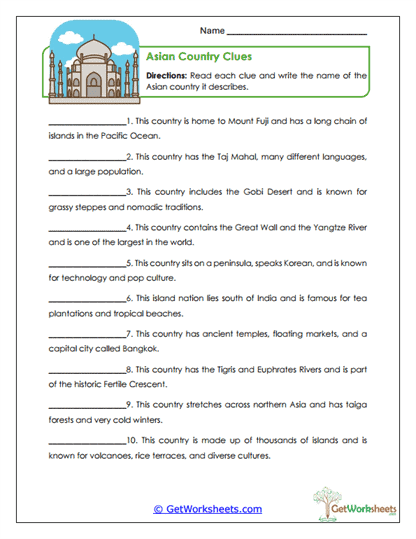
Students read clues about landmarks, cultural traits, or economic features to identify Asian countries such as Japan, China, India, or Thailand. This inferential task strengthens reasoning as learners deduce answers from context. It also improves recall of country characteristics and reinforces map-related knowledge. The activity highlights Asia's cultural and geographic diversity through recognizable examples.
Chrono Map
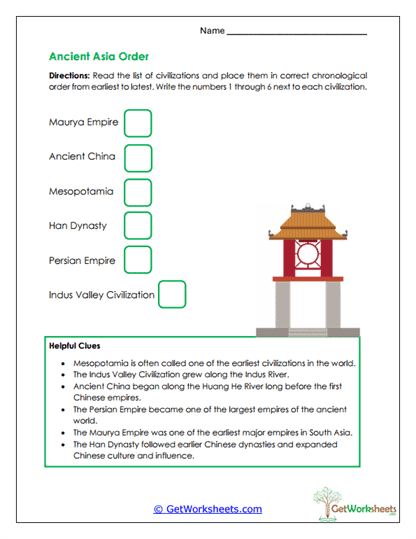
Learners arrange major ancient civilizations-such as Mesopotamia, the Indus Valley, Ancient China, and the Persian Empire-in chronological order using provided clues. This sequencing task strengthens historical reasoning and timeline construction skills. Students explore how early societies emerged and how their innovations shaped world history. It connects geography to the development of major civilizations.
City Life
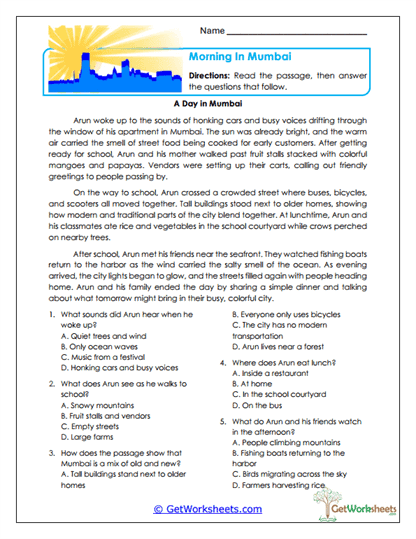
Students read a narrative passage about a day in Mumbai, exploring school routines, markets, transportation, and cultural diversity. Multiple-choice questions assess comprehension of setting, plot details, and sensory descriptions. This worksheet builds narrative-reading skills while increasing cultural awareness. Learners practice interpreting context clues and eliminating distractors.
Landmark Legends
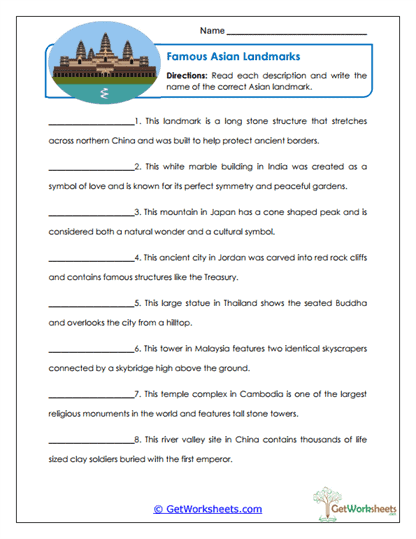
Students identify major Asian landmarks-such as the Great Wall, Taj Mahal, Petra, and Mount Fuji-based on descriptive clues. The task deepens understanding of Asia's most iconic locations and their cultural or historical importance. Learners build deductive reasoning by matching details to the correct site. The activity supports global awareness and geographic literacy.
Border Links
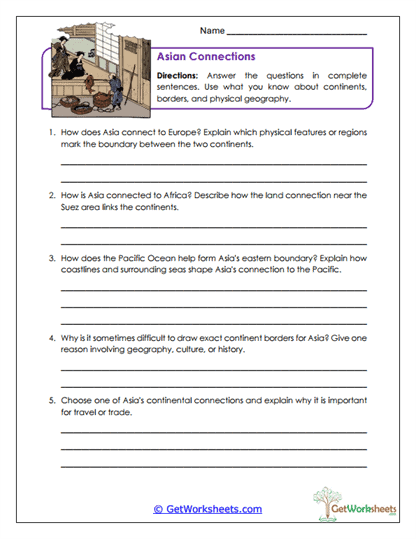
This worksheet asks students to explain how Asia connects geographically to Europe, Africa, and the Pacific through landforms and waterways. They reflect on natural boundaries like the Ural Mountains and regions such as the Suez area. The writing prompts encourage clear explanation of continental relationships. Students also consider how these connections support travel, culture, and trade.
Global Impact
Students read a passage explaining Asia's influence on world history through inventions, religion, trade, and cultural diffusion. They then answer reflective questions requiring evidence and analysis. The worksheet strengthens critical reading and helps students understand how technologies like the compass or printing spread globally. It reinforces historical reasoning and recognition of Asia's lasting contributions.
Bookmark Us Now!
New, high-quality worksheets are added every week! Do not miss out!