Boundary Decisions
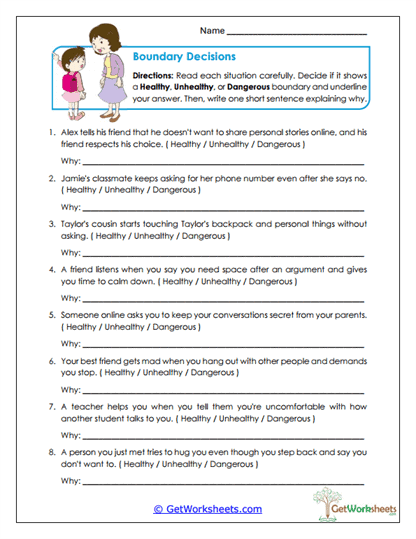
This worksheet helps students in Grades 4, 5, and 6 develop critical thinking and self-advocacy skills by evaluating interpersonal boundary scenarios. Students read situations involving sharing private information, peer pressure, unwanted touching, demands from friends, and supportive behaviors, then classify each one as a healthy, unhealthy, or dangerous boundary and explain their reasoning using clear written responses.
Learning Goals
- Boundary Identification (Grades 4-6) – Distinguish between healthy, unhealthy, and dangerous interactions.
- Emotional & Physical Safety Awareness – Recognize when situations move from uncomfortable to unsafe.
- Critical Thinking & Judgment – Analyze social scenarios and evaluate the level of risk or appropriateness.
- Written Explanation Skills – Justify decisions using complete sentences and logical reasoning.
Instructional Benefits
- Teacher-Created Resource – Designed to align with SEL, health education, and ELA standards.
- Scenario-Based Learning – Uses realistic, age-appropriate situations students may encounter.
- Explanation Component Included – Strengthens comprehension, reflection, and self-advocacy.
- Flexible Use – Suitable for health lessons, counseling groups, advisory periods, or homeschool instruction.
This printable worksheet empowers students to recognize and name boundary-related behaviors while understanding why boundaries matter for emotional and physical well-being. By classifying scenarios and explaining their thinking, learners build confidence, awareness, and assertiveness. Ideal for classroom and homeschool settings, this activity supports responsible decision-making, personal safety, and respectful relationships.
This worksheet is part of our recognizing unsafe or unhealthy social interactions worksheets collection.
Bookmark Us Now!
New, high-quality worksheets are added every week! Do not miss out!