Online Boundaries
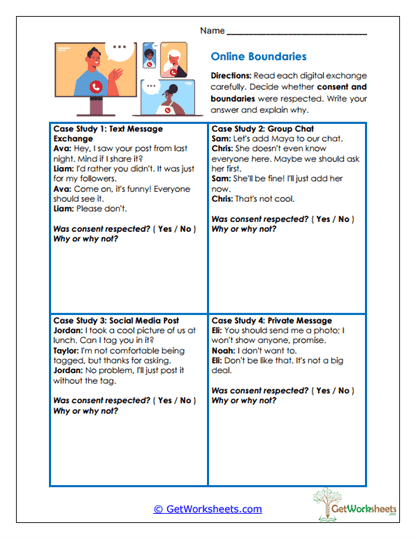
This worksheet helps students in Grades 5, 6, and 7 strengthen digital citizenship, critical thinking, and written reasoning skills by analyzing realistic online case studies. Students examine scenarios involving text messages, group chats, social media posts, and private messages to determine whether consent and personal boundaries were respected, building awareness of privacy, safety, and respectful online communication.
Learning Goals
- Consent & Privacy Online (Grades 5-7) – Identify when digital boundaries are respected or violated in common online situations.
- Boundary Setting & Respectful Communication – Understand how consent, permission, and privacy apply to digital interactions.
- Scenario Interpretation – Analyze case studies to recognize unsafe or inappropriate online behaviors.
- Written Justification Skills – Explain decisions clearly using evidence and thoughtful reasoning.
Instructional Benefits
- Teacher-Created Resource – Designed to align with digital citizenship, SEL, health education, and ELA standards.
- Case Study Format – Encourages deeper analysis of realistic online interactions.
- Focus on Advocacy – Helps students practice standing up for their own online safety and boundaries.
- Flexible Use – Suitable for digital safety units, advisory lessons, small groups, or homeschool instruction.
This printable worksheet empowers students to think critically about consent, privacy, and boundaries in digital spaces. By evaluating online scenarios and explaining their reasoning, learners build confidence, analytical skills, and awareness of safe online behavior. Ideal for classroom and homeschool settings, this activity supports responsible digital citizenship, respectful communication, and proactive protection of personal boundaries.
This worksheet is part of our recognizing unsafe or unhealthy social interactions worksheets collection.
Bookmark Us Now!
New, high-quality worksheets are added every week! Do not miss out!