Signal Word Sleuths
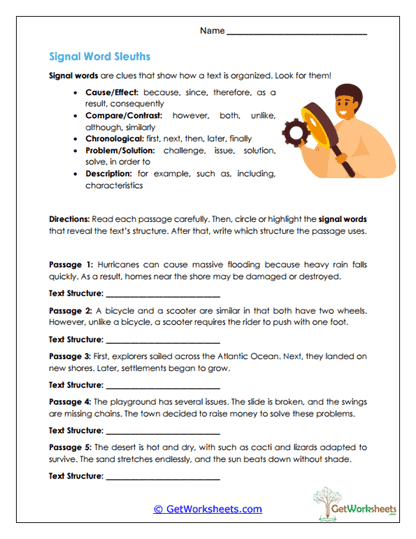
This engaging worksheet helps students in Grades 4, 5, and 6 strengthen reading comprehension and analytical thinking by learning how signal words reveal the organization of informational texts. As students read short passages, they actively identify and highlight key words such as because, both, next, and for example, then use those clues to determine whether the text follows a cause/effect, compare/contrast, chronological, problem/solution, or descriptive structure. The activity builds awareness of how authors guide readers through ideas using purposeful language.
Learning Goals
- Analyzing Informational Text Structures (Grades 4-6)
Students identify how nonfiction passages are organized using structural clues. - Recognizing Signal and Transition Words
Learners locate words and phrases that indicate relationships between ideas. - Understanding Author’s Organization and Purpose
Students explain how signal words help convey meaning and clarity. - Contextual Inference and Reasoning
The activity requires students to infer structure based on language cues rather than labels.
Instructional Benefits
- Teacher-Created and Standards-Aligned
Designed by educators to support informational reading, vocabulary, and comprehension standards. - Promotes Active Reading
Highlighting and identifying signal words keeps students engaged and attentive to text details. - Builds Transferable Nonfiction Skills
Helps students apply signal-word recognition to science, social studies, and other content areas. - Flexible Classroom and Homeschool Use
Ideal for literacy lessons, guided practice, centers, or formative assessment.
This printable worksheet helps students become more confident nonfiction readers by teaching them how to use signal words as clues to text structure. By identifying transitions and connecting them to organizational patterns, learners improve comprehension, vocabulary awareness, and critical reading skills. Suitable for both classroom and homeschool settings, this resource supports deeper understanding of how authors organize information to communicate ideas clearly.
This worksheet is part of our Identifying Text Structures collection.
Bookmark Us Now!
New, high-quality worksheets are added every week! Do not miss out!