Protest Methods Analysis
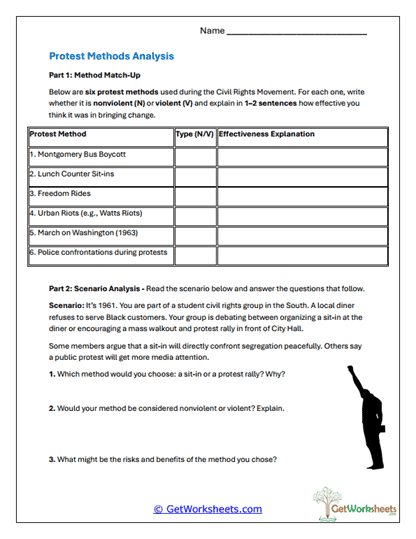
This critical thinking worksheet supports students in Grades 5 and 6 as they build civic reasoning, historical understanding, analytical evaluation, and persuasive writing skills through the study of Civil Rights-era protest methods. By examining six different protest strategies, students classify each as nonviolent or violent, evaluate effectiveness, and consider consequences, deepening their understanding of how actions influence social change.
Learning Goals
- Civil Rights Tactics (Grades 5-6) – Identify and analyze protest strategies used during the Civil Rights Movement.
- Evaluating Methods & Impact – Classify protest approaches and assess their effectiveness and consequences.
- Civic Responsibility – Understand how choices in activism reflect democratic values and ethical decision-making.
- Argument & Scenario Writing – Apply reasoning to real-world situations by explaining and defending protest choices.
Instructional Benefits
- Teacher-Created Resource – Designed by educators to align with upper elementary social studies and ELA standards.
- Clear Classification Structure – Helps students organize thinking around nonviolent and violent approaches.
- Scenario-Based Application – Encourages students to apply historical reasoning to new situations.
- Flexible Use – Ideal for Civil Rights units, debate preparation, writing lessons, or formative assessment.
This printable worksheet helps students strengthen critical thinking, persuasive writing, and civic understanding by examining how protest methods shape outcomes. By evaluating strategies and reflecting on consequences, learners gain insight into responsible action and effective advocacy. It’s a meaningful, no-prep resource that works well in both classroom instruction and homeschool learning.
This worksheet is part of our Civil Rights Movement collection.
Bookmark Us Now!
New, high-quality worksheets are added every week! Do not miss out!