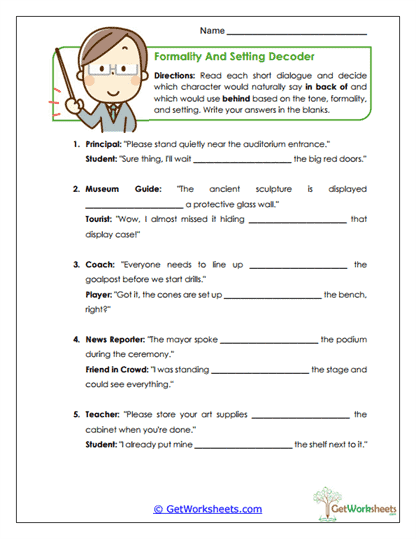
Formality and Setting Decoder
This worksheet helps students in Grades 4, 5, and 6 analyze how setting, role, and situation influence word choice by completing short dialogues with either in back of or behind. As learners decide which character would naturally use casual or formal language, they apply dialogue interpretation, tone awareness, vocabulary register, grammar knowledge, and contextual reasoning to make accurate choices.
Skills Reinforced
- Dialogue Interpretation (Grades 4-6): Read short exchanges and infer how characters would realistically speak.
- Tone and Character Voice: Match word choice to formality, role, and situation within a conversation.
- Vocabulary and Register: Distinguish between conversational phrasing (in back of) and formal language (behind).
- Grammar in Context: Use spatial prepositions accurately within dialogue-based sentences.
Instructional Benefits
- Teacher-Created Resource: Designed to support grammar instruction alongside tone and voice development.
- Context-Driven Practice: Encourages students to think beyond correctness and consider appropriateness.
- Engaging Dialogue Format: Makes abstract concepts like register and audience more concrete.
- Flexible Use: Suitable for grammar lessons, writing workshops, partner discussions, or independent practice.
This printable worksheet helps students develop stronger awareness of how language shifts depending on context and audience. By choosing between in back of and behind within realistic dialogues, learners strengthen grammar accuracy, tone recognition, and understanding of character voice. It is a no-prep resource that works well in both classroom and homeschool language arts settings, supporting clear, thoughtful, and context-appropriate communication.
This worksheet is part of our Behind vs. In Back Of Worksheets collection.
Bookmark Us Now!
New, high-quality worksheets are added every week! Do not miss out!