Alone and Lonely Talk
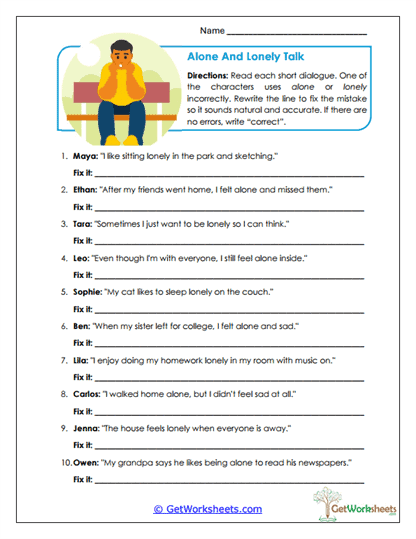
This worksheet helps students in Grades 4, 5, and 6 strengthen vocabulary precision by revising short lines of dialogue that use alone or lonely. As students decide whether each line is correct or needs revision, they apply understanding of word meaning, emotional context, sentence intent, and conversational tone while practicing careful editing and clear expression.
Learning Goals
- Vocabulary Nuance (Grades 4-6): Distinguish between alone (being by oneself) and lonely (feeling emotionally isolated).
- Dialogue Interpretation: Analyze spoken language to determine whether word choice matches the speaker’s feelings.
- Editing for Word Choice: Revise dialogue to improve accuracy, clarity, and meaning.
- Emotional Language Awareness: Recognize how vocabulary choices communicate emotions in conversation.
Instructional Benefits
- Teacher-Created Resource: Designed to address a common vocabulary confusion through realistic dialogue.
- Edit-or-Confirm Format: Requires students to judge correctness before revising, building editing confidence.
- Meaning-Focused Practice: Emphasizes understanding emotion and intent rather than memorization.
- Flexible Use: Suitable for vocabulary lessons, grammar instruction, SEL integration, partner work, or independent practice.
This printable worksheet helps students develop stronger control over emotional vocabulary in conversational writing. By correcting or confirming the use of alone and lonely in dialogue, learners improve clarity, grammar accuracy, and sensitivity to emotional meaning. It is a no-prep resource that works well in both classroom and homeschool language arts settings, supporting thoughtful word choice and effective communication.
This worksheet is part of our Alone vs. Lonely Worksheets collection.
Bookmark Us Now!
New, high-quality worksheets are added every week! Do not miss out!