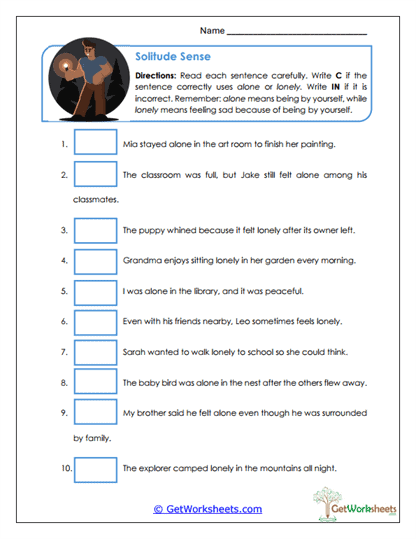
Solitude Sense
This worksheet helps students in Grades 4, 5, and 6 strengthen vocabulary understanding by analyzing sentences that use alone and lonely. As learners decide whether each sentence uses the word correctly, they apply context clues, sentence meaning, emotional awareness, and reading comprehension to distinguish between physical solitude and emotional isolation.
Skills Reinforced
- Vocabulary and Word Meaning (Grades 4-6): Understand the difference between alone (being by oneself) and lonely (feeling emotionally isolated).
- Context Clue Interpretation: Use surrounding details to determine whether word usage fits the sentence.
- Standard English Usage: Identify correct and incorrect application of commonly confused words.
- Social-Emotional Language Awareness: Recognize how word choice reflects emotional states and experiences.
Instructional Benefits
- Teacher-Created Resource: Designed to support both language development and emotional understanding.
- Quick Check Format: Marking sentences as correct or incorrect builds accuracy and efficiency.
- Meaning-Focused Practice: Encourages students to think about what a sentence truly communicates.
- Flexible Use: Suitable for vocabulary lessons, reading comprehension practice, SEL integration, or independent work.
This printable worksheet helps students deepen their understanding of nuanced vocabulary while improving careful reading and sentence analysis skills. By distinguishing between alone and lonely, learners build clarity in word choice, empathy in interpretation, and confidence in vocabulary usage. It is a no-prep resource that works well in both classroom and homeschool language arts settings, supporting precise language use and thoughtful comprehension.
This worksheet is part of our Alone vs. Lonely Worksheets collection.
Bookmark Us Now!
New, high-quality worksheets are added every week! Do not miss out!