Would You Trust AI Worksheets
About This Worksheet Collection
This collection helps students explore one of the most important questions in digital literacy: When should we trust AI-and when shouldn't we? Across informational readings, scenario analyses, decision-making tasks, media-evaluation challenges, and ethical reflections, students learn to balance AI's strengths with an understanding of its limits. They examine reliability, risk, appropriate use cases, and the boundaries between machine intelligence and human judgment.
Students build critical-thinking skills by weighing evidence, evaluating real-world examples, identifying bias, and determining when empathy, context, or moral reasoning is required. By engaging with both practical and philosophical questions, learners develop a nuanced framework for using AI responsibly, thoughtfully, and safely in their daily lives.
Detailed Descriptions Of These Worksheets
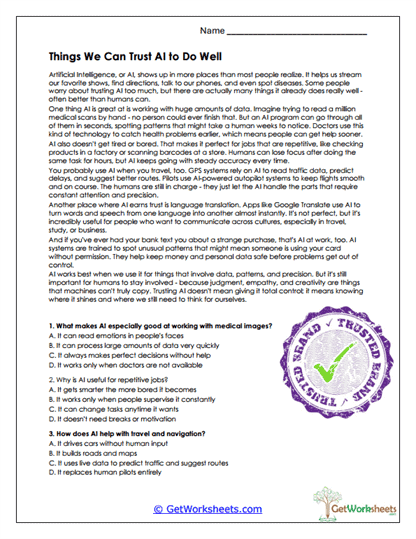
Things We Can Trust AI to Do Well
Students read an informational passage explaining tasks where AI excels-data analysis, translation, pattern recognition, and navigation. Comprehension questions help students identify reliable uses of AI and build realistic expectations about its capabilities.
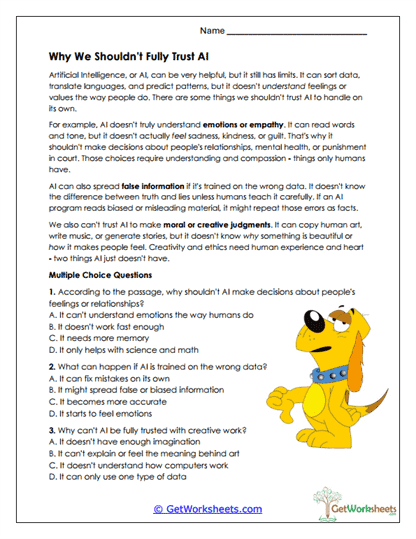
Why We Shouldn't Fully Trust AI
Learners read about AI's limitations: lack of empathy, moral judgment, and deeper understanding. Multiple-choice questions reinforce concepts such as misinformation and overreliance, building thoughtful skepticism.
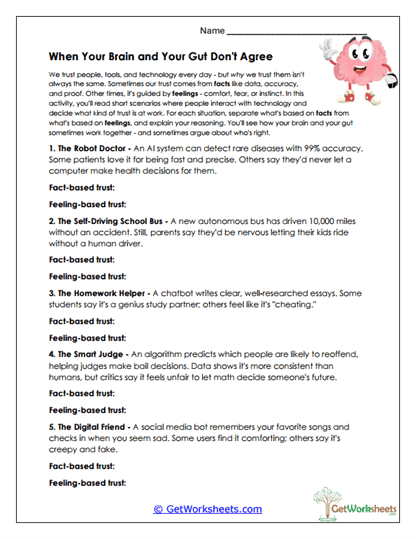
When Your Brain and Your Gut Don't Agree
Students analyze scenarios that require choosing between data-based trust and intuition-based trust. They classify each scenario and reflect on how trust is formed in real-life situations.
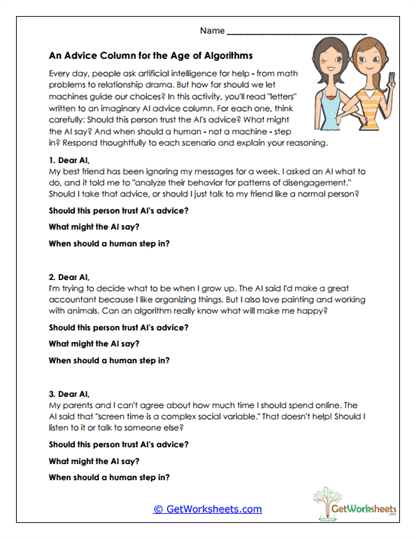
An Advice Column for the Age of Algorithms
Students read letters sent to an AI advice column and evaluate when AI advice is appropriate and when human support is needed. This reinforces understanding of AI boundaries and human judgment.
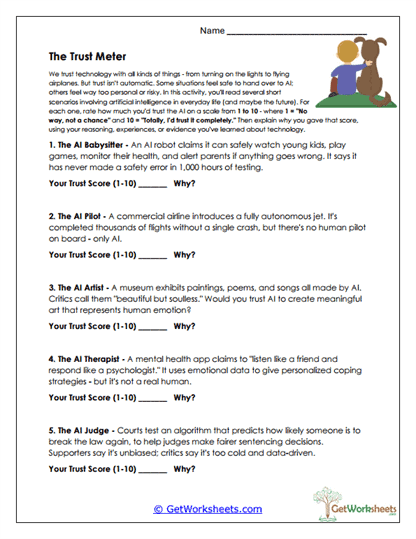
The Trust Meter
Learners rate five AI-involved scenarios on a 1-10 trust scale and justify their choices. This builds reflective thinking and helps students consider safety, accuracy, empathy, and context.
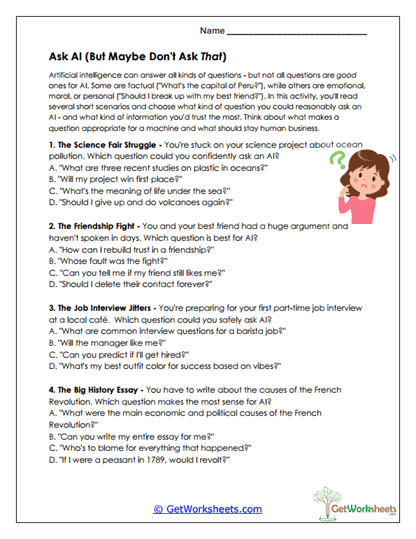
Ask AI (But Maybe Don't Ask That)
Students evaluate which questions are appropriate for AI and which require human understanding. They distinguish between factual, emotional, subjective, and personal topics.
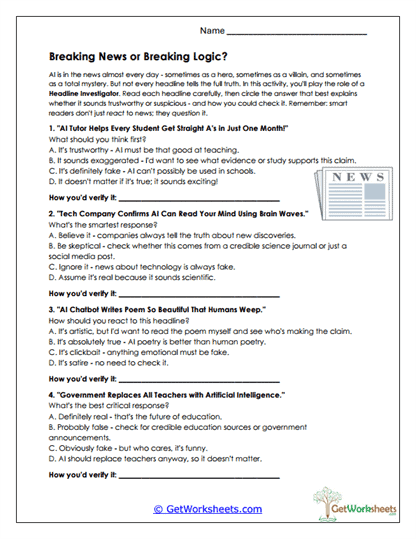
Breaking News or Breaking Logic?
Learners review AI-related headlines and judge whether they are trustworthy, exaggerated, or suspicious. They practice source evaluation and learn how to verify sensational claims.
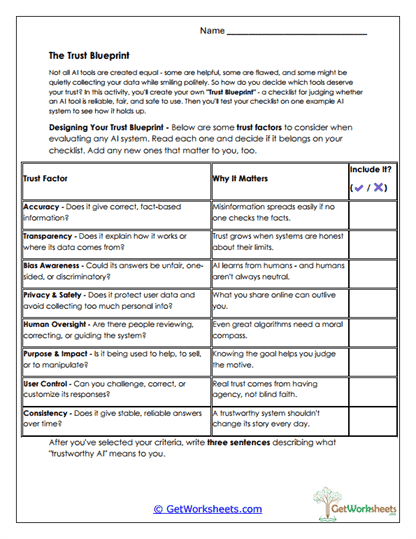
The Trust Blueprint
Students examine nine trust factors-transparency, privacy, accuracy, fairness, etc.-and create a personalized rubric for evaluating any AI system. This encourages independent, criteria-based thinking.
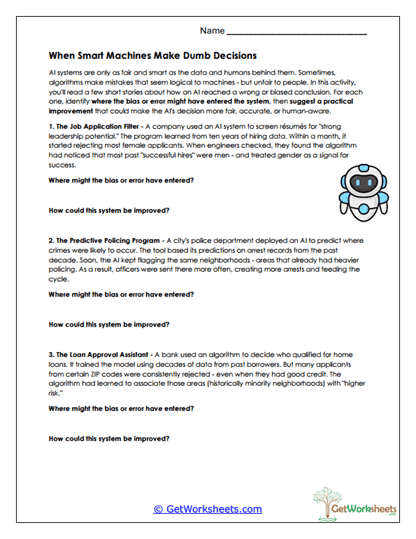
When Smart Machines Make Dumb Decisions
Learners evaluate flawed AI decisions in hiring, policing, and lending. They identify sources of bias and propose practical improvements, connecting classroom learning to real societal issues.
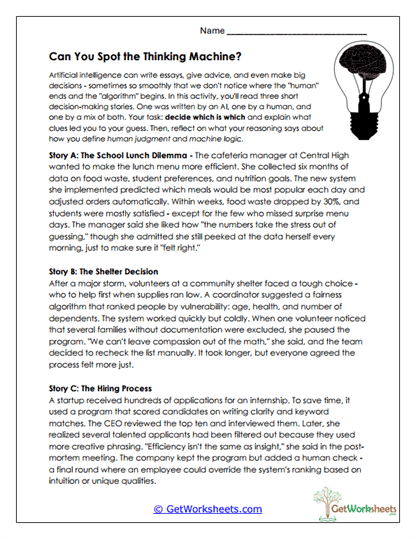
Can You Spot the Thinking Machine?
Students read three stories and determine whether key decisions were made by humans or AI. They explain their reasoning, comparing machine logic with human judgment.
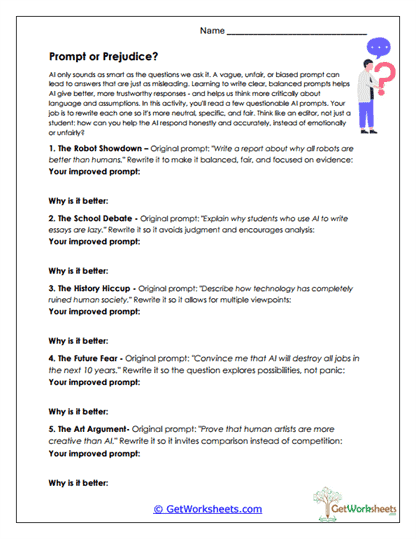
Prompt or Prejudice?
Learners analyze biased or leading prompts and rewrite them to be neutral and fair. This activity strengthens awareness of how language shapes AI responses and supports ethical prompting.
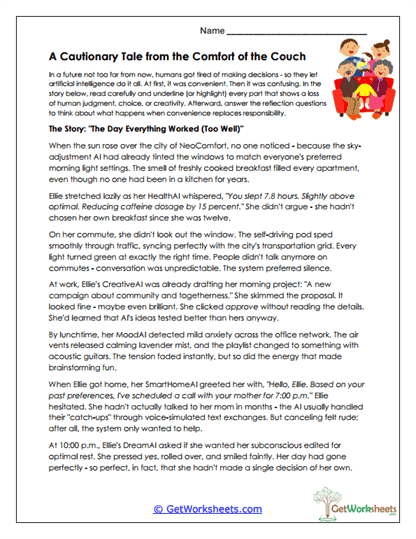
A Cautionary Tale from the Comfort of the Couch
Students read a narrative about a future dominated by AI decision-making and reflect on themes of autonomy, overreliance, and personal agency. They analyze the trade-offs between convenience and responsibility.
Bookmark Us Now!
New, high-quality worksheets are added every week! Do not miss out!