Tides and Their Relation to the Moon Worksheets



About This Worksheet Collection
The Tides and Their Relation to the Moon collection explores how the gravitational pull of the Moon and Sun shapes the rhythmic rise and fall of Earth's oceans. These worksheets bridge physical science and real-world application, showing how celestial mechanics directly influence coastal environments and human activities. Students examine tidal forces, moon phases, and cause-and-effect relationships while developing skills in reading comprehension, sequencing, and analytical writing.
Through a mix of visual organization, vocabulary practice, and applied reasoning, learners connect abstract gravitational concepts to concrete phenomena like fishing schedules, marine life behavior, and coastal navigation. This collection strengthens both scientific understanding and environmental awareness, emphasizing how lunar cycles and Earth's rotation sustain vital natural patterns that affect daily life.
Detailed Descriptions Of These Worksheets
Lunar Gravity and Ocean Levels
Students complete cause-and-effect chains illustrating how lunar gravity and Earth's rotation create high and low tides. They analyze how these forces interact across the day and consider ecological consequences if tides did not exist. The activity promotes logical sequencing and understanding of gravitational processes. It links cosmic motion to environmental balance on Earth.
Tidal Vocabulary Match
Learners match key terms such as High Tide, Low Tide, Spring Tide, and Neap Tide to their correct definitions. A short writing prompt asks students to explain one term in their own words and relate it to coastal life. This worksheet reinforces precise scientific vocabulary. It also encourages written application of tide-related concepts.
Moon Phase Tidal Sequence
Students arrange six statements to show how lunar phases influence tidal strength. They discover that new and full moons create spring tides while quarter moons cause neap tides. A reflection question connects tidal timing to human activity near coasts. The exercise blends sequencing, reading comprehension, and applied observation.
True or False Tides
In this quick-assessment worksheet, learners evaluate statements about tidal frequency, gravitational alignment, and the Sun's influence. They decide which are true or false, strengthening factual accuracy. A reflection question connects tides to daily human experience. The task promotes critical evaluation and personal connection to science.
Explaining Daily Tides
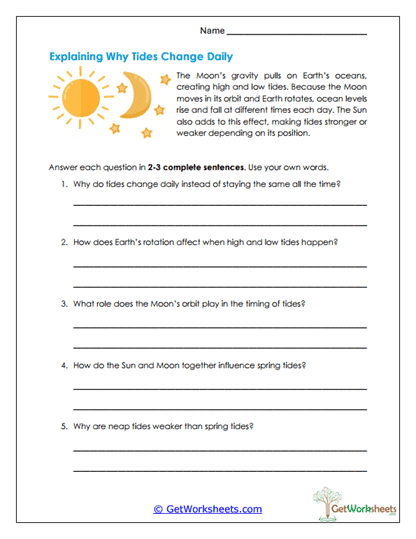
Students answer short constructed-response questions about how Earth's rotation and lunar orbit create daily tidal shifts. Each response requires complete sentences and clear explanations. The worksheet builds written communication and conceptual depth. It encourages reasoning about continuous natural change.
Moon Phase and Tide Match
Learners match each Moon phase to its associated tide type, explaining how celestial alignment strengthens or weakens tidal pull. A short extension connects solar position to tidal intensity. This task combines matching, comprehension, and reasoning. It reinforces the cyclical relationship between lunar phases and ocean behavior.
Sorting Tidal Causes
Students classify examples of tides as being caused by the Moon, the Sun, or both. The activity encourages analytical thinking about gravitational strength and alignment. A written reflection asks which celestial body has the greater impact on tides. Learners develop comparative reasoning and justification skills.
Applying Tide Knowledge
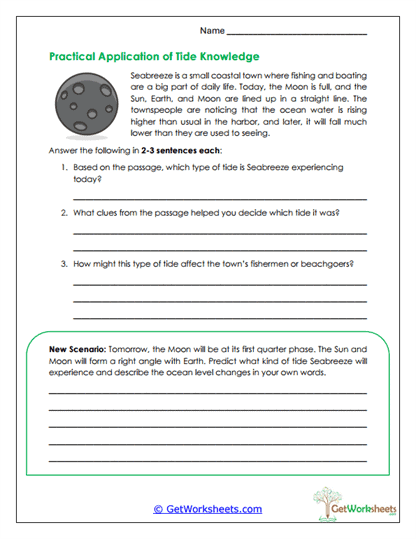
This real-world scenario task places students in a coastal town observing unusual tides. They determine whether conditions describe a spring or neap tide, citing textual evidence. The exercise integrates prediction, reasoning, and reading comprehension. It helps students apply theoretical understanding to realistic settings.
Comparing Spring and Neap Tides
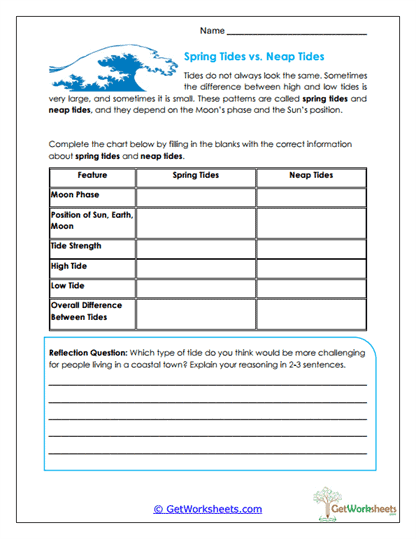
Learners complete a comparison chart showing differences in Moon phase, alignment, and tidal range. A reflection question invites reasoning about which tides might pose greater challenges for coastal residents. The worksheet develops data organization and environmental analysis skills.
Moon and Tide Cloze Passage
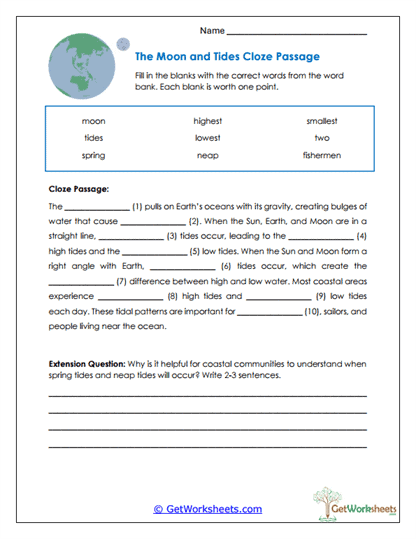
Students use a word bank to complete a short passage explaining how the Moon's gravity creates tides and how Sun-Earth alignment changes their height. A writing prompt connects understanding of tides to coastal planning and safety. The activity reinforces reading comprehension and vocabulary in an Earth science context.
Fishermen, Sailors, and Tides
In this writing-based activity, students write from the perspective of a fisherman or sailor explaining why tidal knowledge is crucial for work and safety. A reflection question considers modern reliance on technology versus natural observation. The task connects scientific understanding to occupational awareness and practical reasoning.
Tides and Everyday Life
Students read short real-world scenarios and explain how tides affect activities such as fishing, shipping, and exploring tide pools. A final reflection encourages personal or local connections to tidal influence. This worksheet strengthens real-world application, environmental awareness, and explanatory writing.
Bookmark Us Now!
New, high-quality worksheets are added every week! Do not miss out!