Speed, Distance, and Time Worksheets
About This Worksheet Collection
The Speed, Distance, and Time worksheet collection guides students through the essential relationships that define motion, blending mathematics, physics, and real-world applications. Through engaging themes-racing, travel, sports, and even space exploration-learners practice applying the core formula Speed = Time / Distance and its variations. The activities are thoughtfully scaffolded to move from basic rate problems to multi-step reasoning, ensuring students build both fluency and conceptual understanding.
As they progress, students strengthen algebraic thinking, unit conversion accuracy, and logical problem-solving skills. Each worksheet connects mathematical modeling to everyday experiences and scientific phenomena-from calculating average speeds to analyzing relative motion in water, air, and outer space. This collection promotes quantitative literacy and prepares learners for more advanced study in physics, STEM, and applied mathematics.
Detailed Descriptions Of These Worksheets
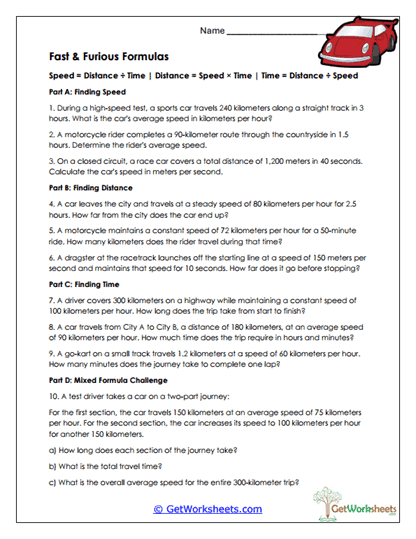
Fast and Furious Formulas
Students apply the speed-distance-time relationship to racing-themed problems involving cars, motorcycles, and competitive events. The worksheet reinforces algebraic manipulation and unit conversion while promoting fluency with rate formulas. Learners build confidence using real-world motion scenarios to solve for unknown values.
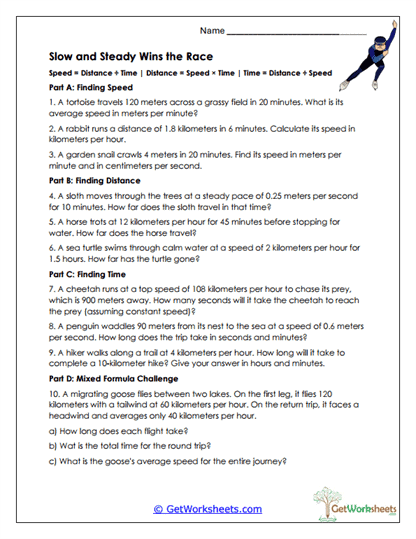
Slow and Steady Wins the Race
Using animal-based examples like tortoises and cheetahs, students calculate distances, speeds, and times in relatable contexts. This accessible approach reinforces understanding of how varying speeds affect travel outcomes. It strengthens proportional reasoning and provides meaningful practice with unit conversions.
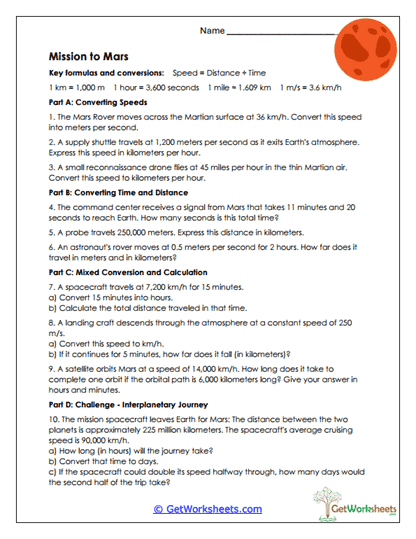
Mission to Mars
Learners explore interplanetary motion by solving problems involving spacecraft travel and orbital speeds. They convert between metric units, calculate travel times, and analyze distances on a cosmic scale. The exercise blends math precision with scientific reasoning, highlighting STEM connections.
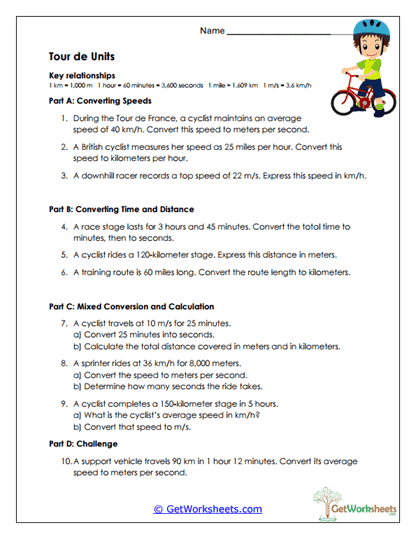
Tour de Units
Set in the world of competitive cycling, this worksheet challenges students to compute average speeds and travel times across different metric and customary units. It emphasizes multi-step reasoning and conversion accuracy while connecting math to sports and real-life performance analysis.
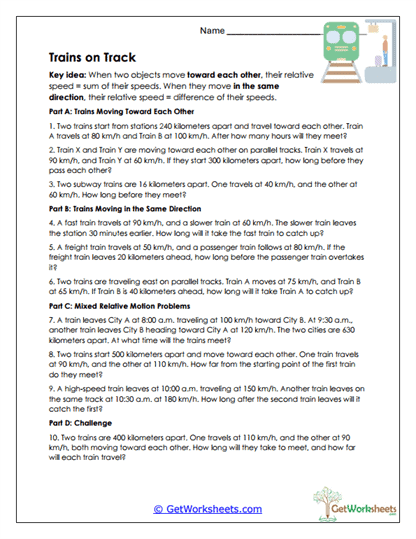
Trains on Track
Students analyze relative motion through train scenarios where objects move toward or away from one another. They compute meeting points, travel durations, and comparative speeds. The worksheet develops algebraic reasoning and logical thinking essential for understanding real-world physics applications.
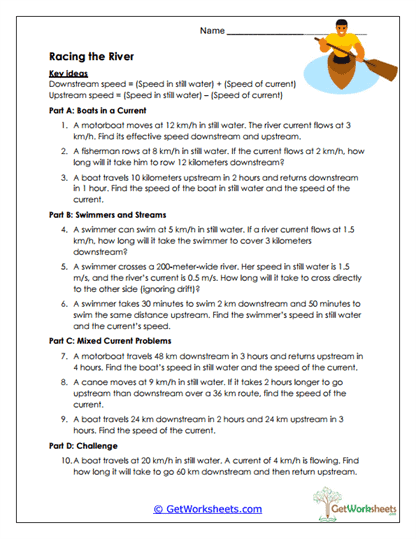
Racing the River
In this set of problems, learners calculate effective speeds in upstream and downstream motion. They account for the influence of water currents to determine true travel rates. The task promotes comprehension of relative speed, algebraic setup, and conceptual understanding of motion in fluids.
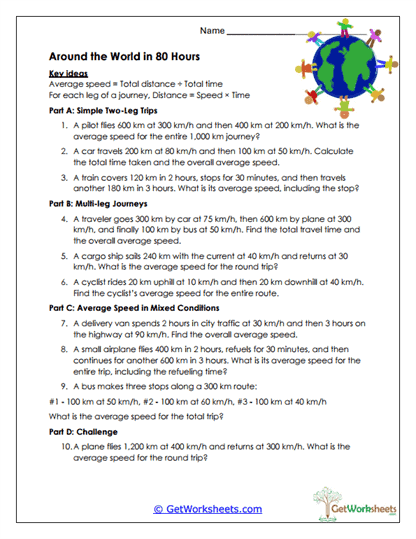
Around the World in 80 Hours
Students simulate global adventures by calculating total travel times and average speeds for multi-leg journeys. The problems incorporate varying conditions, emphasizing systematic reasoning and problem organization. This worksheet builds real-world awareness and cross-curricular connections to geography.
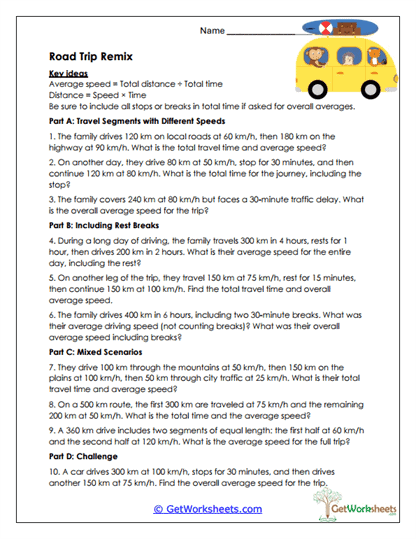
Road Trip Remix
Through realistic driving scenarios with rest stops and delays, learners compute average speeds and total durations. The activity reinforces multi-step reasoning and time management concepts. It helps students connect formulas for distance, rate, and time to everyday travel planning.
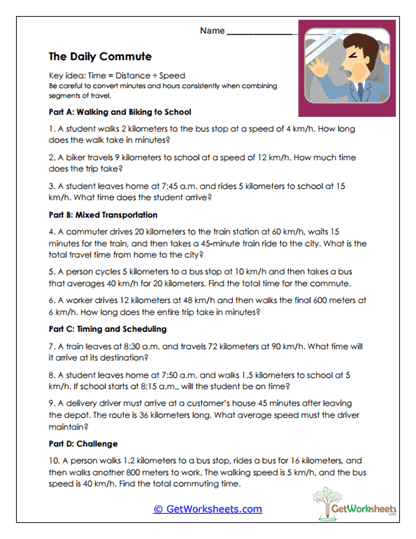
The Daily Commute
Students apply motion formulas to familiar transportation examples such as biking or bus travel. They calculate arrival times and total commute durations while practicing consistent unit conversion. The worksheet supports understanding of time intervals, scheduling, and efficient travel reasoning.
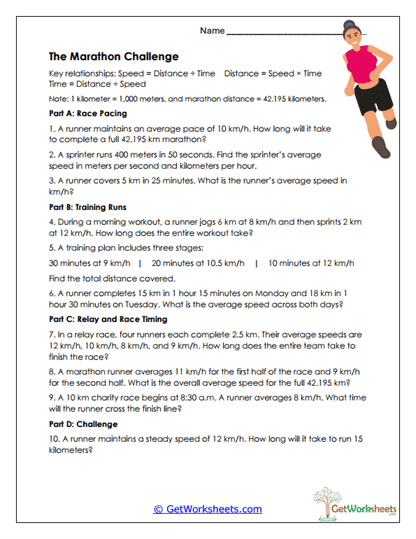
The Marathon Challenge
This sports-based worksheet links mathematics to athletic performance by exploring speed, pace, and completion time. Learners solve problems using kilometers, meters, and hours while comparing running data. It encourages critical thinking and connects quantitative reasoning to fitness and health contexts.
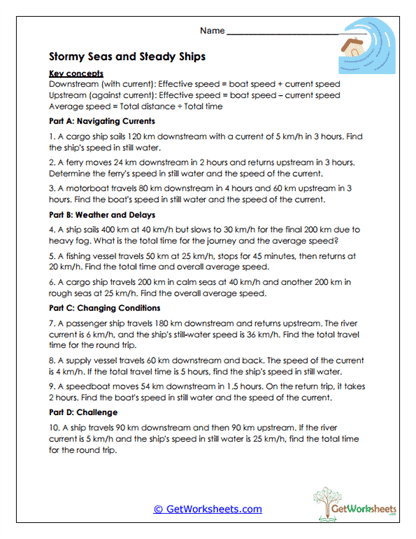
Ships and Currents
Learners calculate travel speeds of boats moving with and against a current, including variable conditions and stops. They solve complex, multi-step problems that require clear algebraic setup and reasoning about rates. The worksheet builds advanced understanding of fluid motion and proportional thinking.
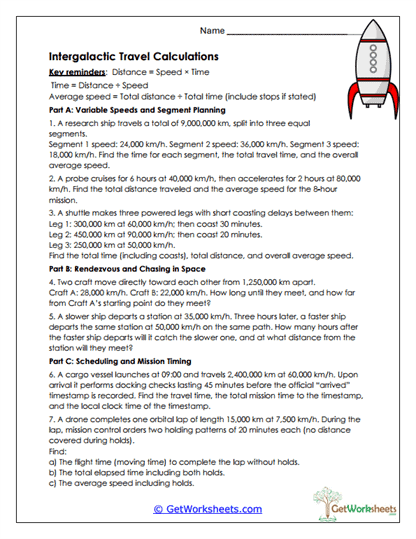
Intergalactic Travel
Students tackle multi-segment motion problems in a futuristic, space-mission setting. They calculate leg times, average speeds, and relative motion for spacecraft, incorporating delays and changing velocities. This culminating challenge synthesizes algebra, units, and kinematics in a creative, real-world-inspired format.
Bookmark Us Now!
New, high-quality worksheets are added every week! Do not miss out!