Identifying Text Structures Worksheets
About This Worksheet Collection
The Identifying Text Structures collection equips students with strategies to recognize how authors organize information in nonfiction writing. Each worksheet introduces or reinforces the five major text structures-cause/effect, compare/contrast, chronological, problem/solution, and description-through varied reading and writing activities. Learners analyze signal words, complete matching and sorting tasks, and write structured passages of their own. These exercises promote comprehension, organization, and the ability to interpret an author's purpose with precision and confidence.
By mastering recognition of structural patterns, students strengthen their ability to summarize, analyze, and synthesize ideas across informational texts. The collection emphasizes critical reading and contextual reasoning, building awareness of how language, sequence, and transitions shape meaning. Through repeated practice, learners become skilled at tracing logical relationships and applying text organization strategies in their own writing.
Detailed Descriptions Of These Worksheets
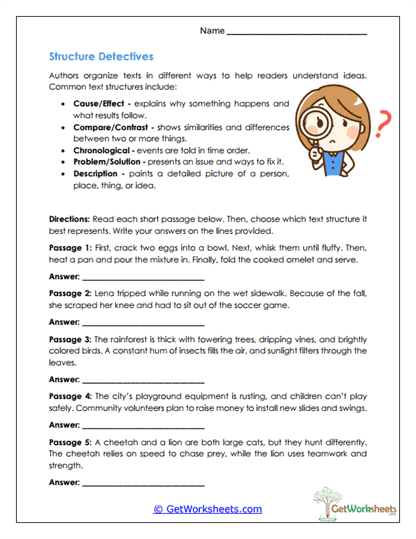
Structure Detectives
Students read short informational passages and determine which organizational pattern-cause/effect, compare/contrast, chronological, problem/solution, or description-best fits each one. They use signal words and contextual evidence to justify their selections. The exercise helps learners see how authors arrange information for clarity and emphasis. It deepens comprehension by linking structure to purpose and meaning.
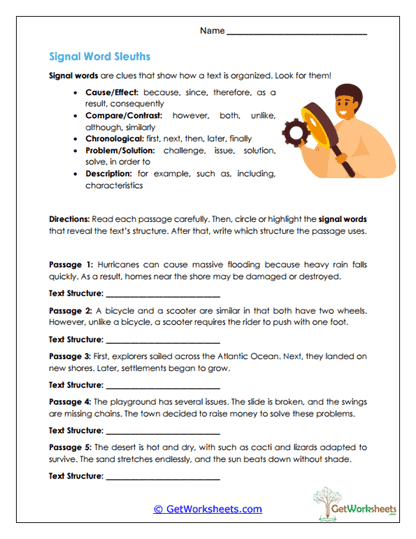
Signal Word Sleuths
Learners highlight key words such as because, both, next, or for example to determine a passage's organizational pattern. The activity trains students to spot linguistic cues that reveal how ideas are connected. It improves analytical thinking and vocabulary awareness by focusing on transitions that shape comprehension. Through repetition, readers develop stronger recognition of text structure signals in nonfiction.
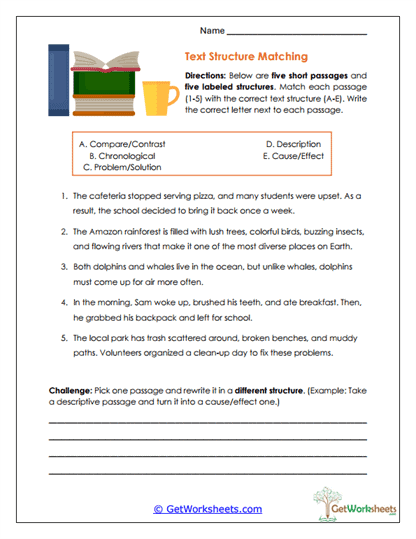
Text Structure Matching
Students match five short passages to labeled structure types, analyzing transitions and key phrases to identify each. They then rewrite one passage in a different structure to test their understanding. This creative twist encourages flexibility in applying knowledge of organization. The activity builds mastery through both recognition and composition.
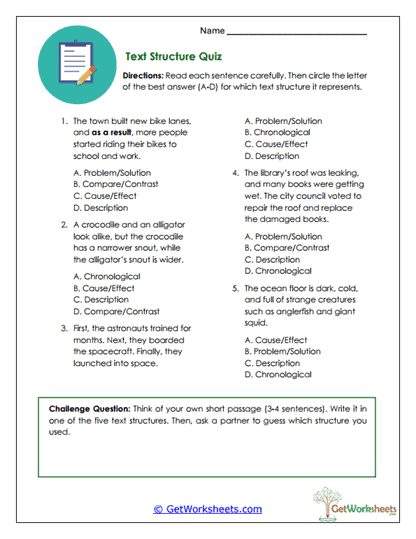
Text Structure Quiz
This short assessment challenges students to identify text structures from multiple-choice examples. Learners differentiate between closely related patterns such as cause/effect and problem/solution. The final writing prompt asks them to compose a passage using one of the five structures, turning recognition into practice. It's a quick yet meaningful way to gauge comprehension and analytical growth.
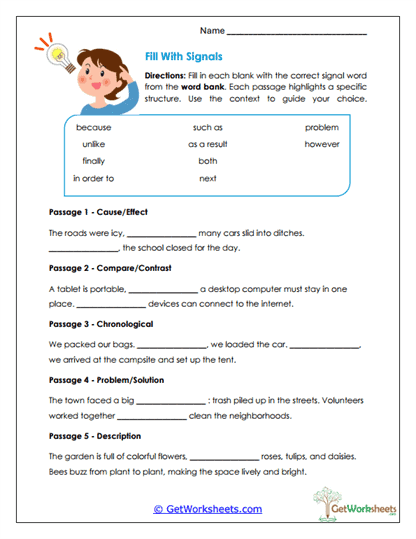
Fill with Signals
Students complete short passages by inserting appropriate transition words from a word bank to reveal the intended structure. This hands-on task highlights how signal words create logical flow and coherence. Learners gain awareness of vocabulary that conveys sequence, contrast, or causation. The exercise strengthens comprehension and reinforces sentence-level organization.
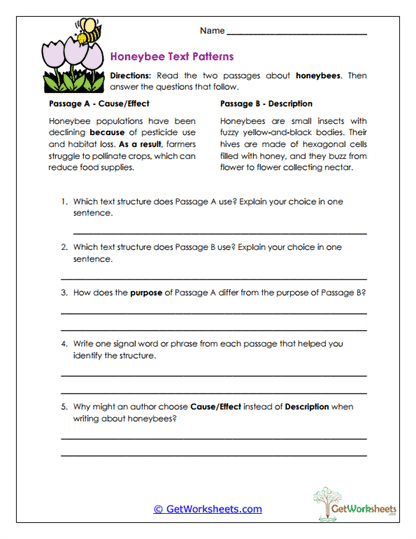
Honeybee Text Patterns
Students compare two passages about honeybees-one descriptive and one cause/effect-to see how structure shapes content. Guided questions lead them to analyze signal words and author intent. The activity blends reading comprehension with comparison of organizational techniques. Learners discover how structural choice influences meaning and emphasis.
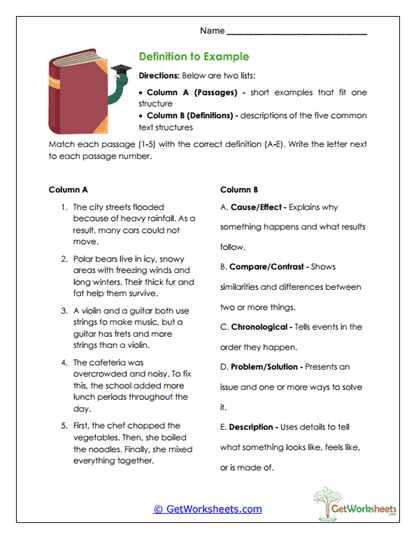
Definition to Example
This matching worksheet connects definitions of text structures to real-world examples. Students analyze how organization supports clarity and meaning in informational writing. The format promotes metacognitive understanding of how authors group and connect ideas. It's an effective review tool for reinforcing vocabulary and recognition of structure types.
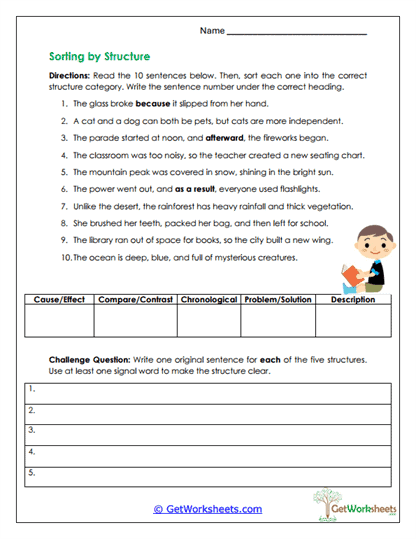
Sorting by Structure
Learners read ten short sentences and categorize them under the correct structure heading. They identify organizational cues and record each example beneath its proper label. The challenge prompt asks students to write their own examples using transitions. This task strengthens analytical precision and reinforces active application of text structure knowledge.
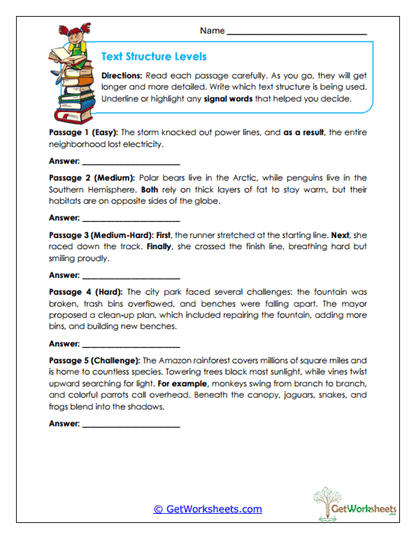
Text Structure Levels
Students work through five passages that gradually increase in complexity, identifying the text structure of each. Context clues and transition words guide their reasoning as difficulty rises. The progressive format supports scaffolded learning and skill confidence. It ensures that learners can apply structural analysis across texts of varying challenge.
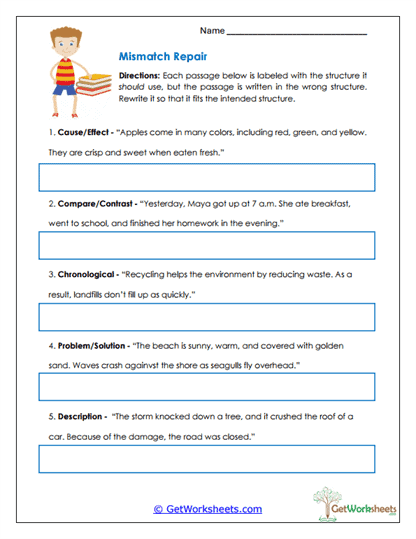
Mismatch Repair
Each passage in this worksheet is labeled with an incorrect structure, and students must rewrite it so that the label fits. They revise organization, transitions, and sentence flow to correct the mismatch. The task develops critical thinking and demonstrates how structure affects clarity. It's an active way to reinforce comprehension through creative editing.
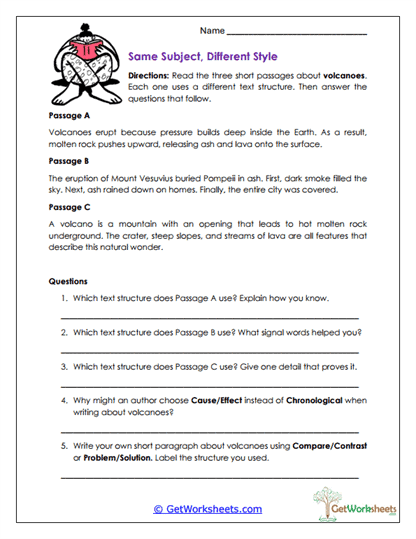
Same Subject, Different Style
Students read three short passages about volcanoes, each written with a different text structure. They identify and justify each format, explaining how organization changes meaning and focus. A writing task asks them to create their own structured paragraph. This activity builds higher-order reasoning by connecting author choice, structure, and audience purpose.
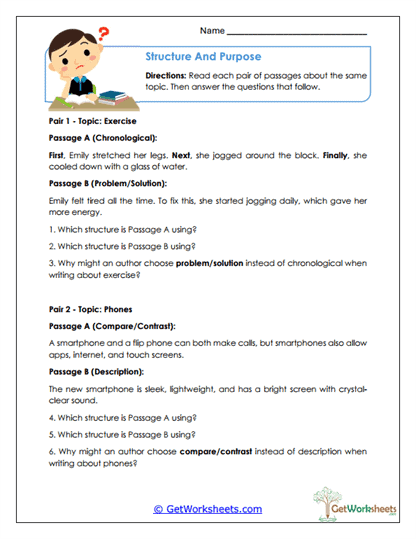
Structure and Purpose
Learners analyze paired passages on topics like exercise and technology, noting how differing structures influence clarity and tone. They cite signal words and explain why an author might choose one format over another. The reflection step links structure to purpose and audience. This advanced analysis deepens comprehension of how organization drives effective communication.
Bookmark Us Now!
New, high-quality worksheets are added every week! Do not miss out!