Finding Evidence Worksheets
About This Worksheet Collection
This collection of finding evidence worksheets is designed to help learners move from basic comprehension to deeper, evidence-based analysis of text. Each activity guides students in locating, selecting, and explaining textual evidence to support their thinking, making reading more intentional and accountable. These resources are especially valuable for teachers preparing students for constructed responses, close reading tasks, and standards-aligned assessments. Parents will also find them useful for building strong reading habits at home, where learners are encouraged to explain not just what they think, but how they know.
As students work through these worksheets, they develop critical skills such as citing evidence, making inferences, evaluating arguments, and structuring written responses. The activities emphasize reasoning, clarity, and precision, helping learners connect ideas directly to supporting details in the text. Educators will appreciate how the collection scaffolds from simple evidence identification to more advanced analysis and writing. Together, these worksheets build the foundation for confident, analytical readers and effective evidence-based writers.
Detailed Descriptions Of These Worksheets
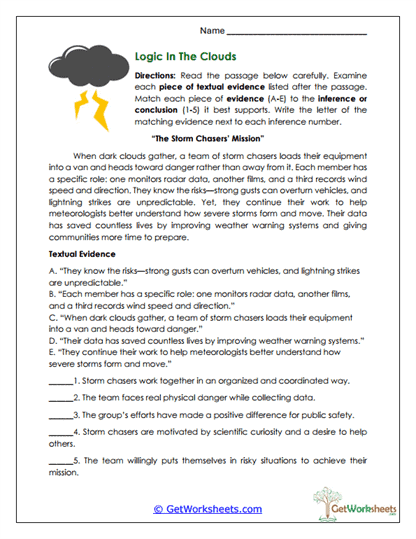
Logic in the Clouds
This worksheet guides learners in pairing specific text details with logical conclusions, helping them distinguish between explicit information and inferred meaning. By working with informational content, students practice connecting evidence to ideas in a structured way. Teachers can use it to introduce or reinforce inference skills alongside evidence identification. The matching format provides clear support while encouraging deeper reasoning.
The Reading Detectives
A detective-themed approach encourages learners to search for precise textual clues that support their answers. By requiring direct quotes or references, the activity promotes accountability and careful reading. Educators will find it especially effective for teaching students how to justify their thinking with proof. It also builds strong habits for citing evidence consistently.
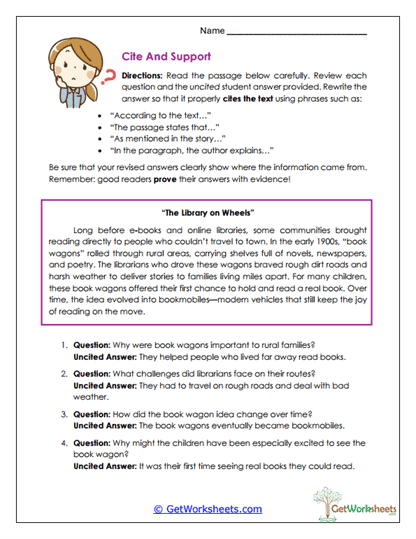
Cite and Support
This worksheet focuses on improving written responses by incorporating evidence using clear sentence structures. Learners revise incomplete answers, adding phrases that connect ideas directly to the text. Teachers can use it to model strong academic writing and reinforce expectations for complete answers. The structured approach helps students gain confidence in expressing their reasoning.
Two-Part Text Support
Learners are challenged to locate multiple pieces of evidence that support a single idea, encouraging more thorough analysis of a passage. This task helps students move beyond surface-level responses and consider how different details connect. Educators can use it to strengthen comprehension and promote deeper thinking. It also reinforces the importance of supporting ideas from more than one part of a text.
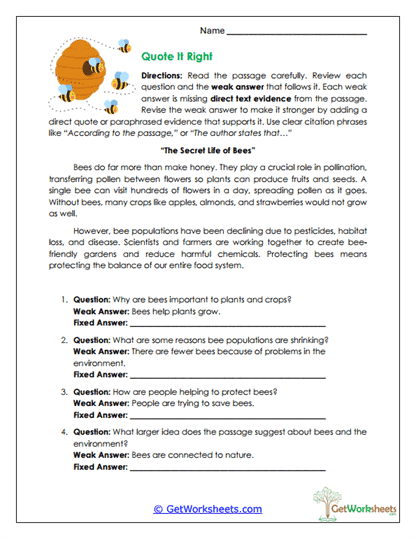
Quote It Right
This activity emphasizes strengthening responses through both direct quotation and paraphrasing. By revising weak answers, learners develop a clearer understanding of how to use evidence effectively. Teachers will find it useful for improving clarity and precision in student writing. It also supports the transition from simple answers to well-supported explanations.
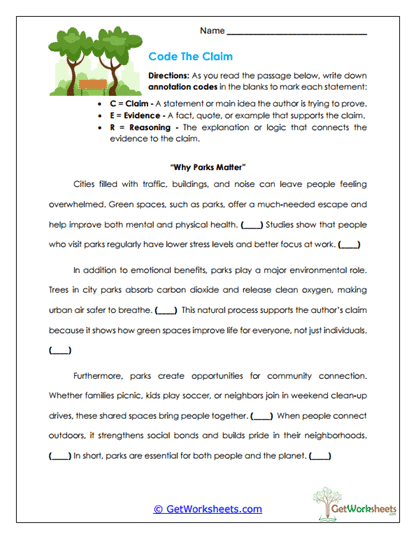
Code the Claim
Breaking down text into claims, evidence, and reasoning helps learners understand how arguments are constructed. This worksheet introduces foundational analytical skills that support both reading and writing. Educators can use it to build early understanding of argumentative structure. The labeling format makes complex ideas more accessible.
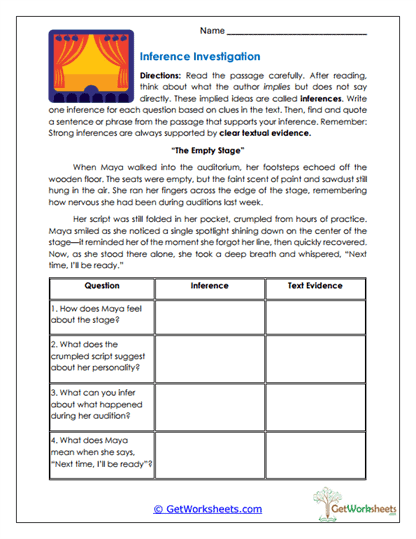
Inference Investigation
This worksheet combines inference with evidence citation, requiring learners to justify their conclusions using specific details. By analyzing characters and events, students practice connecting clues to meaning. Teachers can use it to deepen comprehension and strengthen reasoning skills. It encourages thoughtful, evidence-based interpretation of text.
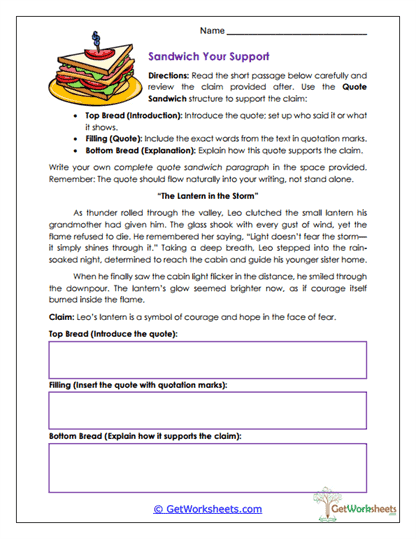
Sandwich Your Support
A structured "quote sandwich" approach helps learners organize their writing with a clear introduction, supporting evidence, and explanation. This format provides a reliable framework for developing strong paragraphs. Educators will find it particularly helpful for teaching evidence integration in writing. It also supports clearer and more organized responses.
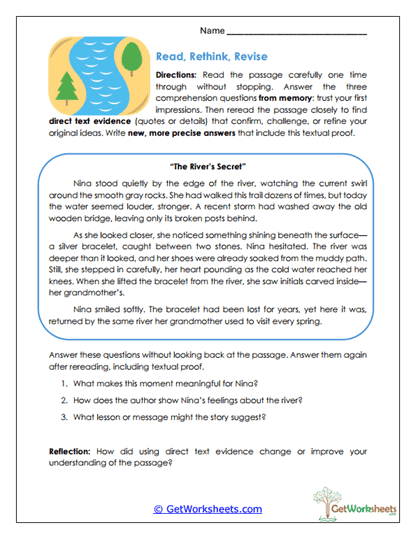
Read, Rethink, Revise
This worksheet emphasizes the importance of revisiting initial answers and improving them with textual support. By comparing first responses with revised ones, learners see the impact of evidence on clarity and accuracy. Teachers can use it to promote reflection and independent improvement. It reinforces the value of rereading and refining ideas.
Support Searchers
Learners identify claims within a passage and locate the evidence that supports them, then explain the connection. This process strengthens both comprehension and analytical thinking. Educators can use it to reinforce how ideas are developed in text. The combination of identification and explanation builds deeper understanding.
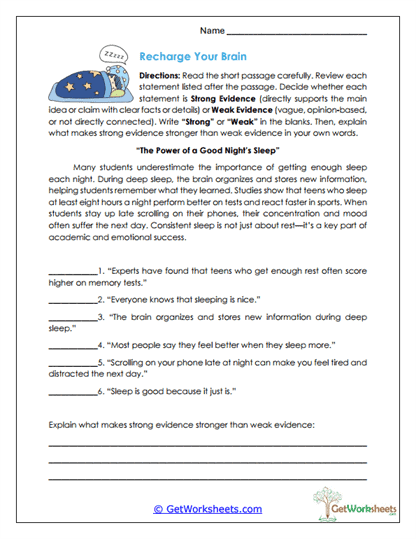
Recharge Your Brain
This worksheet introduces evaluation by asking learners to distinguish between strong and weak evidence. By analyzing credibility and relevance, students begin to think critically about the quality of support, not just its presence. Teachers will find it valuable for advancing reasoning skills beyond basic comprehension. It prepares learners for more sophisticated analysis and argument evaluation.
Sports Build Skills
Organizing evidence into a structured written response is the focus of this activity, helping learners connect reading and writing skills. By combining multiple details into a cohesive paragraph, students practice clarity, organization, and explanation. Educators can use it to support extended response preparation and academic writing. It provides a clear model for turning evidence into well-developed ideas.
Bookmark Us Now!
New, high-quality worksheets are added every week! Do not miss out!