Fact vs. Opinion Worksheets
About This Worksheet Collection
The Fact vs. Opinion Worksheets collection helps students build a deep, practical understanding of how to distinguish objective, verifiable information from subjective beliefs, interpretations, and value-based statements. Rather than merely labeling sentences, students explore how authors blend facts and opinions, how persuasive language influences readers, and how opinions can be strengthened or challenged through evidence. Across the collection, learners engage with real-world formats-blogs, news reports, debates, social media posts, and mixed passages-so they develop the ability to think critically in both academic and everyday contexts.
Through activities involving matching, rewriting, classifying, identifying signal words, analyzing bias, and comparing informational and opinion texts, students build essential media literacy skills. They learn how language choices reveal purpose, how tone signals subjectivity, and how facts serve as the foundation for solid reasoning. These worksheets prepare students to read with discernment, evaluate information responsibly, and express their own ideas with clarity and accuracy.
Detailed Descriptions Of These Worksheets
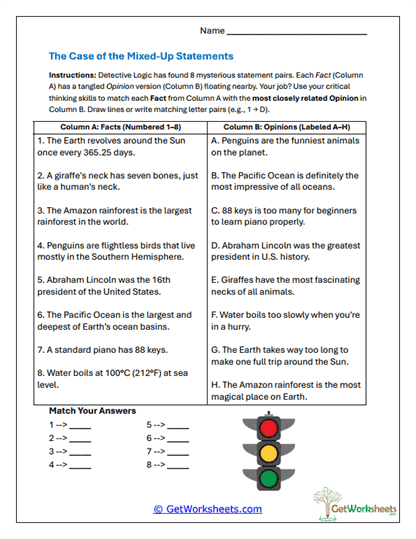
Paired Statement Sorter
This worksheet challenges students to analyze two columns-one containing facts and the other containing opinions-and match each fact to its corresponding opinion. Learners must evaluate the content carefully, identifying how opinions often develop in response to factual information. This deep comparison helps students understand not just the difference between the two categories, but how subjective reactions frequently connect to objective statements. Students also learn to notice subtle language cues that reveal personal judgment, strengthening their ability to identify tone and perspective in everyday communication.
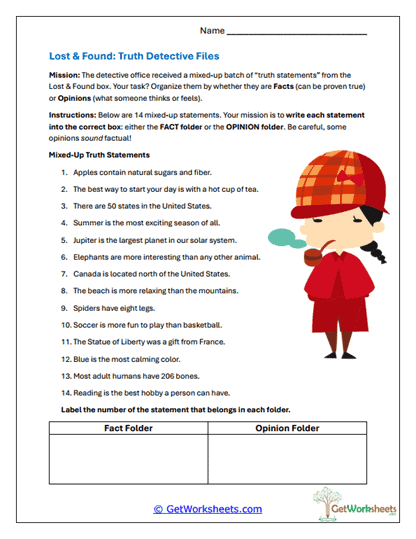
Truth File Organizer
Students evaluate fourteen mixed statements and classify them into Fact or Opinion folders. By examining clues such as evidence-based wording, emotional phrasing, or unverifiable claims, learners develop logical reasoning and analytical judgment. This worksheet builds confidence in deciding what can be proven and what reflects personal belief. The act of sorting also develops decision-making skills and reinforces the foundational principle that factual statements are verifiable, while opinions express viewpoints or preferences.
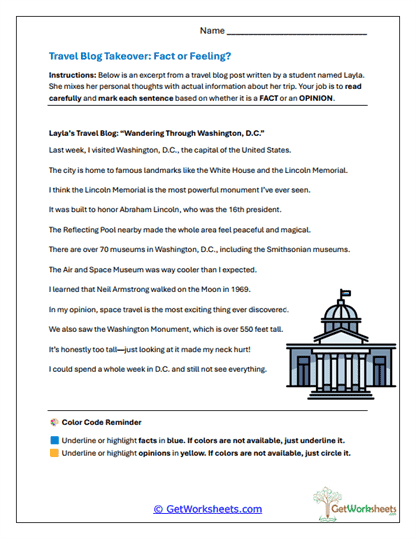
Travel Blog Classifier
In this activity, students read a lively travel blog that blends real information with personal impressions and judgments. They analyze each sentence, deciding whether it represents objective fact or subjective opinion. The text includes sensory descriptions, historical context, emotional reactions, and evaluative statements, giving students practice with complex mixed writing. The worksheet helps learners become more adept at recognizing when an author shifts from informative commentary to personal perspective-an important skill for interpreting online content, reviews, and lifestyle writing.
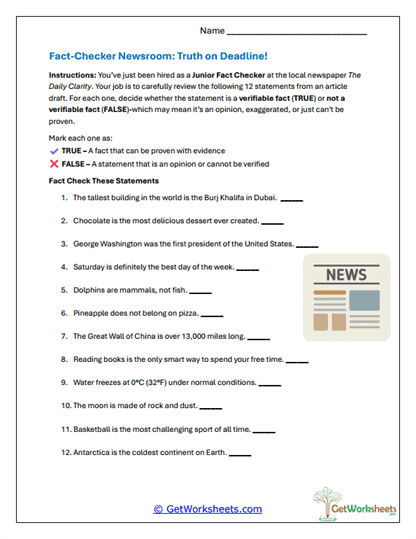
Newsroom Fact Audit
Students step into the role of a newsroom fact-checker and determine whether twelve statements from a newspaper draft are factual or opinion-based. The statements relate to science, geography, and personal belief, requiring students to use background knowledge, logic, and verification cues. Some items clearly reflect measurable information, while others contain subjective claims or exaggerated wording. This task builds media literacy by teaching students how to evaluate accuracy, reliability, and realism in journalistic contexts.
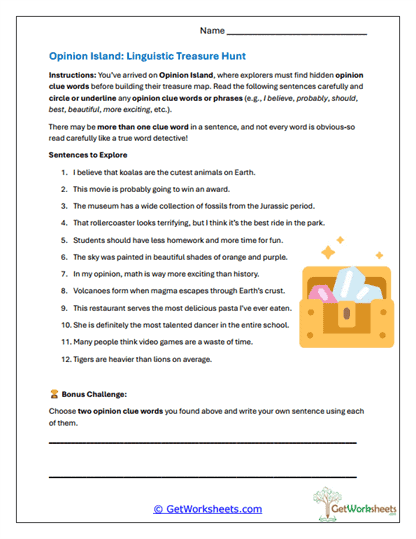
Opinion Clue Explorer
Learners examine twelve sentences and search for opinion signal words such as best, should, believe, think, or probably. By identifying these linguistic markers, students learn to recognize subjective or evaluative language even when a sentence appears neutral at first glance. This worksheet improves vocabulary awareness and helps students distinguish between genuine information and personal interpretation. A bonus challenge invites students to craft their own opinion sentences using selected clue words, reinforcing expressive writing skills and application of new concepts.
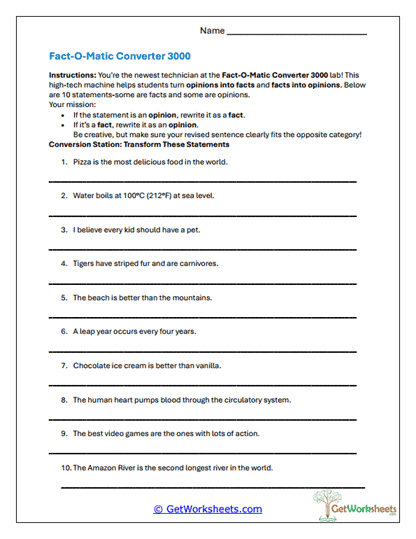
Category Flip Converter
This creative worksheet asks students to transform each statement by rewriting it in the opposite category-turning facts into opinions and opinions into facts. The activity requires learners to think carefully about word choice, tone, and content, making deliberate decisions about what makes a sentence verifiable or belief-based. This deeper level of manipulation helps students internalize the characteristics of both categories, strengthening writing flexibility and understanding of linguistic structure.
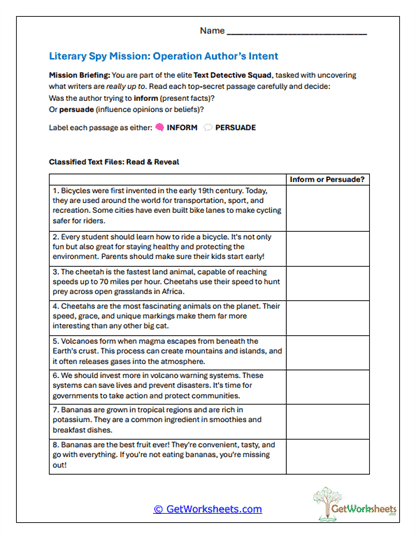
Author Intent Decoder
Students read eight short passages and determine whether the author intends to inform or persuade. Each passage includes clues such as emotional appeals, factual descriptions, statistics, recommendations, or subjective language. By analyzing tone and purpose, students learn how writers shape their messages and influence readers' thinking. This worksheet builds foundational skills for evaluating nonfiction, argumentative writing, and digital media.
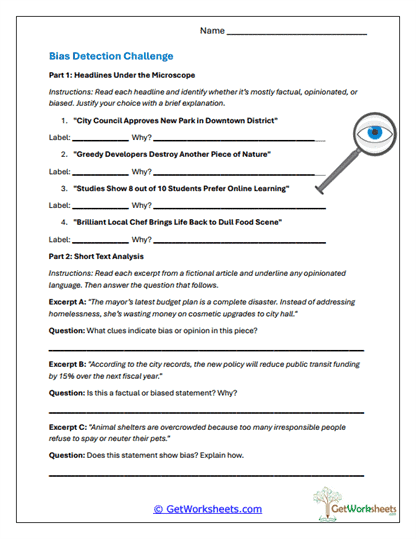
Bias Spotting Lab
This worksheet exposes learners to headlines and excerpted text that may contain fact, opinion, or bias. Students identify which category each example belongs to and underline clues-emotional language, exaggeration, selective detail-that signal subjectivity or slanted reporting. They learn how bias shapes interpretation and how even factual information can be framed to influence opinion. This activity strengthens media literacy, helping students read news, social media, and online content with a critical eye.
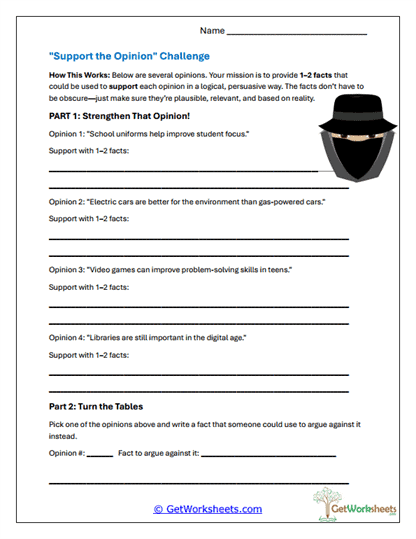
Opinion Support Builder
Students examine opinions and strengthen them by supplying relevant facts that would logically support each viewpoint. In the second section, they practice creating counterarguments by providing facts that could challenge or complicate a stated opinion. This worksheet teaches learners how evidence supports or disputes beliefs and helps them understand that well-constructed opinions rely on carefully selected factual information. It builds persuasive writing skills and encourages thoughtful analysis of claims.
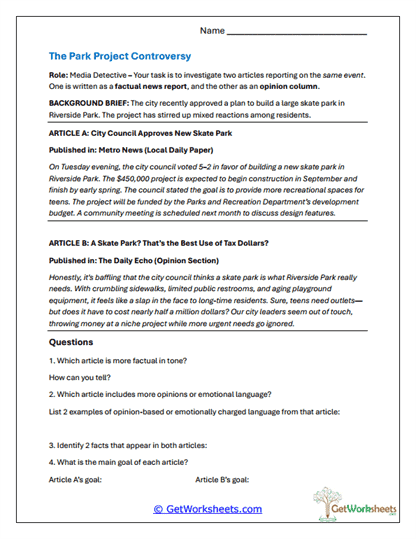
Article Comparison Analyst
This advanced worksheet presents two texts covering the same event: one informational article and one opinion column. Students compare how each piece presents details, tone, and emphasis. They examine persuasive techniques, emotional appeal, and how opinion-based language differs from straightforward reporting. By answering guided questions, learners build media literacy and learn to evaluate reliability, fairness, and author intent. They also come to understand how the same topic can be framed in dramatically different ways.
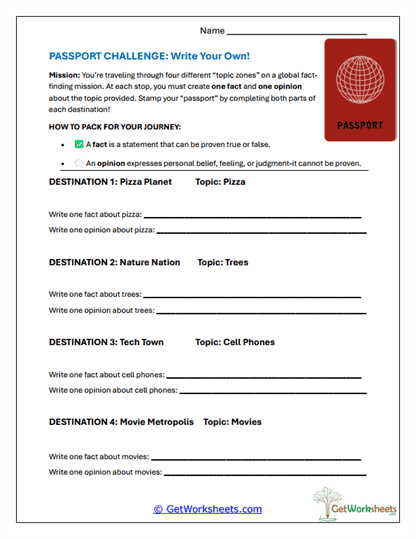
Global Passport Classifier
With a creative, travel-themed structure, students "visit" destinations such as pizza, trees, cell phones, and movies. At each stop, they generate one factual statement and one opinion of their own. This encourages independent thinking and reinforces understanding through creation rather than identification. The worksheet supports writing fluency, idea development, and the ability to distinguish between verifiable information and personal viewpoints using accessible, fun prompts.
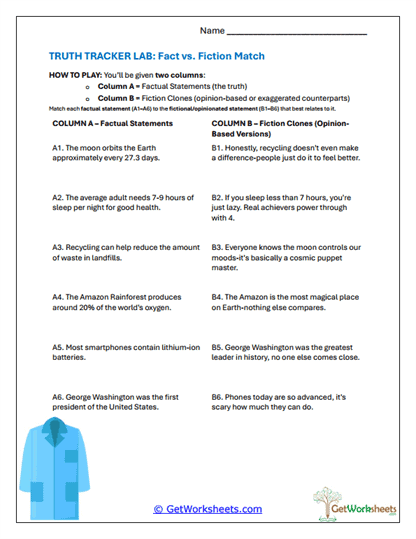
Fiction Clone Matcher
Students match realistic factual statements with their exaggerated or opinion-based "fiction clones." The activity trains learners to spot subtle differences in tone, distortion, or emotional phrasing. They analyze how truth can be altered-sometimes slightly, sometimes dramatically-to create opinion, bias, or fictionalization. This skill is essential for recognizing misinformation and evaluating exaggerated claims in media or conversation. The pairing format strengthens close reading and careful comparison habits.
Bookmark Us Now!
New, high-quality worksheets are added every week! Do not miss out!