Entering and Exiting Group Activities Worksheets






About This Worksheet Collection
This Entering and Exiting Group Activities collection provides educators with a rich set of resources that help students understand how to join and leave group situations politely, confidently, and respectfully. Each worksheet uses stories, scenarios, dialogues, rewriting tasks, or social cue interpretation to teach children how to communicate kindly and navigate group dynamics. The activities are designed to be relatable and practical, guiding students through everyday interactions they may experience in classrooms, playgrounds, and social settings.
Through this collection, learners build important skills in communication, empathy, boundary awareness, and social participation. They practice recognizing welcoming signals, reading nonverbal cues, choosing polite phrases, and responding thoughtfully to others. The worksheets also reinforce reading comprehension, writing fluency, and decision-making, helping students develop the social awareness needed to enter and exit group activities with confidence and consideration.
Detailed Descriptions Of These Worksheets
Friendly Playtime
Students read a short story about joining and leaving a group respectfully and fill in missing polite phrases. They answer questions that prompt them to think about the character's choices and the importance of using kind words. This activity teaches students how courtesy and communication shape group interactions. It strengthens comprehension, writing skills, and empathy.
Joining In Nicely
Learners read brief scenarios about joining or leaving an activity and choose the politest response. This task helps children recognize appropriate phrases and understand how respectful behavior supports positive group dynamics. Students develop decision-making skills as they evaluate each situation. The activity reinforces kindness as a foundation for friendships.
Group Moments
Students read sentences that show someone either joining or leaving a group and label each example accordingly. This sorting activity helps them identify verbal cues and social signals related to entering or exiting. It builds awareness of group etiquette and strengthens categorization skills. Learners also practice interpreting everyday social actions.
Playground Helpers
After reading a story about a child who wants to join a group building an obstacle course, students answer comprehension questions about respectful joining. The worksheet highlights teamwork, patience, and helpfulness as key traits for positive group participation. It encourages learners to notice how polite behavior supports successful collaboration. The activity deepens comprehension and social understanding.
Group Timing
Students read short dialogues and identify nonverbal cues-such as body language and facial expressions-to decide whether it is a good moment to join or leave a group. Follow-up questions guide them to reflect on timing and social signals. This activity teaches subtle social awareness and builds empathy. It helps students understand the importance of reading cues before interacting.
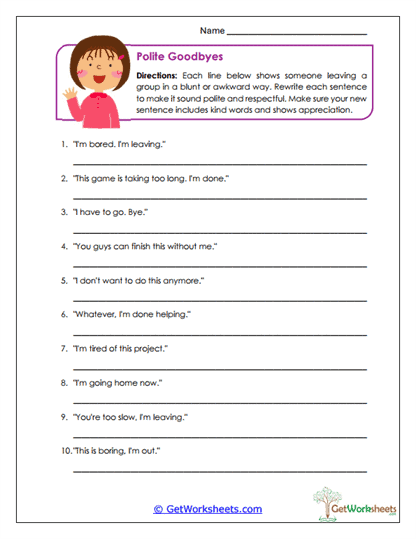
Polite Goodbyes
Learners rewrite rude or abrupt exit statements to make them polite and appreciative. As they transform each example, they practice using kind words and improving tone. The activity helps students understand how respectful communication maintains positive relationships. It supports sentence rewriting and emotional regulation.
Group Signal Sleuths
Students read short conversations and underline clues that show whether a group is open to new members or not ready for someone to join. This task builds awareness of group readiness and boundary recognition. Learners practice interpreting tone and context while strengthening inference skills. The activity promotes thoughtful, considerate behavior.
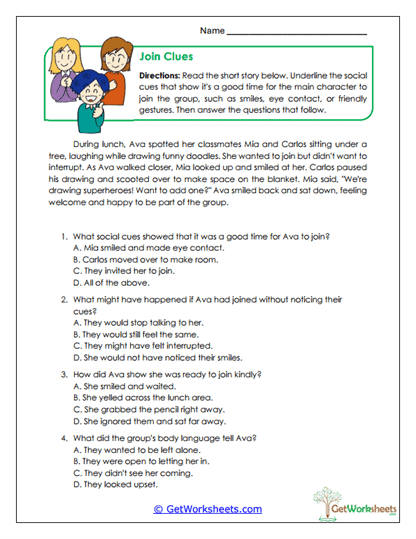
Join Clues
In this worksheet, students read a story and identify cues that signal it is a good time for the character to join a group. They answer multiple-choice questions to reinforce understanding of inviting gestures and friendly body language. The activity helps learners recognize moments when joining feels natural and welcome. It develops comprehension and awareness of group dynamics.
Respectful Revisions
Students read dialogues containing rude or awkward responses and rewrite them in polite, respectful ways suitable for group communication. The activity encourages learners to reflect on tone, timing, and appropriate phrasing. It builds strong sentence-writing skills and supports thoughtful communication. Students gain confidence in responding kindly during interactions.
Join and Leave Lines
Learners use sentence starters to create their own polite entry and exit scripts for different group settings. They craft respectful phrases that show appreciation when joining or leaving activities. This task promotes creativity, social etiquette, and confidence in group behavior. It also strengthens writing fluency and kindness.
Meeting Manners
Students read workplace-style scenarios and select the answer that shows courteous and professional entry or exit behavior. The activity helps learners understand real-world expectations such as waiting for pauses, greeting others politely, or excusing themselves respectfully. It strengthens scenario comprehension and decision-making skills. Students gain insight into appropriate group conduct in professional settings.
Social Flow Quiz
This worksheet presents short social scenarios and asks students to choose the response that best reflects appropriate entry or exit behavior. Learners think about greetings, nonverbal signals, and timing as they analyze each option. The activity teaches them how groups naturally open or close and how to navigate those cues respectfully. It builds confidence, empathy, and strong social reasoning skills.
Bookmark Us Now!
New, high-quality worksheets are added every week! Do not miss out!