Context Clues Worksheets
About This Worksheet Collection
This collection of context clues worksheets helps students become confident, independent readers by teaching them how to determine the meaning of unfamiliar words using surrounding text. Through a wide variety of passages, students learn to analyze sentence structure, tone, grammar, and story details to infer meaning without relying on a dictionary. These worksheets progress from basic inference skills to deeper analysis involving implied meanings, figurative language, syntax, and parts of speech.
By working through the collection, learners strengthen vocabulary, comprehension, and critical thinking. They learn how authors provide hints-through contrast, explanation, emotion, setting, or sentence structure-that guide the reader toward a word's meaning. These activities help students read more fluently, interpret nuanced language, and build essential academic reading skills across subjects.
Detailed Descriptions Of These Worksheets
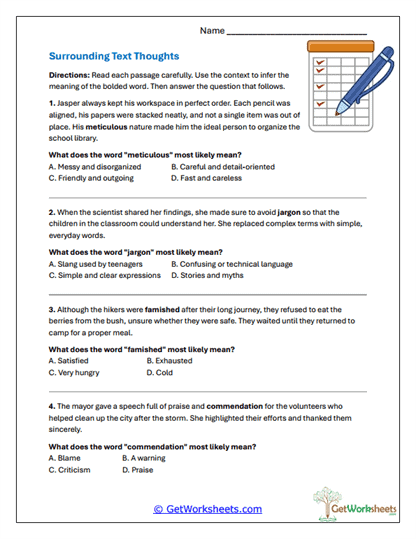
Surrounding Text Thoughts
Students read short passages with bolded words and select meanings using multiple-choice options. They rely on clues from surrounding sentences, character actions, and descriptive details. This foundational activity teaches students how context guides vocabulary understanding and encourages inference-based reasoning.
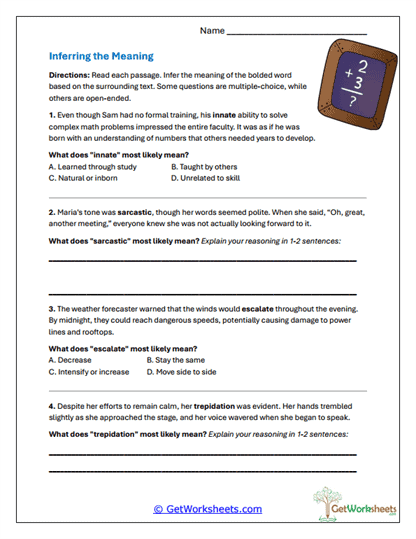
Inferring the Meaning
Learners examine bolded vocabulary within short passages and justify their answers using evidence from the text. Some items are multiple-choice while others require explanation. This worksheet strengthens deeper contextual analysis and helps students articulate how they know a word's meaning.
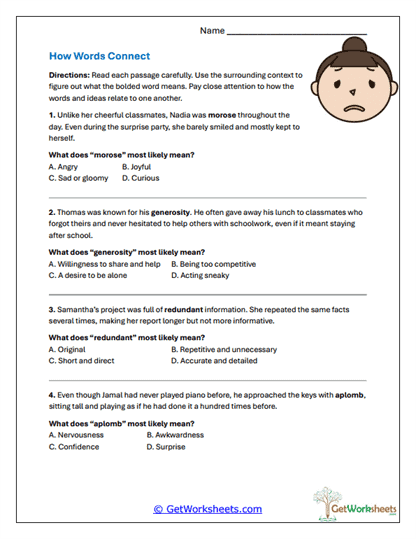
How Words Connect
Students analyze how ideas within a sentence relate to each other in order to define bolded words. They observe emotional cues, actions, and descriptive language to determine meaning. The activity reinforces vocabulary reasoning and improves understanding of how words connect logically.
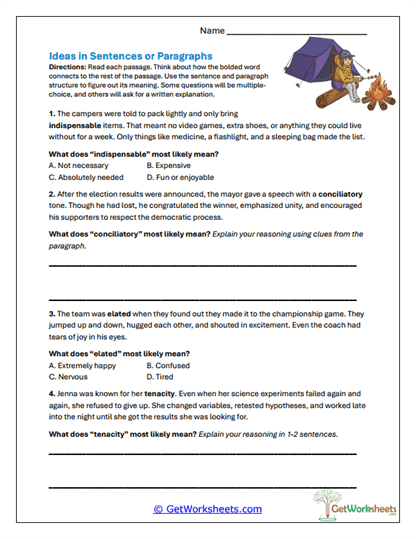
Ideas in Sentences or Paragraphs
Learners determine the meaning of bolded words using clues across entire paragraphs-not just single sentences. Both multiple-choice and short-answer questions require analysis of tone, detail, and idea structure. This worksheet teaches students how context functions on a broader scale.
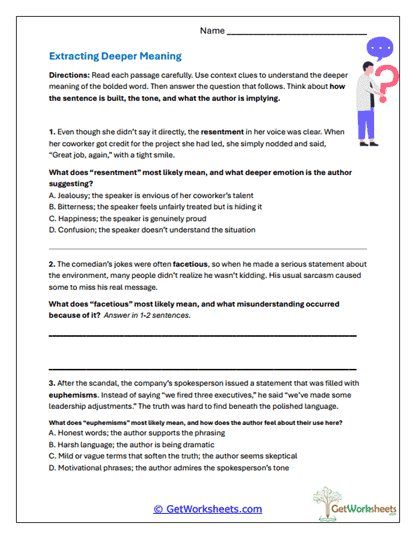
Extracting Deeper Meaning
Students determine the deeper, sometimes emotional or implied, meaning of bolded words. They analyze tone, author implication, and descriptive nuance. Short written responses require them to explain how they reached their interpretation, promoting advanced inferential thinking.
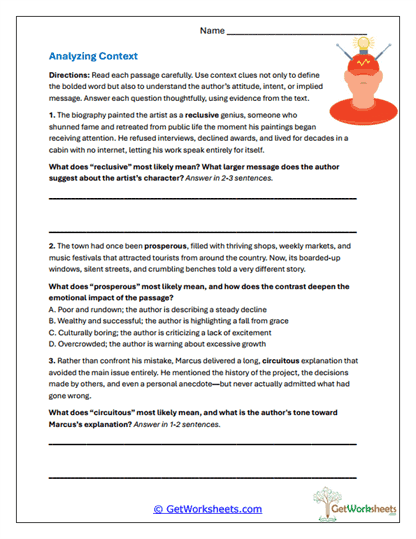
Analyzing Context
Learners interpret bolded vocabulary by examining tone, setting, contrast, and the implied message of a passage. Each question requires a written explanation, pushing students to articulate the specific clues that guided their understanding. This worksheet builds high-level context-analysis skills.
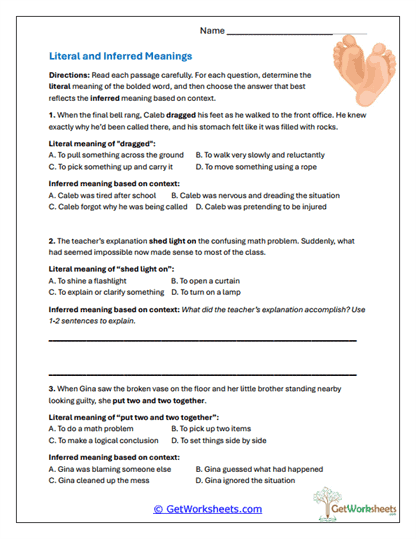
Literal and Inferred Meanings
Students identify both the literal dictionary meaning and the inferred contextual meaning of bolded words. They compare how meaning shifts depending on usage, strengthening their ability to interpret nuanced and flexible language.
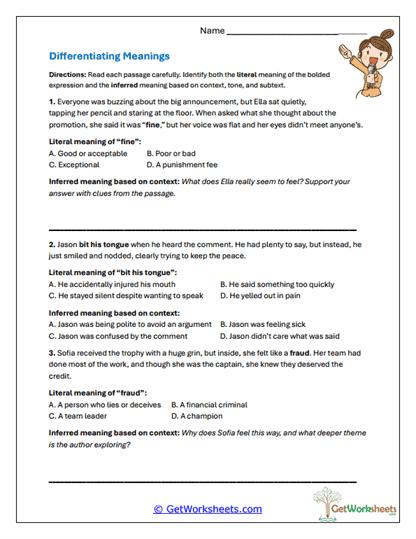
Differentiating Meanings
Learners analyze literal meanings and implied meanings of expressions using emotional cues, tone, and situational context. They justify inferred meanings using evidence, developing deeper understanding of figurative and layered language.
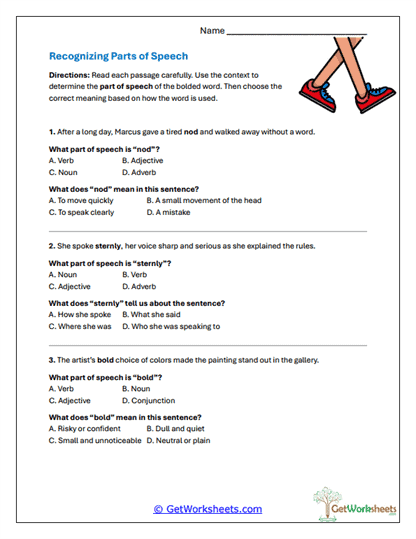
Recognizing Parts of Speech
Students determine the part of speech of bolded words using context. They identify the correct meaning based on grammatical function and sentence structure. This worksheet reinforces grammar, vocabulary, and reading comprehension simultaneously.
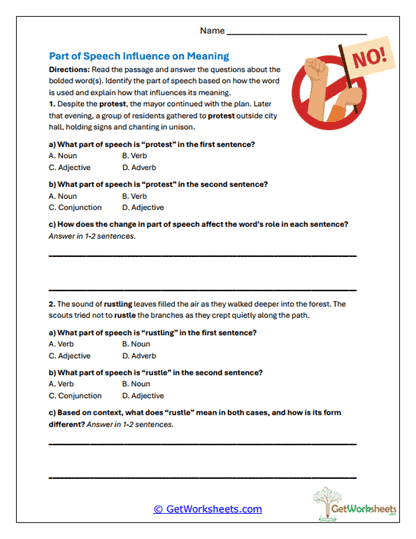
Part of Speech Influence on Meaning
Learners analyze how the same bolded word changes meaning depending on its role (noun, verb, adjective). They explain how the sentence structure affects interpretation, deepening their understanding of grammar's impact on meaning.
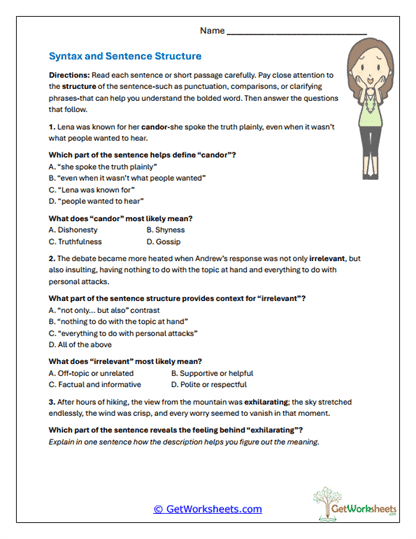
Syntax and Structure Clues
Students examine how punctuation, comparisons, and clarifying phrases provide clues to a word's meaning. They identify which part of the sentence offers the strongest hint and answer both multiple-choice and short-response items. This worksheet teaches the connection between syntax and meaning.
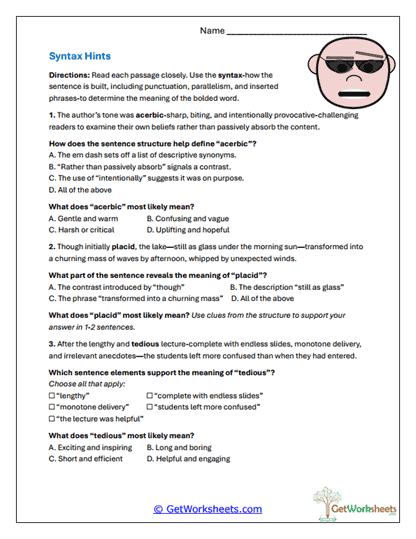
Syntax Hints
Learners analyze parallel structure, inserted phrases, contrasts, and punctuation to determine word meaning. Written responses require them to identify which sentence elements reveal meaning. This worksheet supports advanced reading analysis and prepares students for complex academic texts.

Bookmark Us Now!
New, high-quality worksheets are added every week! Do not miss out!