Columbus Day Worksheets
About This Worksheet Collection
This Columbus Day worksheet collection provides a multifaceted look at Christopher Columbus, early European exploration, and the broader historical consequences of contact between Europe and the Americas. Through informational passages, comparison charts, math integrations, timeline activities, creative historical thinking, and coordinate-mapping tasks, students gain a well-rounded understanding of both Columbus's voyages and the era in which he lived. The wide variety of formats allows teachers to approach the topic from multiple angles-historical, geographical, mathematical, and civic-while keeping learners engaged.
Across the collection, students strengthen core skills such as reading comprehension, historical analysis, chronological sequencing, factual reasoning, and mathematical application. They practice distinguishing fact from opinion, interpreting mapped voyages, evaluating multiple perspectives, and connecting historical events to larger cultural or societal discussions. Whether students are analyzing primary misconceptions, plotting exploration routes, or debating Columbus's legacy, these worksheets promote critical thinking and a deeper understanding of exploration's role in shaping world history.
Detailed Descriptions Of These Worksheets
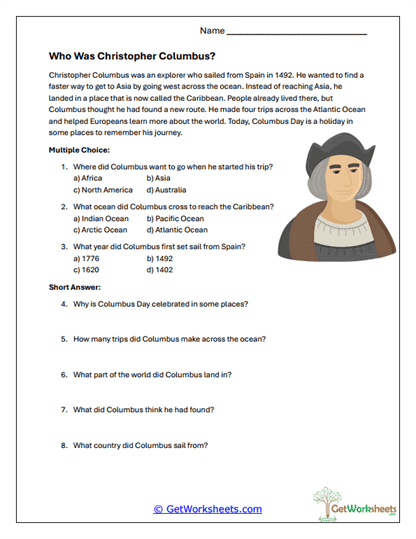
Who Was Christopher Columbus?
Students read a beginner-friendly passage introducing Columbus's 1492 voyage, his mistaken assumption about reaching Asia, and his encounters in the Caribbean. Multiple-choice and short-answer questions help learners recall key facts, understand motivations, and analyze the historical context. The activity supports informational-text comprehension and builds foundational knowledge about European exploration. It also encourages students to think about early navigational challenges and cultural misunderstandings.
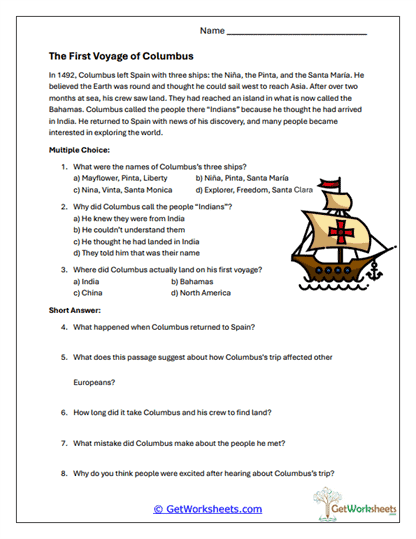
The First Voyage of Columbus
Learners explore Columbus's first journey aboard the Niña, Pinta, and Santa María, examining why he believed he had reached Asia and why he used the term "Indians." Students answer comprehension questions that highlight ship details, crew experiences, and landing sites. This worksheet strengthens historical thinking and helps clarify misconceptions embedded in early exploration. It reinforces geography skills by prompting students to connect the voyage to real-world locations.
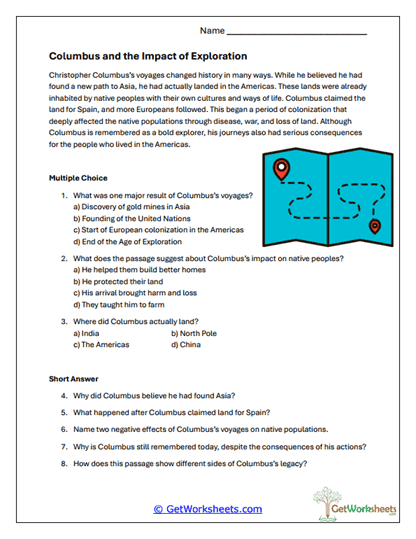
Columbus and the Impact of Exploration
Students read about the far-reaching consequences of Columbus's voyages for both Europe and Indigenous peoples. Questions focus on disease spread, land loss, colonization, and long-term cultural effects. The worksheet encourages critical thinking about positive and negative impacts of exploration. It helps students understand how Columbus's actions influenced world history in complex ways.
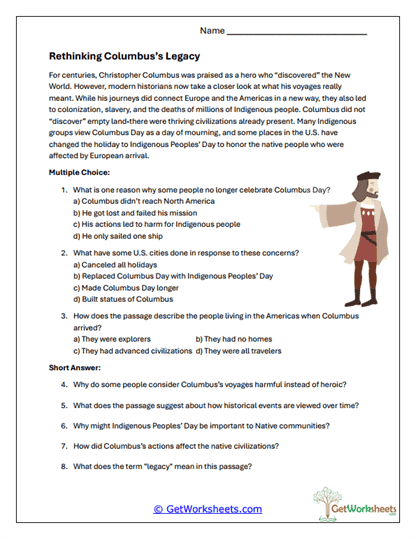
Rethinking Columbus's Legacy
This passage introduces modern viewpoints about Columbus Day, explaining why some communities now honor Indigenous Peoples' Day. Questions invite students to analyze changing interpretations and evaluate historical narratives. The activity encourages thoughtful discussion about commemoration and cultural perspective. It deepens understanding of how history can be re-evaluated over time.
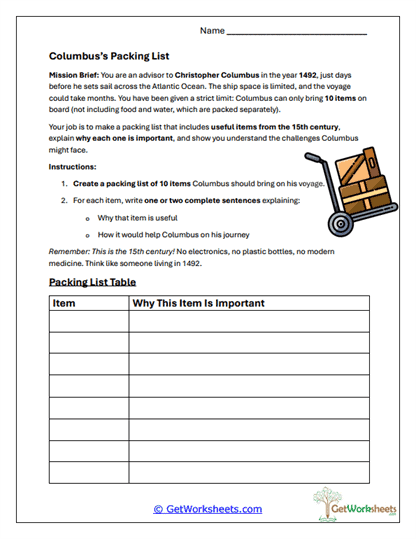
Columbus's Packing List
Students imagine advising Columbus before his 1492 voyage and create a historically accurate packing list of ten items. They explain why each item would be useful aboard a 15th-century ship. This activity blends creativity with historical reasoning, prompting learners to consider daily life and technological limitations of the Age of Exploration. It strengthens explanatory writing and contextual understanding.
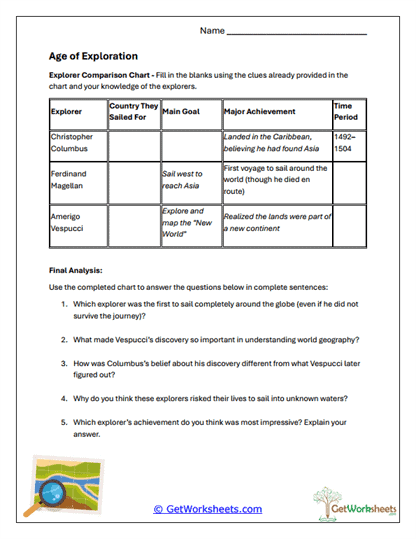
Age of Exploration Comparison Chart
Learners compare Columbus, Magellan, and Vespucci using a three-column chart of goals, achievements, and time periods. After completing the chart, students answer questions requiring deeper comparison and interpretation. The worksheet reinforces understanding of how different explorers shaped geography and global connections. It supports analytical thinking using structured visual organization.
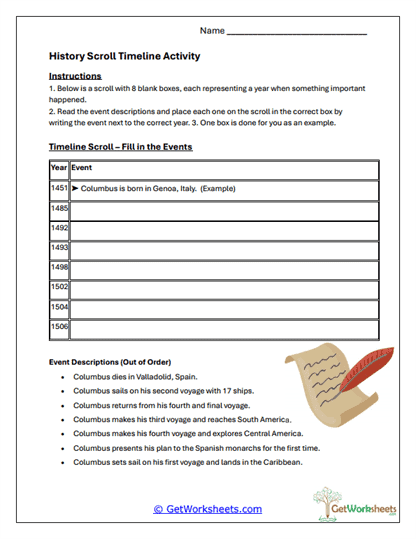
History Scroll Timeline Activity
Students place scrambled events from Columbus's life and voyages into a chronological timeline. This strengthens sequencing skills and reinforces understanding of major milestones in early exploration. The activity helps learners visualize progression and cause-and-effect across historical events. It serves as a strong review or introduction to Columbus's biography.
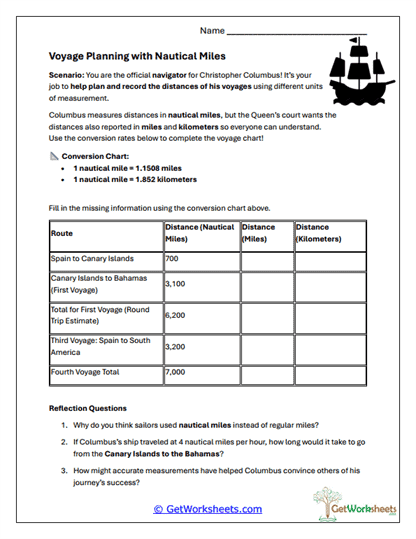
Voyage Planning with Nautical Miles
Students use a conversion chart to compute distances between voyage locations in miles, nautical miles, and kilometers. Reflection questions explain why nautical miles are used in navigation. The activity blends historical context with unit conversion practice. It strengthens both math fluency and navigational understanding.
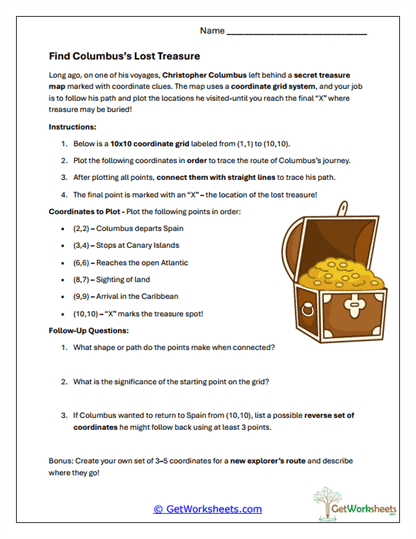
Find Columbus's Lost Treasure (Coordinate Grid)
This worksheet features a 10×10 grid that students use to plot Columbus's route across several stopping points. When the points are connected, the final coordinate reveals the treasure. Follow-up questions ask students to analyze the path and reverse coordinates. It balances geography, graphing skills, and exploratory learning in a playful format.
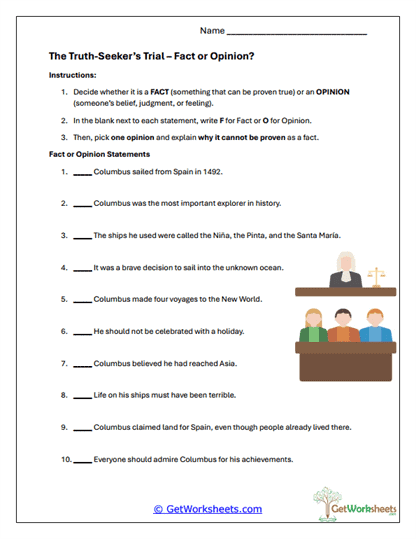
The Truth-Seeker's Trial - Fact or Opinion?
Students classify statements about Columbus as fact or opinion, then explain why an opinion cannot be proven. The worksheet reinforces media literacy and the ability to evaluate claims. Learners practice distinguishing between evidence-based statements and subjective viewpoints. This supports critical thinking and historical analysis.
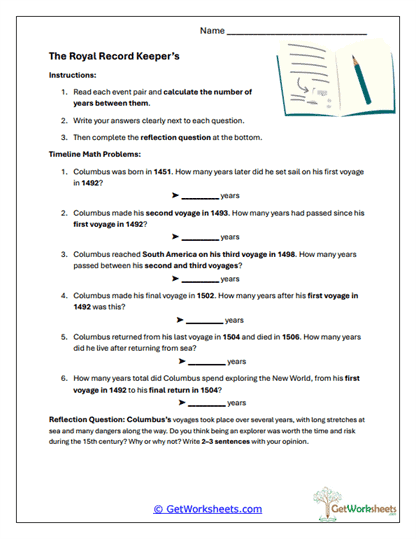
The Royal Record Keeper's
Students calculate time spans between major events in Columbus's life, from his birth year to each voyage and finally his death. The activity strengthens chronological reasoning and math-in-context skills. Learners analyze informational text carefully to extract accurate dates. The reflection question builds analytical thinking about the challenges of 15th-century exploration.
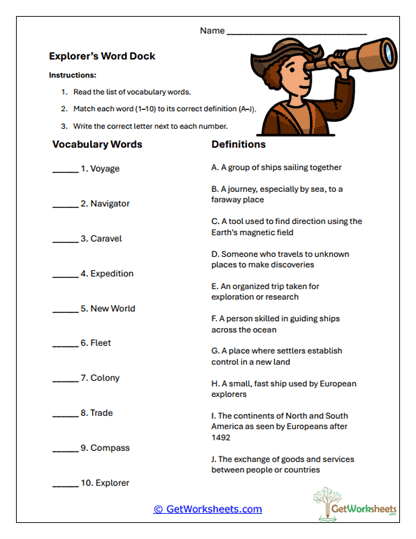
Explorer's Word Dock
Students match exploration vocabulary such as "caravel," "voyage," "navigator," and "colony" to their definitions. This builds essential domain knowledge for understanding Age of Exploration texts. The matching task reinforces precise word-meaning connections and strengthens reading comprehension. It helps students use historical terminology confidently and correctly.
Bookmark Us Now!
New, high-quality worksheets are added every week! Do not miss out!