Asking and Answering Questions Worksheets




About This Worksheet Collection
This collection of asking and answering questions worksheets helps students strengthen the essential comprehension skills they need to understand texts, think critically, and communicate their ideas clearly. Through short stories, informational passages, and guided question sets, learners practice identifying key details, determining main ideas, making inferences, and evaluating different types of questions. Each worksheet encourages active reading, prompting students to engage with text in meaningful ways rather than simply skimming for answers.
These activities also support students in formulating their own questions-an important strategy for deepening comprehension and improving metacognitive awareness. By writing complete-sentence responses, labeling question types, and generating literal, inferential, and evaluative questions, students build strong reading-writing connections. Across this collection, learners develop confidence as thoughtful readers who can understand text, ask purposeful questions, and express ideas with clarity.
Detailed Descriptions Of These Worksheets
Short Story Questions
Students read a short story about Emma's weekly park visits and answer comprehension questions that focus on characters, actions, and setting. The task encourages close reading as learners rely on explicit details from the passage. An extension invites them to write their own questions, helping them practice crafting meaningful text-based inquiries. This worksheet supports early comprehension and questioning strategies.
Longer Passage Questions
Learners read a longer narrative about Jared, who dreams of becoming a scientist. They answer questions about his motivations, feelings, and the story's message. A deeper-thinking section prompts inference-making using evidence from the text. Students finish by composing two thoughtful questions of their own, reinforcing higher-order questioning skills.
Identifying Main Idea
Students read an informational passage about koalas and determine its main idea. Follow-up questions ask them to recall supporting details such as habitat, diet, and behaviors. The worksheet helps learners distinguish central ideas from specific facts. This activity strengthens nonfiction comprehension and summarization abilities.
Main Idea and Details
Learners read two paragraphs about recycling and reusing materials. They identify each paragraph's main idea and locate supporting details within the text. Additional questions prompt students to compare and contrast the information. This worksheet reinforces understanding of informational structure and evidence-based reading.
Analyzing Story Information
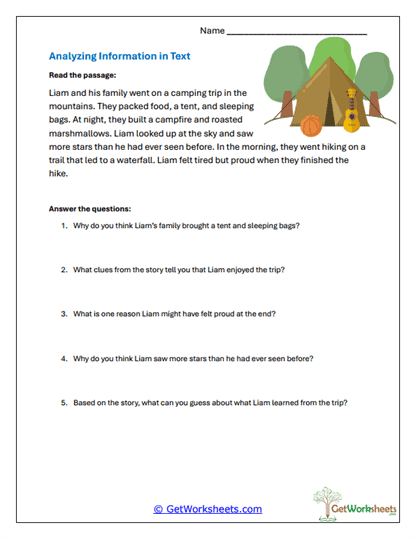
Students read a short narrative about Liam's camping trip and respond to questions requiring both detail recall and inference. They consider why items were packed, how Liam felt, and what he may have learned. The activity supports comprehension of characters, events, and simple logical conclusions. It builds confidence in interpreting narrative clues.
Story Analysis Questions
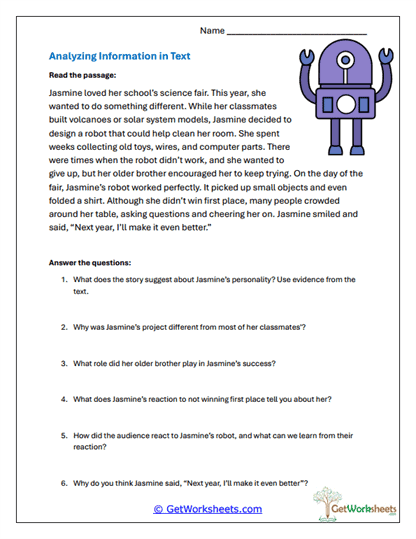
Learners read about Jasmine's science fair project and analyze her personality traits, motivations, and reactions using text evidence. They compare characters and interpret how emotions influence story meaning. The worksheet encourages deeper inference and character analysis. Students strengthen skills in answering text-dependent questions.
Question Types
Students read a story about Carlos at his grandmother's farm and answer literal, inferential, and opinion-based questions. Then, they classify additional questions according to type. This dual approach helps learners understand how different questions function and what kinds of answers they require. It supports critical thinking and comprehension flexibility.
Evaluating Deep Questions
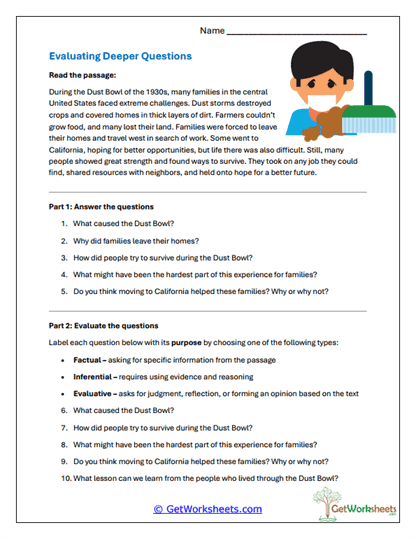
Students read an informational passage about the Dust Bowl and answer questions before labeling them as factual, inferential, or evaluative. The activity teaches students how question purpose affects response expectations. By analyzing historical content, they also deepen understanding of past events. This worksheet blends text analysis with question-type evaluation.
Formulating Questions
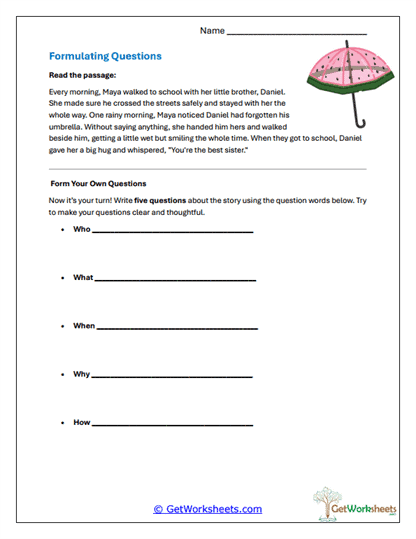
Learners read a short passage about Maya walking her brother to school and write five questions of their own. Guiding question words help them construct meaningful, text-based inquiries. This activity strengthens comprehension by encouraging students to think critically about story elements. It develops strong questioning habits and curiosity-driven reading.
Writing Deep Questions
Students read a passage about Amina and her irrigation project, then write and label six questions-literal, inferential, and evaluative. The task encourages higher-order thinking and understanding of diverse question purposes. Learners analyze character motivation and narrative problem-solving. It supports advanced questioning and comprehension skills.
Expressing Ideas Clearly
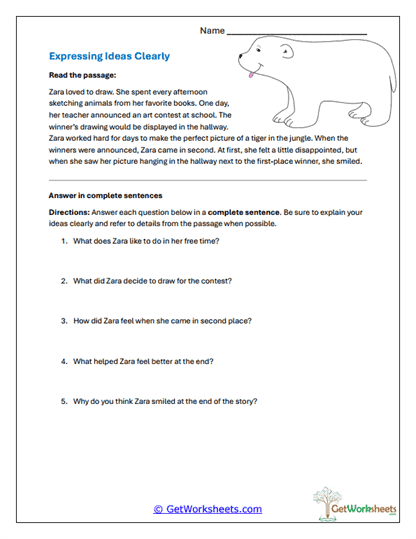
After reading about Zara's art contest experience, students answer comprehension questions using complete sentences. They practice referencing text details and clearly explaining ideas. This worksheet strengthens written communication and comprehension of character emotions and actions. Learners build confidence in expressing responses with clarity.
Expressing Ideas More Clearly
Students read about Marcus learning to play the guitar and overcoming challenges. They respond to open-ended questions, explaining their thinking in full sentences. The activity promotes thoughtful reflection on character growth and motivation. It also reinforces clear written expression supported by textual evidence.
Bookmark Us Now!
New, high-quality worksheets are added every week! Do not miss out!