Arguments and Claims Worksheets
About This Worksheet Collection
This collection of arguments and claims worksheets helps students build the essential reasoning and analytical skills needed for understanding and constructing arguments. Each worksheet guides learners through identifying claims, distinguishing them from evidence, recognizing counterclaims, and evaluating the overall strength of arguments. Through short passages, real-world scenarios, and classification tasks, students practice breaking down ideas and interpreting what an author or speaker is truly asserting. These activities are designed to meet upper elementary and middle-grade literacy standards while remaining accessible and engaging.
By working through the collection, students strengthen their critical reading, logical reasoning, and opinion-writing skills. They learn to determine central ideas, evaluate relevance of supporting details, and analyze opposing viewpoints-skills that are vital not only for academic writing but also for media literacy and everyday decision-making. With structured practice in recognizing the building blocks of argumentation, students grow more confident in both interpreting and crafting clear, well-supported claims.
Detailed Descriptions Of These Worksheets
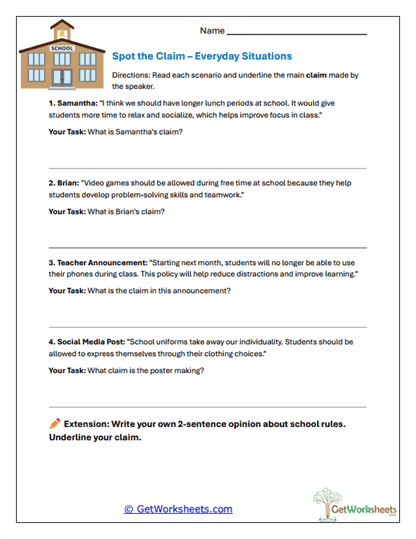
Spot the Claim
Students read short everyday scenarios and identify the main point each speaker is making. The task helps learners distinguish the central claim from additional explanations or details. As they underline or restate the claim, students strengthen critical reading and summarizing skills. An optional extension invites them to write a brief opinion related to school rules, reinforcing their ability to construct a clear claim.
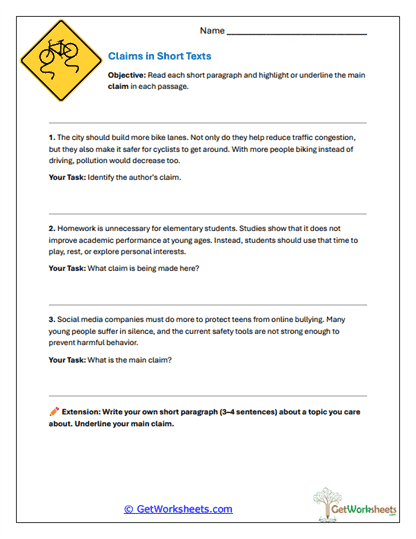
Claims in Texts
Learners read short paragraphs on real-world topics and determine the author's main claim. They must separate the central argument from supporting evidence, building close-reading and argument-analysis abilities. The worksheet's extension encourages students to write a paragraph featuring their own claim. This activity prepares students for evaluating stance and purpose in informational texts.
Claim or Not
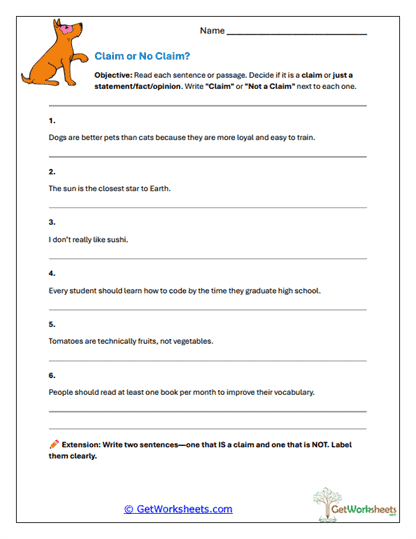
Students decide whether each statement represents a claim or a non-claim such as a fact or simple preference. This distinction helps learners understand what makes a statement argumentative. The classification task promotes critical thinking as students explain their reasoning. An optional prompt invites them to write both a claim and a non-claim to demonstrate mastery.
Claims and Evidence
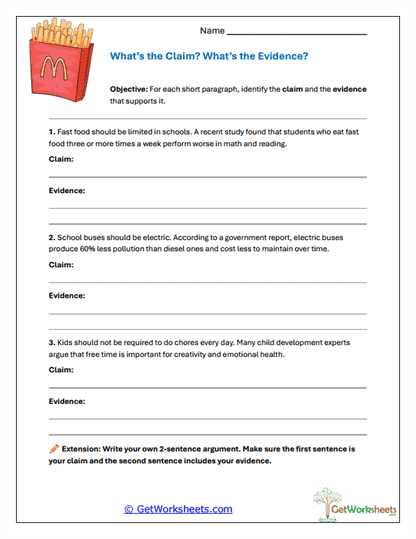
Learners read paragraphs and label both the main claim and the evidence that supports it. The worksheet highlights the relationship between argument and proof, helping students see why strong reasoning requires credible support. An extension asks them to write a two-sentence argument using both a claim and evidence. This reinforces foundational persuasive-writing structure.
Claim or Evidence
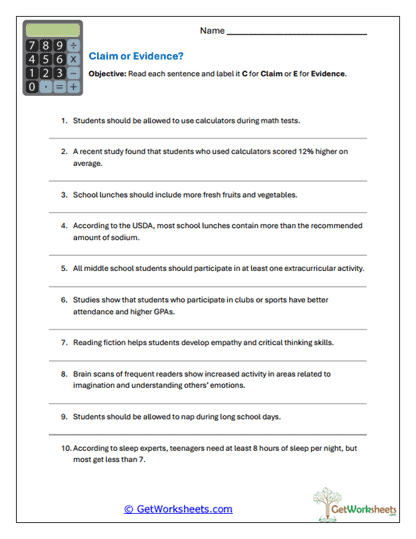
Students examine a series of statements and determine whether each one is a claim or a piece of evidence. By sorting opinion-based assertions from factual support, learners deepen their understanding of argument components. The activity encourages thoughtful analysis of how reasoning and proof differ. It sets the groundwork for constructing more effective persuasive writing.
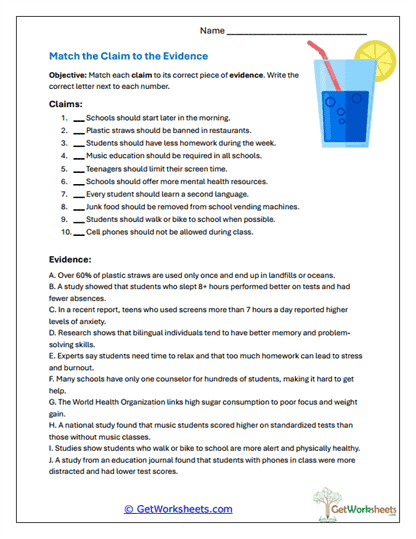
Match Claim to Evidence
Students match each claim to the evidence that best supports it. This teaches the importance of relevance and strong connection between ideas and proof. The matching activity builds logical reasoning as learners evaluate which pieces of information strengthen an argument. It also helps students recognize how effective writers support their positions.
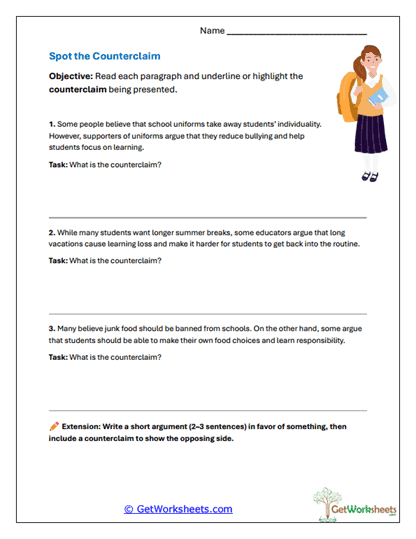
Spot the Counterclaim
Learners read short passages that include both a claim and a counterclaim, then identify the counterclaim within each. This helps students understand how arguments acknowledge opposing viewpoints. The activity also strengthens reading comprehension and prepares learners for writing more balanced arguments. An extension invites them to draft an argument containing a counterclaim of their own.
Claim or Counterclaim
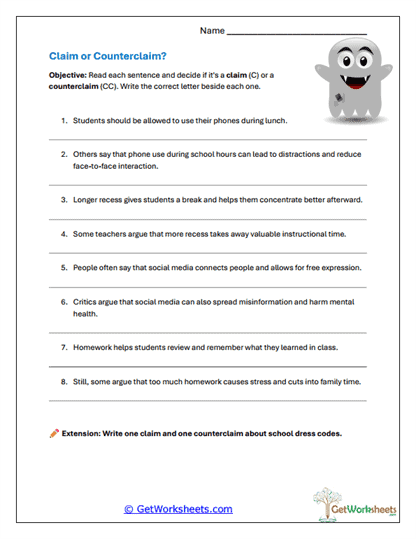
Students identify whether each sentence presents a claim or a counterclaim. The task supports understanding of how arguments and rebuttals function together. It encourages critical thinking as learners analyze whether a statement supports or opposes a position. The worksheet includes a writing prompt in which students craft both a claim and a counterclaim.
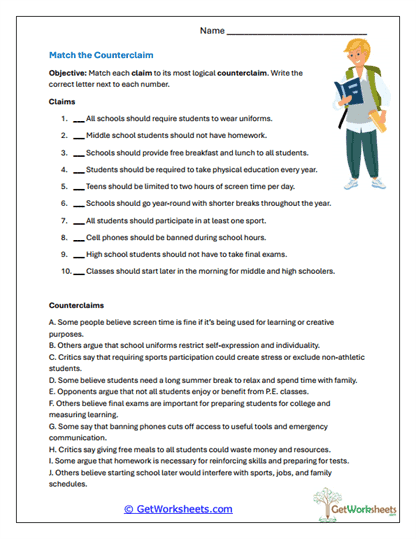
Match the Counterclaim
Learners pair claims with appropriate counterclaims from a provided list. The exercise strengthens awareness of opposing arguments and helps students understand how rebuttals contribute to more complete argumentative structure. Matching tasks require evaluating logic and relevance, reinforcing analytical reading skills. This prepares students for higher-level debate and essay writing.
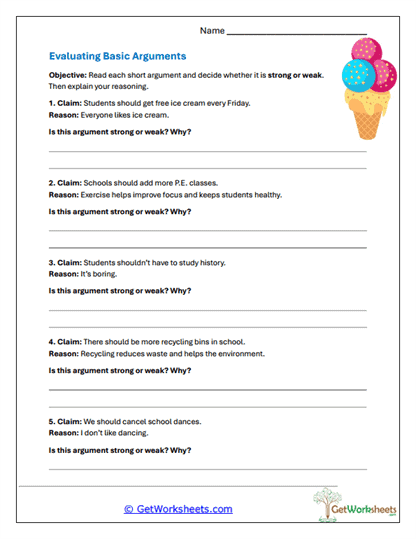
Evaluating Arguments
Students read short arguments that include a claim and a supporting reason, then determine whether the argument is strong or weak. They must justify their evaluation, which builds analytical depth and clarity of thought. The worksheet encourages students to consider the quality and relevance of reasons. This practice develops sophisticated argument-evaluation skills.
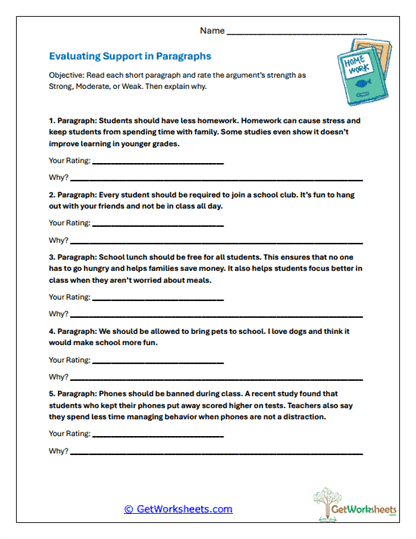
Evaluating Support
Learners evaluate the strength of arguments presented in short paragraphs, rating each as Strong, Moderate, or Weak. They must explain their reasoning, reinforcing reflective thinking and evidence-based analysis. The varying quality of supporting details helps students understand the difference between logical proof and weak justification. This task strengthens comprehension and argument-writing readiness.
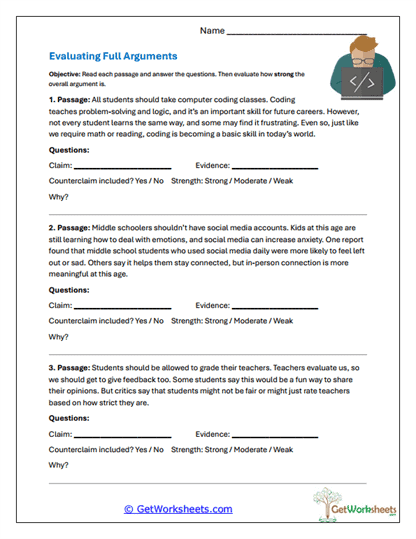
Evaluating Full Arguments
Students analyze full argumentative passages by identifying the claim, evidence, and any included counterclaim. After examining these components, they evaluate the overall strength of the argument and justify their rating. This worksheet deepens students' understanding of balanced persuasive structure. It helps learners connect evaluation skills with real-world argumentative writing expectations.
Bookmark Us Now!
New, high-quality worksheets are added every week! Do not miss out!