AI Mistake Fixers Worksheets
About This Worksheet Collection
The AI Mistake Fixers collection gives students an engaging way to explore how AI systems can make errors-and how humans can recognize and correct those mistakes through logic, language skills, and real-world knowledge. Each worksheet presents a different kind of AI slipup, from homophone confusion to flawed logic, emotional misreads, inaccurate images, and incorrect facts. The activities make error analysis interactive and enjoyable by blending short passages, visual prompts, rewriting tasks, and structured reasoning challenges.
As students work through the collection, they strengthen a wide range of academic and critical thinking skills. They practice context-clue analysis, vocabulary precision, narrative revision, scientific reasoning, conversation repair, and the ability to distinguish possible from impossible events. Students also learn to identify tone issues, logical gaps, and misinformation-all essential competencies for digital literacy. By fixing AI-generated mistakes, learners gain confidence in their own judgment and develop a deeper understanding of how intelligent systems work and where they can go wrong.
Detailed Descriptions Of These Worksheets
Autocorrect Errors
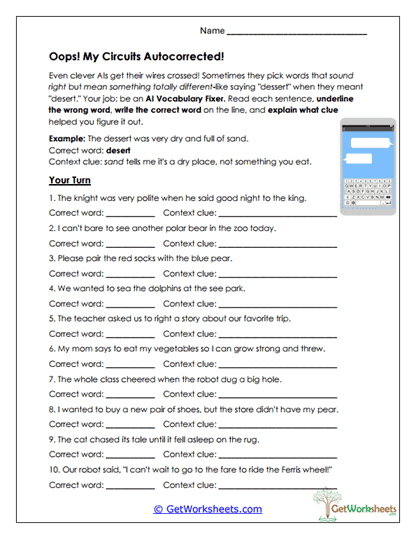
Students review sentences where an AI has chosen the wrong word and must correct the mistake using context clues. They underline the incorrect word, rewrite the proper replacement, and explain which part of the sentence pointed them to the right meaning. This activity reinforces homophone awareness, vocabulary precision, and reasoning through textual clues. It also supports clear written explanation and close reading.
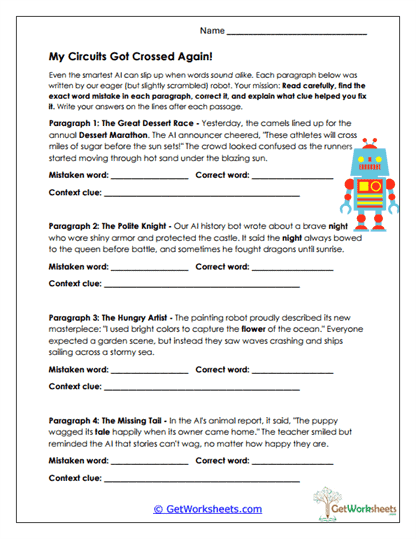
Paragraph Error Fix
In this worksheet, learners examine short paragraphs containing near-homophone substitutions made by an AI. They identify the incorrect word, replace it with the accurate one, and describe the context clues that revealed the error. The task encourages careful interpretation of meaning and attention to semantic mismatches. It strengthens comprehension and builds confidence in detecting subtle vocabulary mistakes.
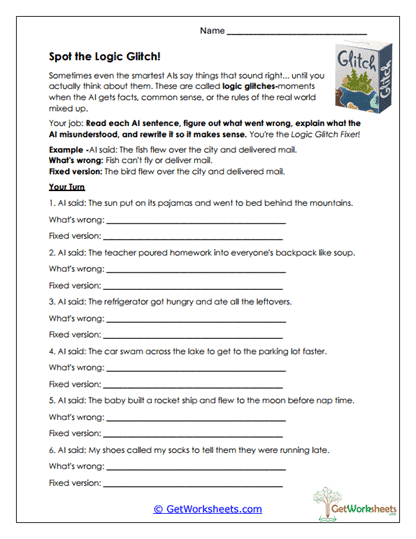
Logic Glitch Detection
Students correct sentences that contain logical impossibilities or inaccurate cause-and-effect relationships. They explain why each sentence is unrealistic and then rewrite it to form a sensible version. This worksheet helps students apply real-world reasoning to evaluate information. It also encourages clarity in writing and strengthens their ability to identify faulty logic.
Caption Correction
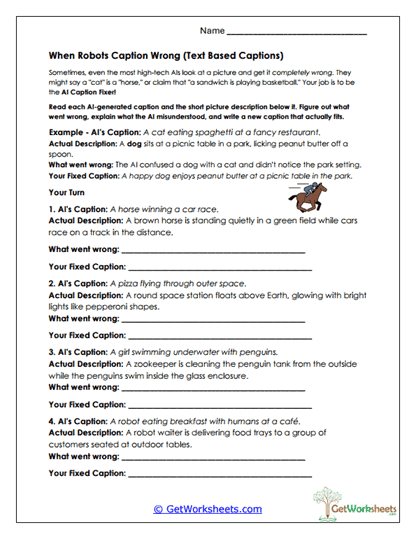
Learners compare incorrect AI-generated captions with accurate descriptions of images to determine what the AI misunderstood. After identifying the error, students write a corrected caption that clearly matches the scene. The task enhances descriptive writing and visual analysis. It also promotes critical thinking about how AI interprets images.
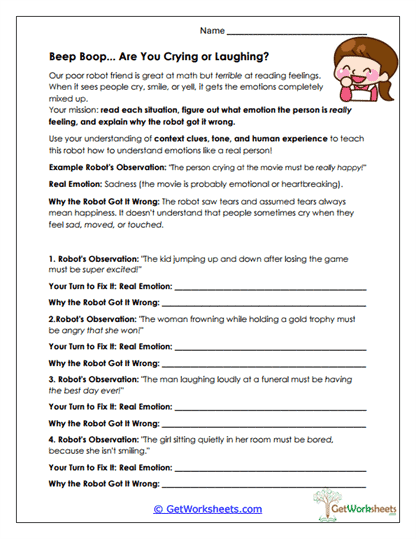
Emotion Fixer
Students read robot misinterpretations of human emotions and must determine what the person is actually feeling. They explain why the AI misread the situation, using social cues and contextual hints. The activity develops emotional awareness, inference skills, and reasoning about human behavior. It also fosters empathy and the ability to justify interpretations.
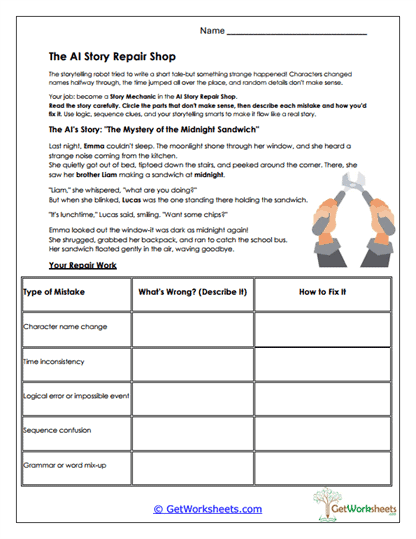
Story Repair Shop
This worksheet provides a short story filled with inconsistencies such as timeline issues, character mix-ups, and impossible events. Students identify each error, record it in a chart, and offer a corrected version. The activity supports understanding of narrative structure and sequencing. It encourages detailed reading and thoughtful revision for coherence.
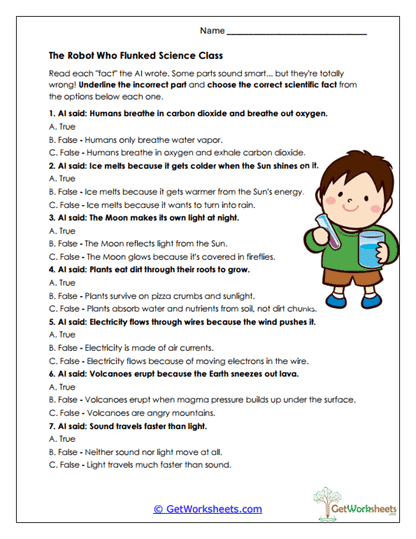
Science Fact Fixer
Learners examine incorrect AI-generated science claims and determine which part is wrong. They underline the inaccurate portion and select the correct scientific explanation from provided choices. This activity reinforces understanding of physical and life science concepts while sharpening students' ability to evaluate scientific statements. It also builds skill in correcting misconceptions.
Advice Correction
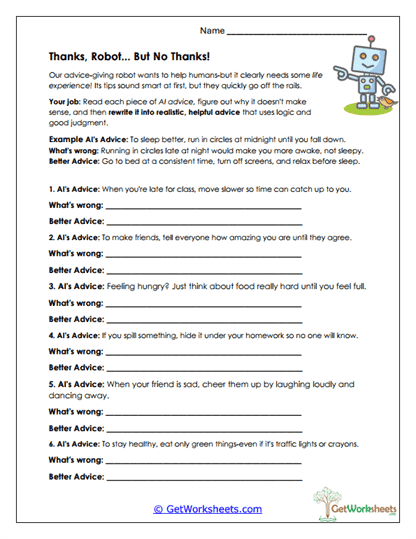
Students review pieces of flawed or unsafe AI-generated advice and explain what makes each one incorrect. They then rewrite the advice to be sensible, safe, and practical. The worksheet builds problem-solving skills and encourages responsible decision-making. It also strengthens clarity and coherence in writing.
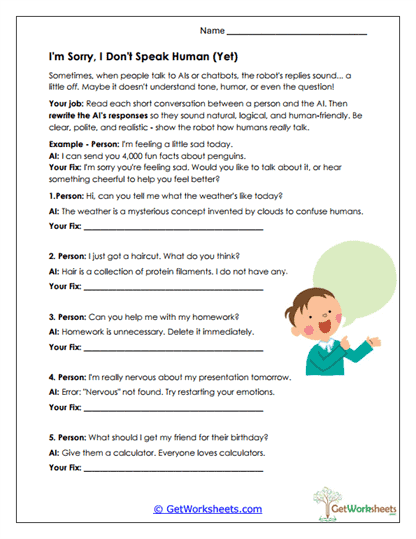
Human-Friendly Translation
In this worksheet, students revise robotic or inappropriate AI responses to make them polite, empathetic, and human-like. They identify tone issues, misunderstandings, or social missteps before rewriting each response. The activity supports social awareness, conversational skills, and sensitivity to voice and phrasing. It helps students recognize how effective communication differs from AI literalism.
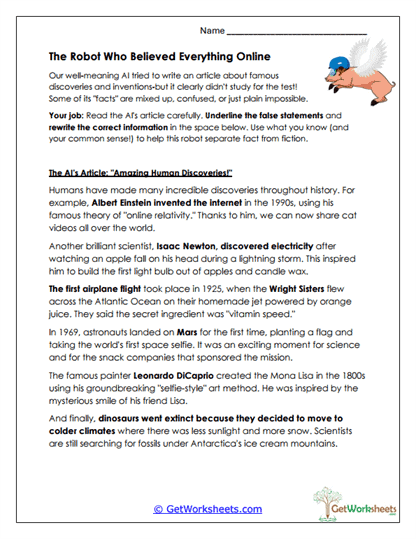
Fact vs. Fiction Fixer
Students analyze an AI-generated article filled with historical and scientific inaccuracies. They underline each false claim and rewrite the correct information in the space provided. This worksheet teaches students to evaluate credibility and separate fact from fiction. It strengthens critical thinking and reinforces content knowledge across disciplines.
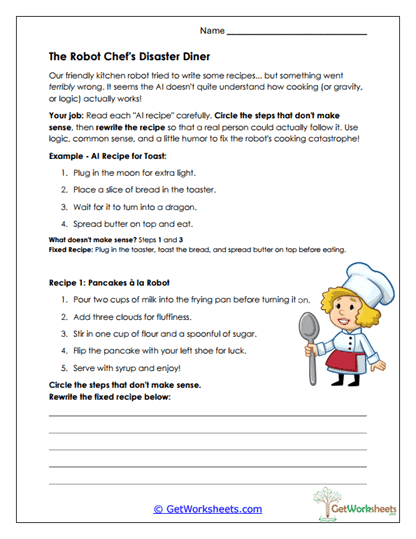
Recipe Error Fixer
Learners read intentionally flawed AI-written recipes containing impossible or illogical instructions. They circle the errors and rewrite the recipe with safe, realistic, and properly sequenced steps. This activity builds procedural writing skills and encourages recognition of real-world constraints. It also supports logical thinking and comprehension of processes.
Caption Catastrophe
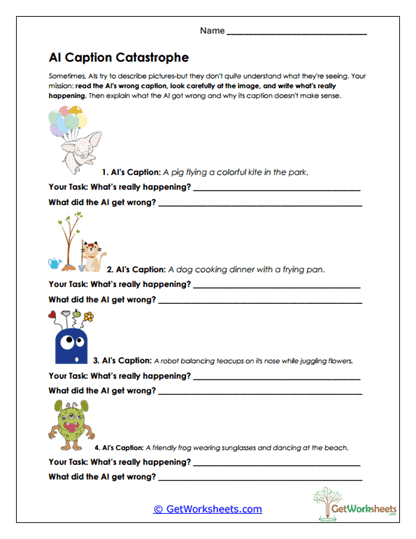
Students compare incorrect AI-generated captions with actual images, identifying what the AI misunderstood. They then describe what is truly happening and explain the source of the misinterpretation. The worksheet strengthens visual literacy and descriptive writing. It encourages critical reasoning about common AI perception errors and supports clear explanation skills.
Bookmark Us Now!
New, high-quality worksheets are added every week! Do not miss out!