AI Feedback Loop Worksheets
About This Worksheet Collection
The AI Feedback Loop collection invites students to step into the role of digital explorers, uncovering how artificial intelligence learns, improves, and adapts through feedback. Each worksheet transforms complex machine learning ideas into hands-on classroom experiences that connect technology with human learning. Through real-world examples and guided analysis, learners gain insight into how AIs make mistakes, process corrections, and evolve over time. Teachers can use these resources to blend computer science, literacy, and critical thinking into an engaging, interdisciplinary learning experience.
As students progress through this series, they develop valuable reasoning and problem-solving abilities while deepening their understanding of cause and effect. Activities strengthen digital literacy and analytical reading skills by encouraging learners to diagnose AI "errors," evaluate feedback quality, and predict system improvement. This collection builds foundational knowledge of AI processes-input, output, feedback, and retraining-while inspiring curiosity about how intelligent systems mirror the ways people learn from experience.
Detailed Descriptions Of These Worksheets
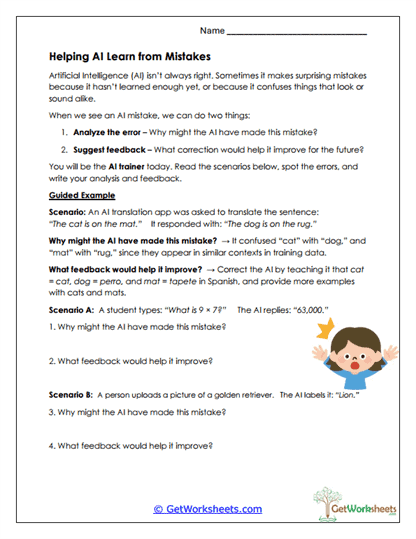
Helping AI Learn
In this interactive worksheet, students take on the role of AI trainers, guiding digital systems to learn from their mistakes. They review sample scenarios where an AI has misidentified an image or mistranslated a phrase and determine how to provide better feedback. The exercise models the logic behind retraining and teaches how specific corrections lead to improvement. By examining errors and offering refined input, students connect AI learning cycles to human learning processes and strengthen analytical reasoning.
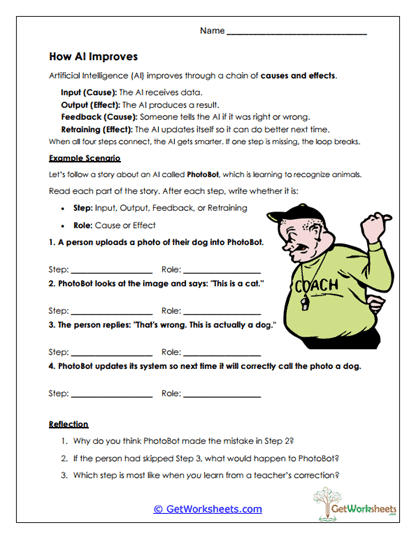
How AI Improves
Learners explore the concept of AI improvement by studying a fictional program named PhotoBot. They trace the flow of information through each stage-input, output, feedback, and retraining-while labeling causes and effects that drive progress. The activity helps students grasp the cyclical nature of learning systems and the importance of reflection. It reinforces logical thinking, reading comprehension, and the understanding that both people and machines learn best through continuous feedback.
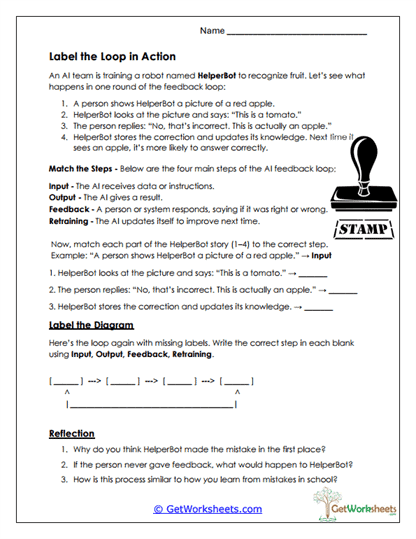
Labeling the AI Loop
This worksheet walks students through the fundamental structure of an AI feedback loop using a relatable example with HelperBot. Learners match story events to the correct loop stages and label a diagram showing how information cycles through a learning system. Reflection questions invite them to reason about why mistakes occur and how feedback improves performance. The visual and analytical approach deepens comprehension of both AI learning and human growth processes.
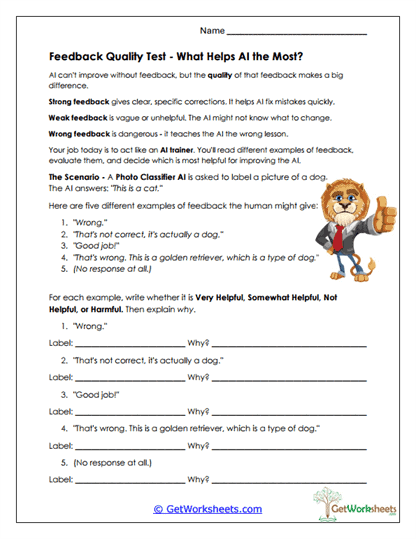
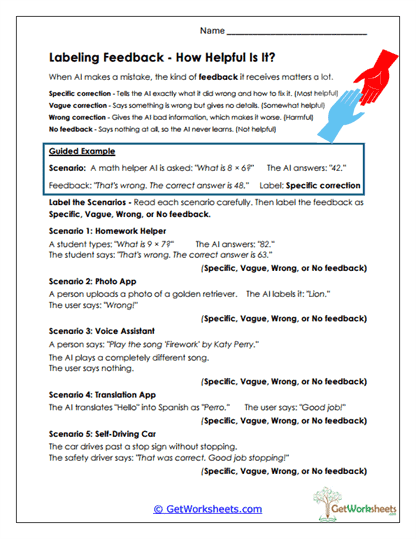
Labeling Feedback
Students compare different kinds of feedback-specific, vague, incorrect, or missing-to evaluate their impact on AI learning. They practice identifying which responses accelerate understanding and which hinder progress. The activity promotes analytical thinking by having learners categorize scenarios and justify their reasoning. It draws parallels between helpful classroom feedback and effective machine training, emphasizing how clarity drives improvement.
AI Progress Report
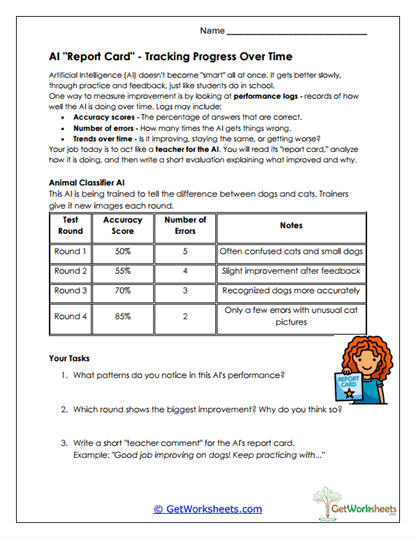
In this data-focused activity, learners act as evaluators reviewing an AI's progress report. They interpret tables showing accuracy rates and error trends over multiple testing rounds. By writing comments and analyzing patterns, students develop data interpretation and reasoning skills. This worksheet bridges technology and real-world learning by showing how consistent practice and feedback lead to measurable improvement.
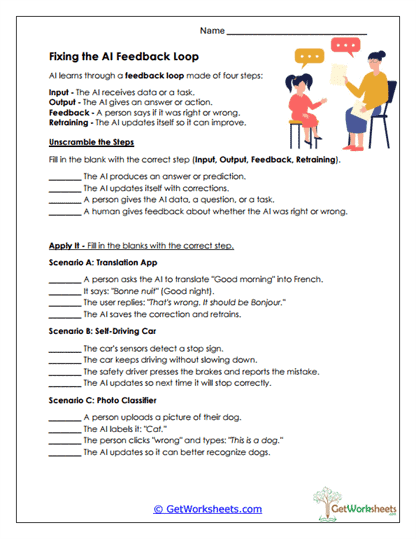
Fixing the Feedback Loop
Students reconstruct the stages of an AI feedback loop by unscrambling and applying the steps to real-world examples. Each scenario-from translation tools to self-driving cars-tests their ability to identify where feedback processes break down. The task sharpens logical sequencing and problem-solving abilities. Learners gain a deeper understanding of how complete feedback systems ensure continual improvement in both AI and human learning.
Broken AI Loop
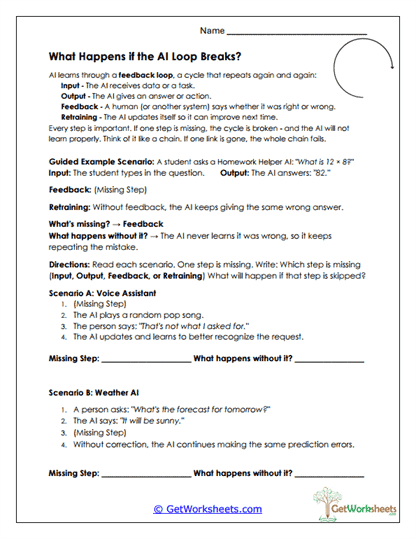
Through guided examples, this worksheet challenges students to discover what happens when an AI's feedback loop is incomplete. They identify which stage is missing and predict the resulting consequences for system performance. The task cultivates cause-and-effect reasoning and conceptual understanding of AI processes. Students see firsthand how missing feedback prevents growth, reinforcing why every step in the learning loop matters.
Evaluating Feedback Quality
Students assess multiple feedback responses to determine how helpful each is for an AI learning task. Using clear examples, they label feedback as highly effective, somewhat helpful, or unhelpful and explain their reasoning. This activity builds evaluative judgment and written justification skills. It also connects digital learning principles to classroom communication, showing that precise feedback is key to both AI and student success.
AI Detective Challenge
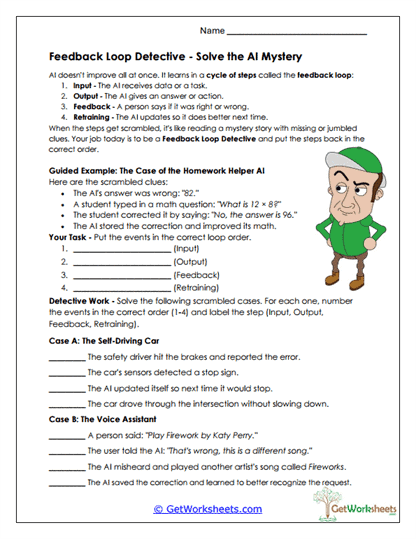
Learners become "AI detectives," tasked with reordering scrambled steps of the feedback loop. They apply logic and pattern recognition to place input, output, feedback, and retraining in the correct sequence. As they solve guided and independent examples, students build understanding of iterative learning and system improvement. The challenge format makes technical reasoning engaging and accessible.
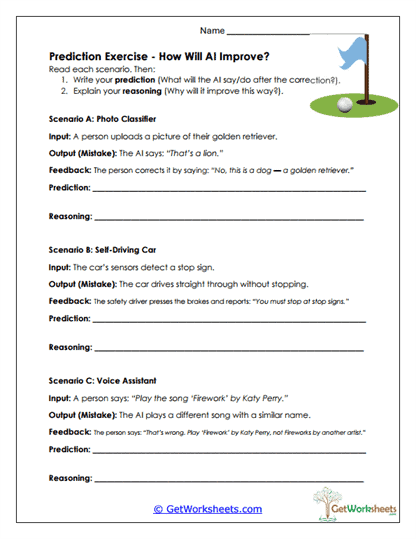
Predicting AI Improvement
This worksheet encourages students to anticipate how an AI system will change after receiving new feedback. They study photo recognition and language examples, make predictions, and explain their reasoning in writing. The process enhances inferential thinking and understanding of adaptation. Students connect the cycle of AI progress to their own experiences learning from correction and reflection.
AI Learning Vocabulary
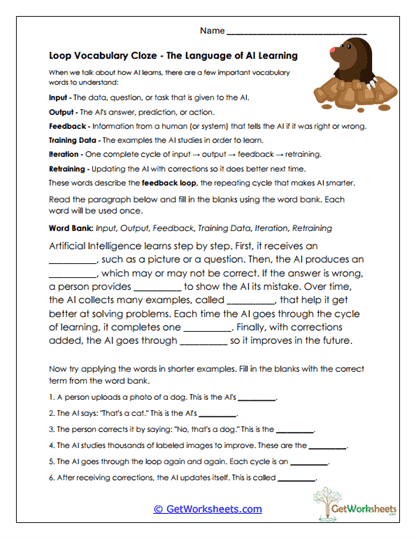
Students strengthen their understanding of AI terminology by filling in missing words in an informational passage. Key terms such as input, output, feedback, and retraining are reinforced through contextual examples and short application tasks. The activity blends vocabulary learning with conceptual comprehension. Learners come away with both language skills and a clear picture of how feedback loops drive AI learning.
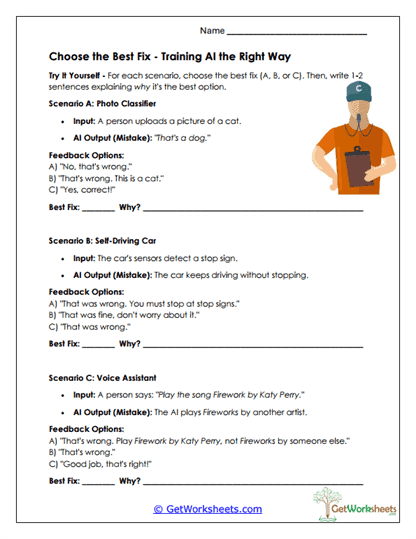
Choosing the Best Feedback
This final worksheet asks students to read AI learning scenarios and decide which feedback option produces the best outcome. They justify their choices in short written explanations, practicing reasoning and evaluation. Through realistic examples, learners see how precise corrections accelerate AI improvement. The task reinforces critical thinking, decision-making, and an appreciation of the shared logic behind human and machine learning.
Bookmark Us Now!
New, high-quality worksheets are added every week! Do not miss out!