Double View
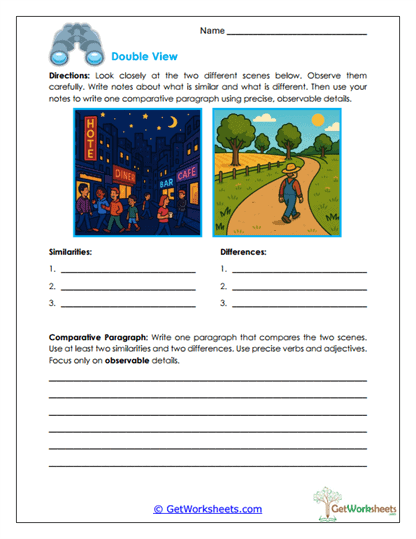
This writing worksheet helps students develop strong compare-and-contrast writing skills by closely observing two contrasting illustrated settings: a busy city at night and a quiet country path. Students first record observable similarities and differences, then use those details to write a focused comparative paragraph grounded in precise verbs and descriptive adjectives.
By emphasizing what can be seen rather than what is assumed, the activity strengthens students’ ability to describe settings accurately and meaningfully.
Learning Goals
- Compare and Contrast Writing
Practice identifying and explaining similarities and differences between two settings. - Descriptive Detail Gathering
Collect concrete, observable details from visual scenes. - Setting Comparison
Learn how environment, movement, and visual elements define different places. - Writing with Precision
Use specific word choices to clearly highlight contrast.
Instructional Benefits
- Observation-Based Writing
Reinforces the habit of grounding descriptions in evidence. - Supports Paragraph Structure
Helps students organize comparisons into a clear, cohesive paragraph. - Builds “Show, Don’t Tell” Skills
Encourages descriptive contrast instead of abstract explanation. - Flexible Classroom Use
Ideal for writing workshops, compare-and-contrast units, small groups, independent practice, or assessment.
The Double View worksheet helps students strengthen descriptive clarity, comparative reasoning, and precision in writing. By learning to contrast settings using observable detail, students gain essential skills for narrative writing, analytical paragraphs, and literary response tasks across grade levels.
This worksheet is part of our Writing from Observation Worksheets collection.
Bookmark Us Now!
New, high-quality worksheets are added every week! Do not miss out!